I ended Part One of this series with our arrival back in Kansas for the last time. Here’s what I surmise about the situation there at the time. My dad had just bought the farm his mother owned and lived on. She wanted the money to move to a smaller house in Hutchinson. Dad and his brother Charlie had been farming wheat on her farm for almost 20 years. Each of the three of them probably got a one-third share of the grain each year.
Dad’s sister Lula and her family had also been living on the farm in a second house. They had been forced to leave their farm in the Dust Bowl a few years earlier. They were also using the barn, hog house, and chicken house.
That second house was a flimsy mobile thing painted dull green as I remember it. Aunt Lula and her husband Sy (Sylvester no doubt) had a little income from milk cows, hogs, and chickens. The Great Depression still held sway so it wouldn’t have been much. From what I’ve been told, Sy wasn’t too practical. They were eking out a living. (A few years later they were doing well running their own frozen food service.)
We were told to never go near that other house. I’m not sure why, and I was never inside it. It didn’t remain there long, maybe a year. My sister Marilyn recently told me that dad was anxious to get that second house off the property. He was concerned that one or the other of his sisters would plead hard times and beg to move in.
Aunt Lula moved to an old house on a farm in the Sand Hills a few miles west. They continued to earn income from their animals. She also opened a country store that provided a little more income. That farm was across the road from the Welsh ranch, where 40 years earlier Grandma Miller had gone as a cook.
Leona (grandma) was 14 years old then. She was one of 20 siblings, if you can believe it. A few years later she married William Moses (Moe) Miller. They settled a mile further west on another scrubby farm they bought. More about that later.
Dad bought a 1938 Minneapolis Moline tractor soon after we moved to our farm. I wouldn’t have known how to express it at the time, but the way those M&M’s design fit their purpose was exceptional. It even had rubber tires. That tractor never faltered in 40 years of use.
Dad hated the old tractor with lugged steel wheels that he owned before. He liked the M&M so much that he bought and overhauled a used one several years later. By that time, around 1950, Paul and I were old enough to work all day in the fields. We drove those two tractors during the day. Dad rigged lights on one of them and drove it all night in plowing season.
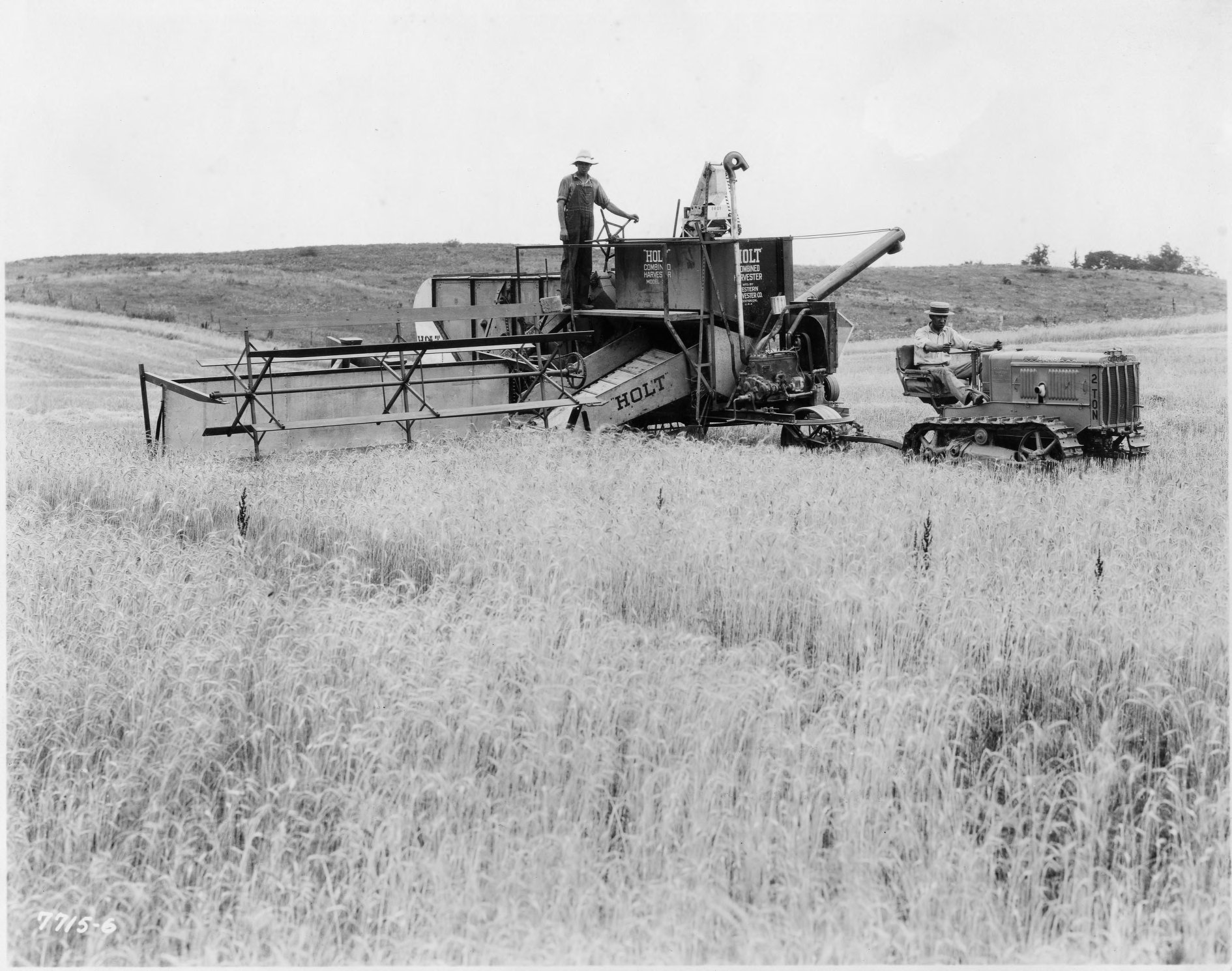
Dad had his 1928 Holt combine at the “home place” before we moved in. He might have even bought it new. The stock market crashed in 1929, and it took a couple of years for the Great Depression to get really bad so he would have had money to buy it in that time frame. We had a rubber-tired tractor to pull the combine. Picture me up there on the platform managing the operation of the combine.
Benjamin Holt designed the Caterpillar tractor, and also the Holt combine. It was the Cadillac of combines. They would work just as well today as any modern combine. It had 105 fittings to grease, and I could do that in less than five minutes.
As you see in the picture, combines are mobile threshing machines with a “header” attached to one side. The header cuts off the heads of grain and feeds them into the throat of the thresher. The thresher knocks the grains loose from the wheat heads. The separator section behind the thresher separates (Duh!) the straw and husks from the grain. A fan spreads the straw out behind the separator, and the grain is routed to a bin.
I wrote earlier about threshing crews of a dozen or more men. Combines made a huge difference in labor. Combine harvesting required one man on the tractor, one on the combine, and two men to transfer the grain to the granary. That’s four men. Less than one-fourth as many as a threshing machine crew.
Combines also eliminated the shocking step that preceded the threshing step by a week or more. Shocking itself takes longer than combine harvesting, and of course, there is still threshing time added to that. It was a huge step forward in the mechanization of wheat farming.
There is little need to trade labor with your neighbors for combine harvesting. But you still need some help. So where do you get hired hands for a combine harvesting crew? Dad took on three McPherson College students as “hired hands”. My mother also had a “hired girl” (my cousin Glenna) to help with cooking and laundry for those hired hands. I long wondered, but never asked why those men would be willing to work for only a couple of weeks.
Update: I’ve surmised that like contract harvesters today, they started working in Texas, Oklahoma or Southern Kansas, and then moved north with the harvest to North Dakota. The further north you go, the later wheat ripens — about two weeks per state. So that would be 8 to 10 weeks of good-paying work if you went all the way to North Dakota.
Then came World War II. The draft boards took college students right along with other young men. They even drafted our Uncle “Doc,” who was 45 — not to be a doctor, but to be an officer in a training camp. Somebody eventually came to their senses and realized people in Lyons needed him more than the Army needed him in Montana. He ended up an officer’s sword to show off though.
Our Uncle Rowland was in medical school at the time the war started. The draft board allowed him to finish because the army needed doctors overseas. That left him free to help with wheat harvest for a couple of years. He used our car on Sundays to go see his friends a few times while he was at the farm. When he got back he always reset the rearview mirror exactly to where my mother had it before. She appreciated that.
I was 12 years old in 1944. That was halfway through the war. I was “drafted” that summer to run the combine. My dad told me it was a good thing I lived on the farm. Otherwise, he’d have to pay me $12 a day ($300 a day for a combine man today). Dad drove the tractor, which required more strength. I had no trouble handling the combine. But who would transfer the wheat to the granary? Shoveling wheat into the bin was strenuous and took a long time. That’s where more mechanization came in.
Dad knew of a “grain blower” that he could borrow. A grain blower works like a big vacuum cleaner. It blows grain into the granary instead of dust into a little bag. He powered the blower with a Model T engine that he borrowed from his brother Charlie. All we had to do now was shove the wheat out of the truck into the hopper on the blower. Even a 12-year old (me) could drive the truck to the granary, blow the wheat into a bin, and go back to load some more.
The blower worked so well that dad built his own that winter to replace the one he borrowed. He fabricated the blower from metal objects in the junk pile. He had some blower pipe made in town to direct the flow of grain. Then he cut off the passenger body of a Model A Ford, mounted the blower in its place, and coupled it to the engine. Worked like a charm. He also bought an old dump truck bed and mounted it on our Model A Ford truck. Now we didn’t even have to push the grain out of the truck. All we had to do was dump it in the grain blower hopper (which he had also designed and built).
There’s some irony in there: The Holt combine had a screw auger to empty its grain bin into the truck. Many combines did it that way. But nobody ever thought of using an auger to empty trucks. (In 1945 someone in Toronto designed a portable auger for just that purpose. Virtually every grain farmer had at least one portable auger by 1955.)
The new augers were simple and light enough to move around by hand. The one we bought had a 5 horsepower Briggs & Stratton engine for power. Everybody moves grain that way now. The original idea to use a blower was overkill, but it was the catalyst for an elegant solution. Only one big step remained at that point to finish mechanizing wheat farming. That was the self-propelled combine.
The original combine harvesters had their own engine to power the threshing and separating sections. There was no way to run a belt from your tractor to power the combine as you did with a threshing machine. The tractor was not stationary, it was pulling the combine. It took two men to run the separate units used for combine harvesting. Why not combine the harvester further with the tractor? That idea became self-propelled combines. Now you’ve reduced the complexity. One man and one engine now do the complete harvesting process.
We just had to have one of those new-fangled combines. Dad found a year-old one for $3,000. (A new one today costs more than $300,000.) You can see why I said earlier that farming has become capital-intensive, not labor-intensive. Both Paul and I went off to the Army and other pursuits at that point. Dad ended up doing all the wheat farming by himself. He continued until he wore out at 84 years old.
***************************************************
I found some nice videos about old-time farming — combines in particular — on YouTube. [Palouse, Washington in the mid-1940s – YouTube | To Till a Field: Man and Machine in the Palouse – YouTube]

 Didit.Live