
Soon after we moved to Spokane I learned that flight training was available at Felts Field. Being a pilot had been in the back of my mind from boyhood. I thought about it for about two minutes and decided to look into it. Felts Field Aviation had a well-structured course that would cost about $2,000 (probably $6,000 today). They offered me a free flight on the spot.
To my surprise, the flight instructor told me to taxi the airplane. Then he talked me through the takeoff. Piece of cake. I already knew how airplanes worked, but that flight gave me a chance to see how it felt to make turns, line up with the runway, read the instruments, listen to the tower, etc. I was back the next day to take my first lesson.
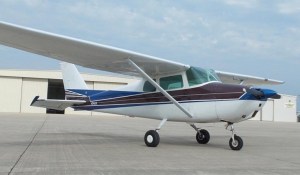
I started my flight training in a Cessna 172. More 172s have been built than any other airplane in the world. They’re all aluminum, tough and easy to fly.
Later on, Felts Field Aviation bought a Cessna 152. If 172s were Ford 250 pickups, then 152s would be Ford 150s. The 152 is small, and the maximum payload is about 520 pounds.
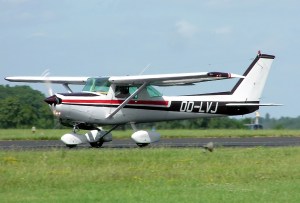
I switched from the 172 to the 152 as soon as my instructor could check me out in it. I also flew my final flight check in a 152.
The examiner for the final flight check was a big guy with a few extra pounds. I guessed his weight and calculated the maximum fuel we could have in the tanks. Otherwise, he might have dinged me for exceeding the maximum weight of 1,670 pounds.
Takeoffs, steep turns, stall recovery, operating the radio, etc., were easy for me. Flying the traffic pattern at the airport went well too. Lining up with the runway and controlling the descent took a little more finesse. Landings did not go well at all.
When landing you try to keep the airplane straight with the runway, over the centerline and flying at the correct airspeed. At the end of the descent, you reduce power and flare from descent to level flight. Now you try to keep everything stable while the airplane settles the last few feet to the runway. All that’s like keeping a hula hoop and a footsie going at the same time (ask Cathy).
Steve Resin, my flight instructor, was surprised that I had trouble with landings. He said he never had a student who could fly an airplane right from the start like I did. When I attempted landings though, everything turned into a blur during the critical seconds of the landing flare. That was one good reason to have a flight instructor.
You don’t sit in the middle of a Cessna (or most trainers). That’s what made landings hard for me. Judging if the airplane is lined up straight is like trying to catch a baseball behind your back. It took so much concentration that I had nothing left for the other tasks. Steve helped me through lots of landings, and soon they were one of my favorite parts of flying. I know now that I could have worried less about alignment. I could have relaxed a little, and let the forgiving little airplane help straighten things out.

It helps to be an engineer when you’re learning to fly. Navigation, weather, navigation instruments, flight planning, aerodynamics, etc., are easier to work with if you have good math skills and a feel for physics. Also if something goes wrong, you’ll have a better chance of figuring out what to do instead of panic.
That’s particularly true for navigation. It also helps you get 100% on the final written exam.
Navigation is a big part of a pilots training. It’s easy to get lost when you’re flying. Everything tends to look the same once you lose track of where you’re at. If you’re only off by a couple of miles you may not be able to find where you’re going or even find your way back. That might ruin your whole day. You could even end up dead. All airplanes have a compass, but it’s not good for much more than a sanity check on your primary navigation. You need sound navigation skills and discipline to be a safe pilot.
The most interesting flights I had were on windy days. The wind was blowing at 25 knots straight down the runway on one of those days. With that wind, Steve thought I should be able to land and stop on the numbers. The 150’s stall speed, which is also the touchdown speed you’re shooting for, is 35 knots. If I could get everything right the ground speed at touchdown would be 35 minus 25, or 10 knots (12 miles per hour). The letters are about 50 feet high, so it should be easy to get stopped on the numbers. I managed to do it. A couple of times.
On another windy day, there was a strong crosswind at Spokane International Airport. I was flying with the chief instructor that day and he wanted me to try some extreme crosswind landings. You do that by keeping the upwind wing down with the aileron, using whatever rudder position is required to force the airplane fuselage into alignment with the centerline, and then planting the upwind wheel on the runway. Now you can let the downwind wheel touch the runway too, all the while slowing the airplane down and keeping it on the center line. I did a half a dozen of those landings, all of which went well.
Cross country flights test most of your flying skills. You make several of these flights in your training. As I remember, one cross country must include landing at two other airports, separated from your starting field and each other by at least 50 miles. I landed, taxied back to the runway, and took off right away from the first airport. At Walla Walla, I had to pee badly. That was a problem. You can’t just leave the engine running while you hop out and find the men’s room. But the starter wasn’t working on that 172. You’re not supposed to start your airplane by hand unless there is a pilot at the controls. Oh, bother.
My plan was to tie the tailwheel to a tie-down ring, set the engine controls for starting, hand-prop the engine to start it, reduce the engine speed to idle, untie the tailwheel, get in the cockpit and go. I’m sure that would have worked. About the time I had the tailwheel tied down and the engine controls set, a grizzled old pilot approached. Might have been an Alaskan bush pilot. He asked if I had trouble. I said yes, the starter is not working. He told me to get in the cockpit, and he would prop it for me. Mighty nice of him.
Learning to fly kept me absorbed in flying, but after I had my license, recreational flying seemed like recreational sailing to me. In other words, I found it boring. The 152 was more fun to fly that the 172 because I felt more like part of the machine. But the smaller, responsive airplane was not enough for long. What I really needed was something like sailboat racing to make flying fun again. At that point, serendipity stepped in again. More to come.

 Didit.Live
Hey, I never knew much about your learning to fly so it’s nice to read so much about it. You didn’t have the plane or training in 1980, yet, and then when we came in 1993, you had sold the plane. Our dear sister told me that you took her for a spin. One of life’s goals achieved; Congrats!!
LikeLike
I remember the first ride I had with you, only Dave and I were brave enough to volunteer for that. We got a wee bit anxious though as you went off by yourself and did many landings before giving us each a ride. Then we flew over the house and Mom and the gang waved to us. The views from the little plane were great.
LikeLike
The landings were to make sure I wasn’t too rusty to take passengers.
LikeLike