I’m going to break off my aviation track briefly to initiate an engineering track. Electronics, and radio frequency engineering has always been one of my main interests. Aviation was another. Growing up during World War II, I decided that I wanted to be a fighter pilot. However, that was never in the cards since I was too nearsighted. My interest in radios and later on engineering lead to my real career. I learned later that being a fighter pilot was not all airplanes, glory and adventure. Oh well, I found out that I was born to be an electronics engineer after all.
***************************************************
Crystal sets: Solid state radios 🙂

My dad liked to read magazines like Scientific American, National Geographic, Farm Journal, Popular Mechanics and Popular Science.
I read them too, some of them cover to cover. I didn’t know it at the time, but an advertisement I spotted in Popular Science set me on the path to my career. I was in grade school then, so it was mid 1940’s.
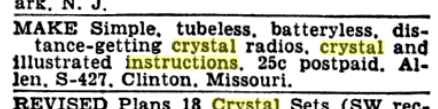
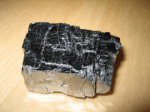
The prospect of having my own radio was exciting. A quarter was a lot of money for a grade schooler, but I decided to risk it. I mailed off my 25 cents, and waited anxiously for my galena crystal and instructions to arrive.
My package arrived in a week or two, and I poured over the instructions to decide which of several “crystal sets” (radios) I wanted to build. Our “NW room” upstairs was used for storage, and there were several artifacts from the 1920’s there. There was an old Victrola, three moribund radios, and a few vintage radio parts. Serendipity all over again. I decided to build the tapped coil version. Even though it seemed to be the most challenging, I thought I could build it, and it seemed to offer the best performance.
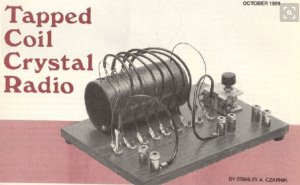
The first step was building the tapped coil. The plans called for a round Quaker Oats package, but there was a heavier cardboard tube in the NW room that I could have. One of the old radios had a multi-point switch I could use to connect the tapped coil, but it wasn’t ideal. My dad suggested that I use the rotor from the switch to build my own switch. He had some “tinner’s rivets” (small flat-headed rivets) that I could use for contact points. I cannibalized one of the ancient radio parts for copper wire of the right size, and wound the coil. I soon had the tapped coil unit assembled.
Within a couple of days I found the other old radio parts I needed, and connected them with solder. My dad told me not to use acid core solder. It works fine at first, but the residual acid eats through fine wires. A friend of his made that mistake in the 1920’s. His radio worked for three days. Rosin-core solder is what you want. I heated a four pound plumber’s soldering iron on the kitchen stove to do the soldering. Now that my crystal set was finished it was time to try it out.
All I needed now was an antenna. I knew some random lengths of electrical wire were lying around. (You never throw anything away on a farm.) I soldered enough random lengths together to reach from my bedroom window to the windmill down by the barn. I climbed the windmill tower and anchored one end of my antenna near the top. I brought the other end under the window frame of my bedroom. I also connected the necessary ground wire to the water faucet below, and brought it in too.
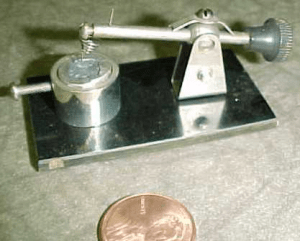
It took some fiddling to get the settings right to pick up a local station. I was using some old headphones from the NW room to listen, but I didn’t hear a whisper. I began to wonder if maybe the headphones or the crystal set itself were not working at all. I finally got one of the stations tuned in though. The main problem had been the crystal detector itself. You have to get the “catwhisker” adjusted just right for it to work. But you can’t tell if you have the whisker on the right spot unless you are tuned to a station. And you can’t tell if it’s tuned in until you get the catwhisker set right. You’re chasing your own tail.
I had lots of fun exploring the airwaves. During the day the sun ionizes the air, and ionized air soaks up radio waves. You can only tune in local stations during daylight hours. Ionization of the lower atmosphere goes away at night though, and it persists in the upper atmosphere. Radio waves bounce off the ionized upper atmosphere, and you can pick up distant stations at night. The Grand Old Opry in Nashville, KVOO in Tulsa, and a super-power US station in Del Rio, Texas (tower in Mexico) are the stations I remember.
I also built a “shirt-pocket” crystal set. It was about 3″ square and 3/4″ thick. It had a flat coil with a slider contact instead of a tapped coil. I used fine copper wire instead of string to fly a small kite, and that was my antenna. I made sure to stay far enough away from power lines though. By then I had a good grasp of radio reception basics, and was ready to try something more ambitious. I wanted to build a radio that used tubes next. That’s coming up in Part Two.
Galena (lead sulfide) is a semiconductor. The contact between the metal catwhisker and the galena crystal forms a solid state rectifier. You need a rectifier to extract sound from a modulated radio wave. So a crystal set is a solid state radio. 🙂
Nobody understood solid state physics well at the time, but Bell Telephone Labs was working on it. Three Bell Labs scientists assembled the first practical transistors in 1947. That was the true start of the solid state era. Twelve years later I was designing some of the first Hewlett-Packard products that used transistors. In essence they were precision radios used to analyze radio signals. I even met one of inventors of the transistor some time after that.

 Didit.Live
Great memories as usual. I had almost forgotten about the antenna to the windmill, but remember listening to the crystal radio for the first time with the old earphones. Also learning other fine points of your progress in the quest.
LikeLike
Is that NW room the one we were told was “off limits, the ceiling is falling in”? LOL
LikeLiked by 1 person
The very one. I have a good nose for valuable “junk”.
LikeLike