The crystal sets I described in my last post were often referred to as “boys radios”. I had graduated to vacuum-tube radios about the time I reached high-school. The designs were still 1920’s – 1930’s vintage though. They were a natural outgrowth of crystal sets. I found the plans in the only place I knew to look, the NW room.
Radios were more advanced in the 1940’s, but they were more complex than those earlier radios. I landed on legacy vacuum-tube radios by accident, but they fit the scope of my skills and budget much better.
A marvelous, seemingly magical, trick enabled those simple old vacuum-tube designs to perform nearly as well as later designs. Operating them required more finesse, but they performed well. The trick was positive feedback. Tubes amplify radio signals to provide stronger output. A little of that output fed back to the tube’s input bootstraps the output even further. It also has the happy effect of making the radio more selective, in other words, better at separating one station from others at nearby frequencies (channels).

The design for the first vacuum tube radio that I built used an iconic vacuum tube. I didn’t know Type 30s were venerable classics though. Several other, more modern tubes would have worked better. But that was what the plans called for.
Type 30s required three batteries to function. The “A” battery, in this case, 2 volts, heated the filament to make a cloud of electrons. The 90-volt “B” battery attracted the electrons to the plate, and the 9-volt “C” battery was connected to the grid. The grid element was located between the filament and the plate. The grid controlled the level of current from the filament and plate. The tube amplified the output of the radio by magnifying the received radio signal.
The best place to get radio parts in those days was from mail-order catalogs. They were that era’s version of buying things online. The parts for this radio cost about $5 — a bit more than the 25 cents for my galena crystal. I talked my mom into funding part of it. I ordered the parts and waited for them to show up in the mailbox.
I followed the mail-ordered plans for the radio closely after all the parts arrived. My practical knowledge about radios was rudimentary at that time. I was concerned that if I didn’t replicate the original accurately the radio wouldn’t work. Sort of a cargo cult mentality. I know now that I needn’t have been so careful. It did look nice though. Nicer than the one in the picture.

I was eager to try out this new radio as soon as I had it finished. I didn’t even connect my long antenna. I attached an 18″ piece of wire to the antenna terminal and started tuning around to see what I could find.
Instead of a tapped-coil, this radio had plug-in coils, one for each radio band. The only coil I had wound at that point was for a shortwave band. I don’t remember which one.
There are several shortwave bands above the AM broadcast band. The first station I picked up with that new radio was located in London, England. What a surprise. That told me that I had a sensitive radio set — even with only two tubes — thanks to the power of “regeneration“.

I used that radio extensively for a couple of years. I found its tuning too sensitive to the position of my hand. I thought a metal screen behind the iconic bakelite panel would fix that, and it did.
The tuning control was also too touchy. I bought a “vernier” tuning knob for the variable capacitor, and that fixed that problem. I now had a very nice 1920’s era radio.
Most radios today are based on a single digital chip. Chips look simple on the outside, but they are complex inside. Cell phones, WiFi and Bluetooth use similar radio chips. But where’s the fun in chip-based radios? You can’t experiment with the interesting parts yourself.
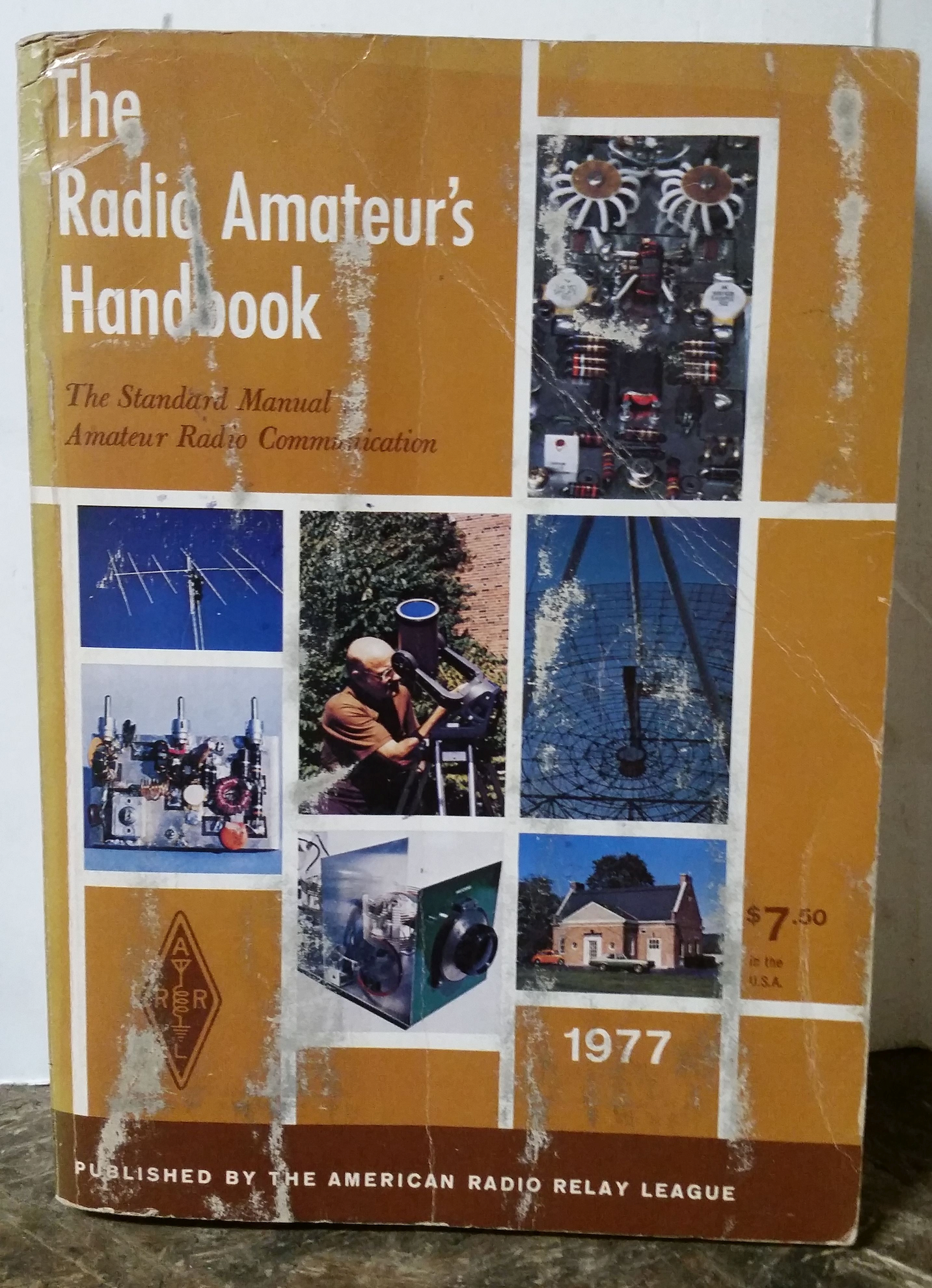
Later on, I was in high school, and getting interested in Amateur Radio. Amateur doesn’t mean neophyte in this case. Amateurs contributed to the state-of-the-art of radio from the beginning. The American Radio Relay League is the nexus of amateur radio.
I knew nothing of The ARRL though. I had been using the 1920’s Amateur Radio book I found in the NW Room. Then one day I saw a high school classmate’s 1947 ARRL Radio Amateur’s Handbook. He let me borrow it, and I soon had a copy of my own. That handbook turned out to be more consequential for me than any other book that I’ve owned. Serendipity happens.

The American Radio Relay League was established in 1914, which was in the early days of radio. Members of the League, and later on its technical arm, have contributed extensively to radio technology.
ARRL has been very effective in working with the FCC and Congress in setting out the structure and regulation of radio communication. ARRL is also the secretariat of the International Amateur Radio Union, serving a similar role with International radio bodies.
The ARRL handbook is just one of many publications they author and distribute for the benefit of members and the public. ARRL is a uniquely well-run organization that has been essential in keeping the regulation of radio communication out of the clutches of clueless politicians and greedy enterprises. More about Amateur Radio coming up…

 Didit.Live
Eagerly read just now and awakening visions of the past. Dad’s radio interest gave the added boost and early technology to encourage and maximize your achievements as well as the books “in the Northwest room”.
LikeLike
this mysterious NW room seemed to have held all kinds of treasures!
LikeLike
I now think some of it accumulated when my dad came home in the summer from school in McPherson to farm. I’m thinking about posting “An Ode to the NW Room” soon.
LikeLike