Rhetorically speaking, “Where is this “Radio” thread going?” My earlier experiences with radios gave me the background and confidence I needed to take on more ambitious challenges. Amateur Radio was the next and most import phase of following this passion.
I’m planning two or three more posts about these radio experiences. They will take us up to the point where the US Army entered the picture. I’ll pick it up later with stories about how the boyhood dream that stemmed from my interest in radio came true. And now, back to our regular programming.
***************************************************
My passion resembled this:
“There is nothing — absolutely nothing — half so much worth doing as simply messing about in boats.” —From The Wind in the Willows, by Kenneth Grahame
Amateur Radio
Amateur Radio gave me a solid grasp of the practical aspects of electromagnetics and electronics. I gained insight from it that helped me penetrate the complex, abstract nature of electronic systems. Amateur Radio gave me a big advantage when it came to engineering studies, practical knowledge, and problem-solving. Problem-solving was particularly important, as I’ll relate in future posts.
Having my own copy of 1947 ARRL Radio Amateur’s Handbook opened up a new world of simply messing about with radios. My limited budget was fortuitous, but I didn’t look at it that way at the time. I would need to build, not buy all the gear that I needed. I learned a great deal more by building my equipment than I would have if I had bought it.
My regenerative receiver was good enough for two-way communication. I needed a transmitter though. And I needed to learn Morse code to qualify for an Amateur Radio Operator’s license. I also wanted to get an electric soldering iron. Heating a 4-pound plumber’s soldering iron on the kitchen stove worked well enough for the limited amount of soldering I had done up to then. It would not do for what I was planning to build next.
I found a place to rent a code machine that I could learn Morse code with. It cost something like $3, plus $1 per month after the first month. I was telling dad about my plans, and he said if I learned Morse code, he would buy me an electric soldering iron. I took me two or three months to get good enough with Morse code that I could return the machine. After that, I used my little receiver to listen to code practice from W1AW, the ARRL station.
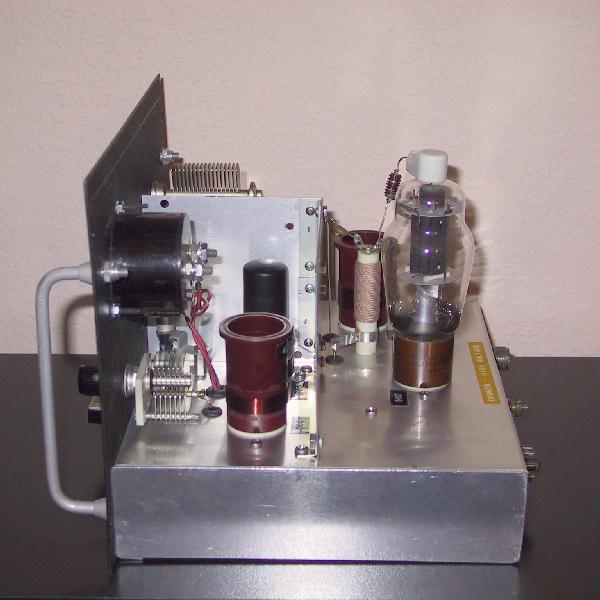
Meanwhile, I poured over the handbook, learning about what was important and deciding which design to select for my transmitter. I didn’t have my license yet, but that didn’t mean I couldn’t begin building my transmitter. I would test it by connecting it to a light bulb to absorb the output power. After I got my license, I could connect it to my antenna.
I selected a 25-watt design that used a classic Type 807 tetrode. The maximum allowed for Amateurs is 1,000 watts, but 25 watts is plenty for contacts anywhere around the world. The transmitter required a 300 volt DC power supply. That voltage puts you in danger of electrocution, so safety precautions are essential.
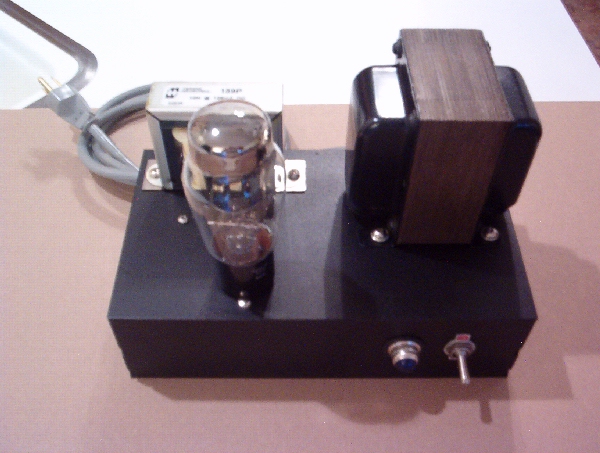
I needed parts for the power supply and the transmitter before beginning my project. Since it was shortly after World War II, many parts that would have been beyond my budget — 807s, large capacitors, power transformers — were available as war surplus at a fraction of the cost. Some of the other parts I made myself. I had a little income from odd jobs, etc. so I acquired the parts over a few months. It took a year or so for me to complete the build phase.
Now I needed my license. There was a written test, and a Morse code test. I had a good handle on the technical questions, and I had studied the regulations, which are extensive and detailed. I was getting good enough (fast enough) with Morse code that I thought I could pass that test.
It’s not like a driver’s license though. The tests are only given periodically and in just a few locations. By this time I was a sophomore at McPherson College. I drove down to Wichita, Kansas for the test. I aced the written test, but I thought I had failed the Morse code test for one error too-many. To my surprise, I passed the code test too. Maybe the examiner cut me a little slack because I did so well on the written. At any rate, I now had my “General Class” license.
Related links
- 807 Tetrode: https://en.wikipedia.org/wiki/807_(vacuum_tube)
- Transmitter: http://www.qsl.net/k5dh/6ag7_6l6.html
- Power supply: http://w5dxs.tripod.com/power.htm

 Didit.Live
Muy interesante!
LikeLike
It’s fun remembering, and trying to keep straight, those times more than half a century ago. I just learned from the internet that my suspicions about a semi-failed transmitter design of mine were correct. I couldn’t cure it though. The highly-promoted 6146 tube I used was very hard to tame. I would not have known how at the time. I did write a treatise when I was at Hewlett-Packard about how to cure very similar problems with transistors.
LikeLiked by 1 person