Taildraggers separate the men from the boys. Most airplanes handle more or less the same in the air, taildraggers included. And these days most of them have tricycle landing gear (nose wheel and two main wheels). That’s for a reason. Tricycle gear makes it much easier to handle airplanes on the ground. Taildraggers have a tail wheel instead of a nose wheel though. They fly better, but you can lose control of them on the ground.
The center of gravity (center of mass) for tricycle-gear airplanes is in front of the main gear. If the airplane begins to turn on the ground, a restoring force develops, which tends to straighten out the airplane.
The center of gravity for a taildragger is behind the main gear (it would flop on its nose otherwise). That location of the center of gravity makes it directionally unstable though. Taildraggers do not have a restoring force on the ground. It is a diversionary force instead.
When a taildragger begins an autonomus turn on the ground, the pilot must counter it immediately. Otherwise, the turning force will quickly become too strong for the pilot to correct. The plane will execute a vicious spiral, called a ground loop.
Handling a taildragger on the ground is similar to the challenge of controlling an automobile if you back it up at 15 miles per hour or more. You must have a feel for it, or things will quickly turn out badly. It’s part of “flying by the seat of your pants.”
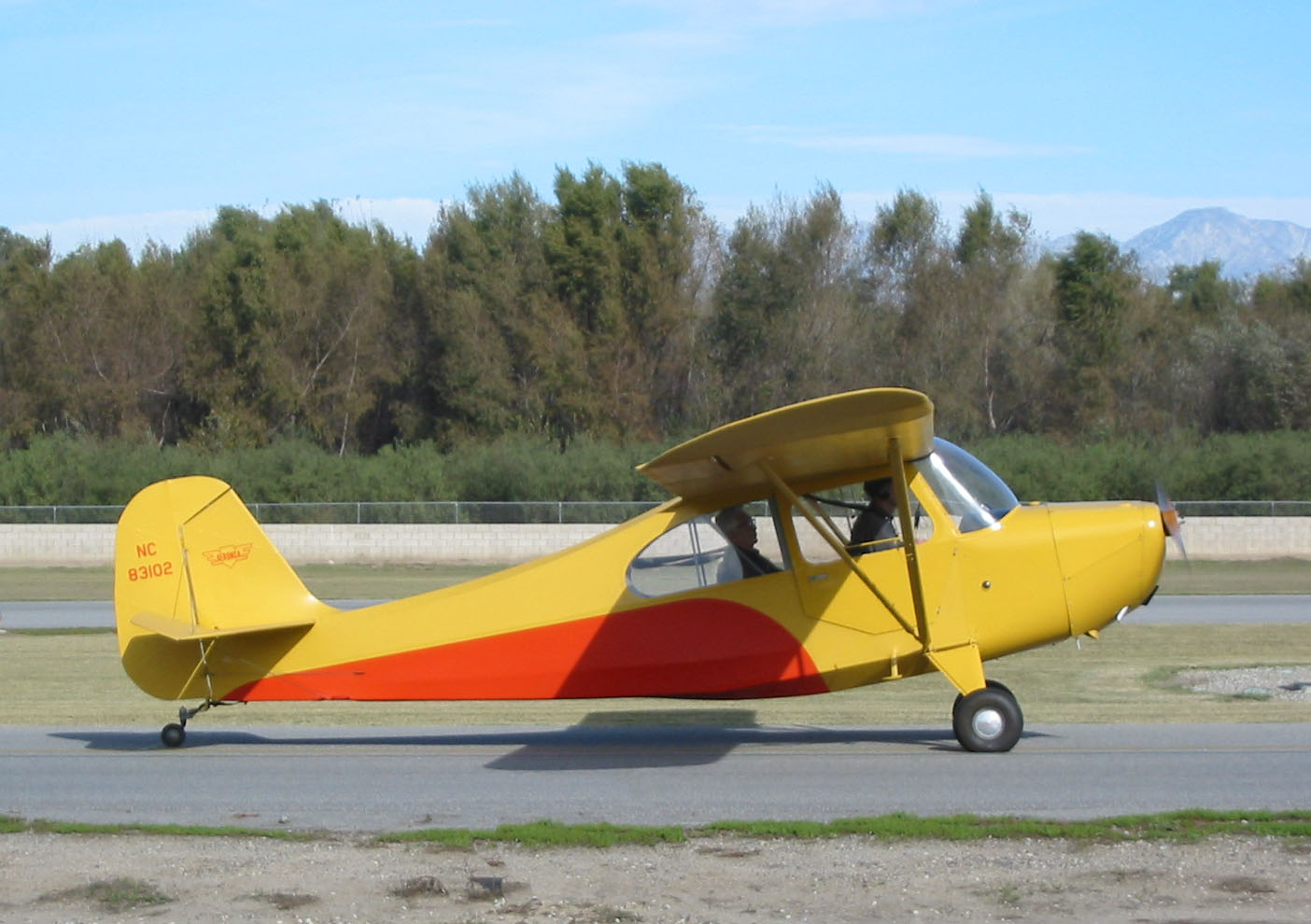
Gladys Buroker [video profile], a legendary flight instructor, lived in a house beside the Henley runway. She gave flight lessons in the Aeronca Champ that was available at Henley. I had begun to think about aerobatic flying, and almost all aerobatic airplanes are taildraggers. It wasn’t long before I decided to add taildraggers to my pilot ratings.
As I recall, I only needed three of four flight lessons before Gladys signed me off (a logbook endorsement) as qualified for taildraggers. Gliders only have one main gear wheel, so they are taildraggers too. Between gliders and the Champ, I acquired a seat-of-the-pants feel for ground handling fairly rapidly.
Old pilots say, “It’s not a question of if. It’s a question of when you will experience a ground loop.” A ground loop can result in dragging a wingtip on the ground. Stearman biplanes are noted for ground loops. The advice to military cadets was to always check the bottom side of the wingtips before you got in a Stearman. “You don’t want to land nicely, only to be held responsible for some other poor devil’s previous indiscretion.”
I have to admit, I’ve experienced two ground loops. The first was caused by turning off the runway too quickly. An unstoppable ground loop emerged. No problem, just a screeching of tires. My other ground loop was one of those events called “gaining experience.” In this case, I was landing in a very strong crosswind at Felts Field.
I handled the crosswind landing expertly and was rolling out nicely. I was going fairly slow when all of a sudden my airplane entered a rapid ground loop. Around I went, ending up headed directly for a blue runway marker light. I had regained some control and managed to just miss it with the propeller. Then I had to turn the other way to avoid hitting the light with the belly of my airplane.
I just sat there in the grass after I got my airplane stopped. The controller in the tower didn’t say a word. I regained a little composure, and radioed, “Permission to taxi to parking, N68553,” (my tail number). The reply from the tower was business like and crisp, “553, taxi to parking.” I had narrowly missed becoming a member of the “Blue-light Club” (hitting a taxiway light).
II sat there in the grass I figured out what had happened. I had fallen into a trap. The crosswind was largely blocked by hangers down at ground lever. It wasn’t bad landing at all. But there was a gap between those hangers. The crosswind was even stronger at each gap that it was aloft. I now know how I would have handled it if I had known, but that’s called gaining “flying experience”.

 Didit.Live