I’m taking license with this title. This ode is a bit of prose, not poetry, in praise of what we called “the northwest room”. I came to realize later in life it was one of the resources that enabled what I came to think of as my accidental homegrown education.
“One man’s trash is another man’s treasure.” —Norman Rockwell
Our farmhouse was commodious by most measures. The northwest room was a “spare bedroom” that we used for storage. It provided a secure, weatherproof place to store fragile things. We all have things we just hate to throw away. Most of the things stored there were artifacts from the 1920s and 30s. There were some precision things in the NW Room too. My dad’s home-made astronomical telescope and its 6″ mirror was one. Also a surveyor’s transit. I don’t know where all those NW Room treasures came from (not a secret — just didn’t ask). But there was a rich variety of things to use and appreciate.
Old radios, radio parts, and books were the most important artifacts for me. There was also a lot of other interesting stuff too — an old x-ray tube from a dentist’s office, a coin collection, an Indian arrowhead collection, my mom’s pair of over-the-calf lace up boots for her visit to Estes Park around 1928, the turntable of a hand-wound Victrola, and an old canvas tent.
The radio stuff was all 1920’s vintage. It offered several things for me. First, it gave me an idea of how radios were constructed. These old radios made the physics of basic radio elements visible. For example, it was very clear how variable coupling transformers and variable capacitors worked. They also made the ultimate sacrifice. I cannibalized them for radio components, insulated wire, connectors, etc., that I needed.
The books might have been more important than the junk. Other than the ordinary grade-school collection of books, I had never seen a real library in those early days. There was no Internet either. But that old bookcase offered many hours of intrigue for me.
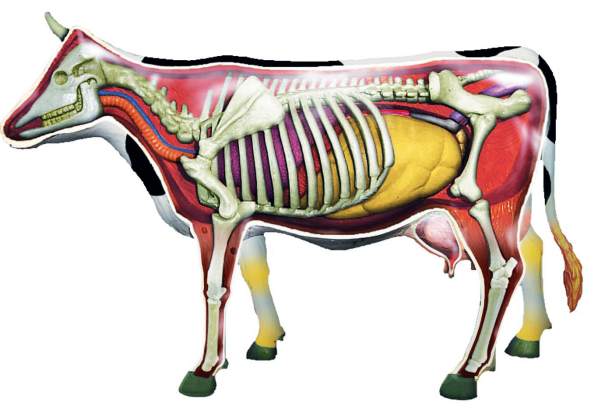 For example, the (farm) Animal Medicine book was fun to peruse. I imagine it was the sort of book that traveling salesmen carried to snag impulse buys with. It was about cows, horses, and I think pigs too. The main feature was colorful, multi-layer illustrations of animal anatomy. As you lifted the layers you went from skin to muscles to bones. It also exposed organs and their interiors. It was much more accurate and detailed that shown in the picture here.
The ABC of Bee Keeping was another detailed book I found interesting. It described the seasonal and life cycle of bees and their hives, illustrated how to manage honey production, etc. We had an active bee hive in the wall of our barn to observe as well. One year they swarmed. Bees swarm when it gets too crowded in their hive. They raise another queen, and she goes off with a large part of the workers looking for a place to establish a new hive.
I thought we could set up a box hive with the swarm, and extract our own honey. Dad even knew where we could get an empty hive. I had no beekeeping equipment, but that didn’t hold me back. Getting them in the hive didn’t go well. They got fed up with my attempt and attacked me. I ended up in the stock watering tank. I had to drown the bees that were all over me and inside my clothes.
The bookshelf in the NW Room held a variety of treasures. I’ve mentioned some, like the old Amateur Radio book. There were books on astronomy, building amateur telescopes, high-school physics, motor vehicles, Latin (the Romans had a way with words), and mental arithmetic. That’s most of what I remember of the 100 or so books that were there.

I spent many hours with a big book that gave instructions for various projects that a boy could undertake. I have no idea how it got there, but I tried several of them. One project was a rubber-band-powered model airplane. It had a quaint old design, with two rubber bands and twin propellers. Never did get it flying. Another was a model of Columbus’s square-rigged Santa Maria. The scope of that project exceeded my persistence. Besides, radios were more fun.
I found the book on physics fascinating. I particularly remember chapters on pulleys and levers. It was very interesting to me to learn that you could accurately describe how they worked by using a little arithmetic. I had an experiential feel from using pulleys and levers, and I learned that math had much more usefulness than just counting. To quote Sir Isaac Newton, “Mathematics is the hound that runs by the wheel of nature.” (Picture a stagecoach pulled by four horses, with a hound following a rear wheel.)
An aside: I’ve walked on the grave of Newton. He is buried under the floor in Westminster Abbey. There was heated competition in his day between the churches that emerged after Henry VIII’s excommunication from the Roman Catholic Church. They were eager to claim famous scientists of their day as members. In those days, science was taken to prove God’s existence (not so much these days). Each church proclaimed that their sect was the true one because the best scientists resided in their graveyards.

 Didit.Live
Again, great memories. I have the A.I. Root book on beekeeping. That N.W. room was a boon to us of accessible learning.
LikeLike