I started taking lessons with Steve Wolf after my brief introduction to aerobatics with Wayne Norton. Steve lived at Hackney Airpark, which is located about three miles from Henley Aerodrome in Athol, Idaho. It is another “residential” airport, with houses and hangers off to one side. Steve was usually at Henley when he was in town though. He is an unassuming fellow, who was and is legendary in the sport aviation world. I think you’ll find a short introduction interesting.
Steve was an airport kid at “Fly for Fun” airport in Vancouver, Washington (not BC). You can take flying lessons at any age, but you cannot solo (fly on your own) until your 16th birthday. Steve soloed in ten different airplanes on his 16th birthday. That means he was already “checked out” (qualified to fly) in those ten planes before his birthday. That’s why he could fly them all on his birthday. Ten endorsements in his logbook in a row.
Before I met Steve at Henley he had been building and repairing airplanes, flying at airshows and giving aerobatic instruction. His specialty was rebuilding wings for Stearman biplanes, but he grew tired of that. He had built his own Pitts Special and was making a living on the airshow circuit when I met him.
Steve began work on his boyhood dream soon after I met him. He was building a replica of the Sampson biplane, AKA “Big Pitts”. Curtis Pitts built the original many years before for another airshow pilot. Steve had been thinking about building a replica for many years.
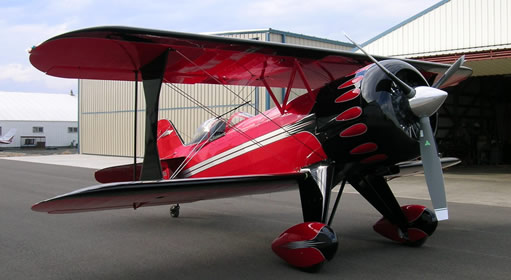
The plans Curtis Pitts drew up for Sampson burned in a hanger fire, but Steve had saved the copy of Model Airplane News that had plans for a scale model of Sampson. Steve knew Curtis long before he decided to build his own Sampson, and he got many pointers about building it from him. Then he scaled up the plans in that magazine to full size and began building the replica with some twists of his own. Steve always has good ideas about how to make an airplane better.
I first saw Steve’s Sampson in 1985 when the fuselage and lower wing were just skeletons. It was sitting on its landing gear in his hanger at Hackney Airpark. Steve was a wizard at adapting basic tools to make complex parts, and he explained some of his methods to my friend Dave Schwartz and me. A FAA certificate is required for all work on aircraft. Dave was also certified, and he did all the wiring for Sampson’s radios, lights, panel instruments, etc.
It is relatively easy to remove the wings from a biplane. When Steve had nearly finished building Sampson he trucked it to Henley, which had a paved runway. He wanted that for safety on the maiden flight. Many Henley regulars were at Henley a couple of weeks later to see Sampson fly for the first time. Knowing Steve, we expected it to fly perfectly, and it did. Steve soon had Sampson on the airshow circuit. He also flew it to the EAA Oshkosh Airshow that year. They had invited him to fly an aerobatic routine every day at the airshow. That was an unprecedented request. Other airshow pilots are lucky if they get to fly once at Oshkosh.
Sampson is light biplane with a 985 cubic inch radial engine, giving it a huge power to weight ratio. Steve set the 10,000-foot time-to-climb world record with Sampson. Sampson could fly a vertical figure 8 maneuver with ease. It’s not the usual horizontal one. It looks like an “8” looks here on the page. Most planes can only muster the bottom half of a vertical 8. Steve sold the Sampson after nine years flying it on the airshow circuit. Later on, he built another Sampson for Bobby Younkin. Steve continued to improve the design for Sampson, and recently offered the last one he built for $495,000. [Video: Bobby Younkin flying Sampson]
Steve moved to Oregon after selling Sampson. He went there to get a bigger hanger and better winter weather. There he built unique one-off planes for other airshow pilots. Most notable was a replica of a 1930s GeeBee R2 air racer. Steve and his flying buddies were always talking about building airplanes that nobody would have given a second thought to.
The original R2 was dangerous to fly, 5 or 6 pilots died trying. Although Jimmy Doolittle set a speed record with it, it was known as The Widowmaker. The R2 was also a complex airplane to build (the Granville Brothers probably had a dozen people building theirs). So why not build a GeeBee R2? There will be a story about that plane later. [here]
Steve also gave aerobatic lessons in Oregon. One of his students was a sports physician. She eventually became a full time spin recovery and aerobatics instructor herself. It was much more satisfying for her than being an MD. She and Steve then married and moved to Florida, where the flying weather is even better than in Oregon. Steve continued to build his own “Wolf-Pitts” brand of biplanes there, but from what I gather from their website he is not very active with projects now. They are both busy with aerobatic and spin recovery instruction though. [Video: Zlin Spin]
That’s a brief summary of Steve’s 48 year (so far) career performing and instructing aerobatics. The next post will have a few stories about my sessions with Steve.

 Didit.Live
I got a ride with him back in the late 70s when he flew into NY and they didn’t like the idea of him putting his plane together and taking off at a major airport so he brought it to a local airport on Long Island where I met him and helped him with getting what he needed to put his plane together and that was the first entry in my log book!
LikeLike