The saga continues…
San Francisco Bay
There weren’t as many Hobie Cat owners around the Bay Area as you’d imagine. Most sailboat prospects there already had a conventional sailboat by the time Hobies were introduced. Remember that Fleet 17 was based in Santa Cruz, where there were better prospects for a beach-oriented sailboat.
The course for one race on The Bay started in Alameda (over by Oakland), circled Treasure Island and went back to Alemada. Aside from seeing San Francisco and the bridges from the water, it was fun to be further offshore than most of our races were. I remember that the wind was strong and I nearly got washed off the boat. But we hung on and did fairly well.
Another race on The Bay followed an epic course up the Sacramento River from Richmond, through San Pablo Bay, up to Rio Vista. It was more than 50 nautical miles (60 miles) long. The beginning of the race was in The Bay of course. The water was very choppy, with lots of big swirls and eddies. I suppose that was from the flow of the tide. After a mile or so, an eddy snapped one of our rudders off. Now, what do we do? Can we even make it back? We decided to try to go on.
Hobies still sail fairly well in certain directions on one rudder. Although it wasn’t easy, we managed to make it through San Pablo Bay to the river channel The direction of the wind with respect to the course was better on that leg, and there were no waves. I found that if I headed off the wind a bit we could pick up enough speed to make the single rudder effective. Then we could turn back to the direction we wanted to go.
It was a constant challenge to balance speed with direction for the next 30 miles. The course turned more northerly at that point, and we had no trouble the rest of the way. We were in about tenth position out of more than 50 boats when we finished at Rio Vista.
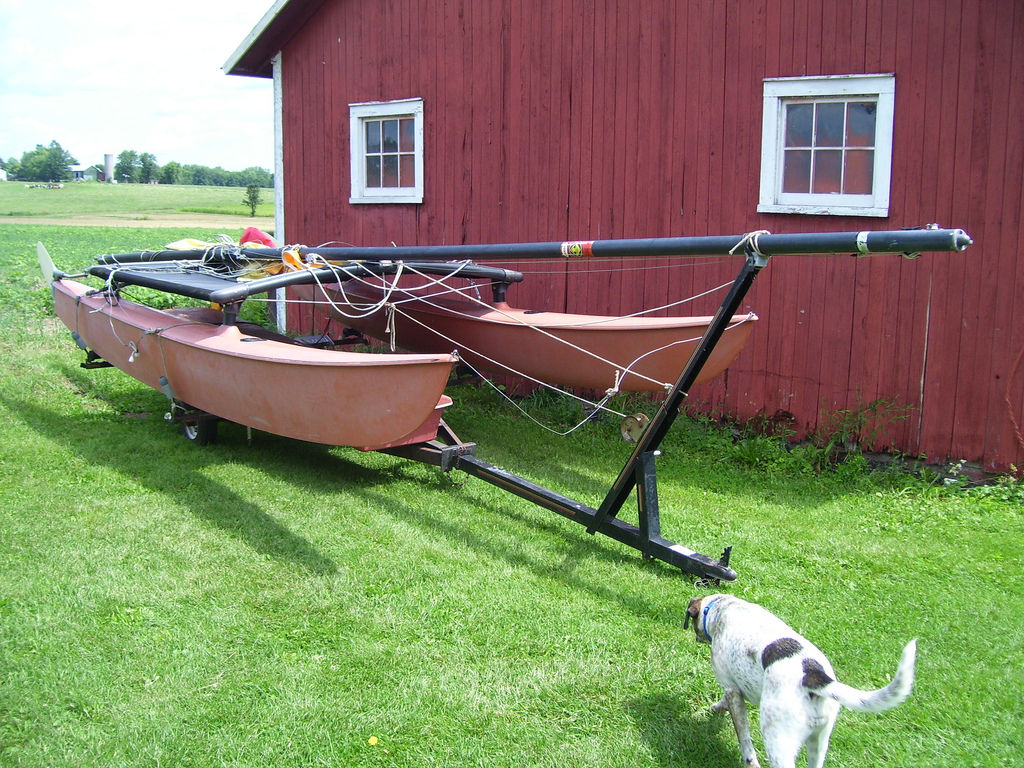 Nancy and Mark were there with the venerable ’66 Ford and the all important boat trailer to greet us. We had some fun sailing around in the river, which was about a fifth of a mile wide at that point. There were a few cargo ships going down the river. They blew their horns at us, but we were well out of the way.
Our landing spot was an Air National Guard exercise area, but it was also designated as a park with public access. A stupid helicopter pilot came over where we were and landed, nearly capsizing some of the boats on the beach. It was obviously intentional. I suppose he just had to mark his territory.
Rudiments of sailing
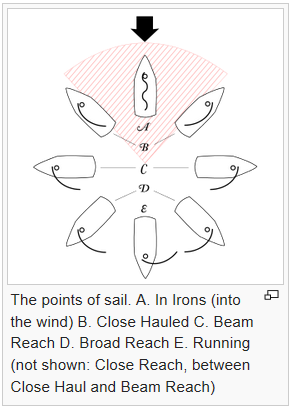 A little sailboat jargon will help you understand the essence of the next story. The diagram shows the points of sail for a sailboat. Point A: the boat is “in irons,” which is a helpless situation. The boat is out of control and will be blown backward.
Point B: “close hauled,” which means sailing as close as possible into the wind. On B you “tack” the boat to change direction by turning the bow through the eye of the wind. If you are on starboard tack (wind coming from the right) you will end up on port tack (wind coming from the left).
Point D or E: you’re sailing downwind and you “gibe” the boat to change direction. You do that by turning the stern through the eye of the wind. Gibing can be dangerous because the boom of the sail travels over the crew as the sail shifts from starboard to port (of vice versa), and the sail and the boom will swing violently if the wind is strong. [points of sail] [tacking and gibing]
San Luis Reservoir

Everyone had been looking forward to this event. It was the first time we were racing at San Luis Reservoir. The wind was strong when we got there, which promised some excitement for the races. The launch area was near a little bay that offered some protection from the wind and waves. Dan and I rigged the boat and took it out to see how it would go in that wind. The answer: not so good.
Lake wave crests are spaced much closer than ocean waves. They were big and spaced about eight feet from crest to crest on that day. Much shorter than ocean waves are spaced. We met the full force of the wind and the waves when we sailed out of the little bay. We were on a broad reach, and things went well. We were in trouble when we tried to go back though. The safest way would have been to tack to turn around. We could not get the boat to tack though. The waves pushed the bows back at the critical point of tacking and we ended up “in irons” every time we tried.
OK, maybe we could jibe if we’re careful. I didn’t like turning that way because it was not far to the rock-faced dam, but it might work. We tried jibing a few times but the wind almost overcame the boat every time we tried. There was one more thing we could try. We capsized the boat, forced it to turn turtle, turned it around while the sail was buried in the water, righted it, and sailed back in. (We could have reefed the mainsail, but we did not have anything to lash it to the boom with.)
Some other boats were coming out by the time we got back into the little bay. We decided to watch them and see how they faired. They simply jibed to get back in. The used a bolder way to handle the mainsail than we did though, and while it was a wild turn, they were not overpowered. My conservative approach was all wrong. We went right back out to try it their way. The anticipation was scarier than the turn itself. It all went smoothly, but the boom flip was breathtaking.
We sailed back to the beach after a few more practice gibes, and waited for the first race to begin. But there was to be no racing. The race committee decided it was too dangerous, and many participants didn’t want to race anyway. What a disappointment. I thought we could at least have had one unofficial race. Oh well, I learned something important that day.

 Didit.Live
My memories of boating seemed to be the “scary” stuff. My kind of sailing was sitting out on the boat and working on my tan!! haha
LikeLike
San Luis is notoriously windy, we call the signs we see on our drive to Reedley “gutsy” even though they actually say gusty!
That Rio Vista trip was interesting, when we got there the road to the pick up spot was closed for a parade! We had plenty of time to wait it out though.
LikeLike
Oh yeah, I remember the parade now.
LikeLike
It’s fun to read your stories; and it’s awesome to live next door to an Adventurer!!
LikeLike
I’m glad you enjoy them Julie. Writing them gives me the satisfaction of reliving them.
LikeLike