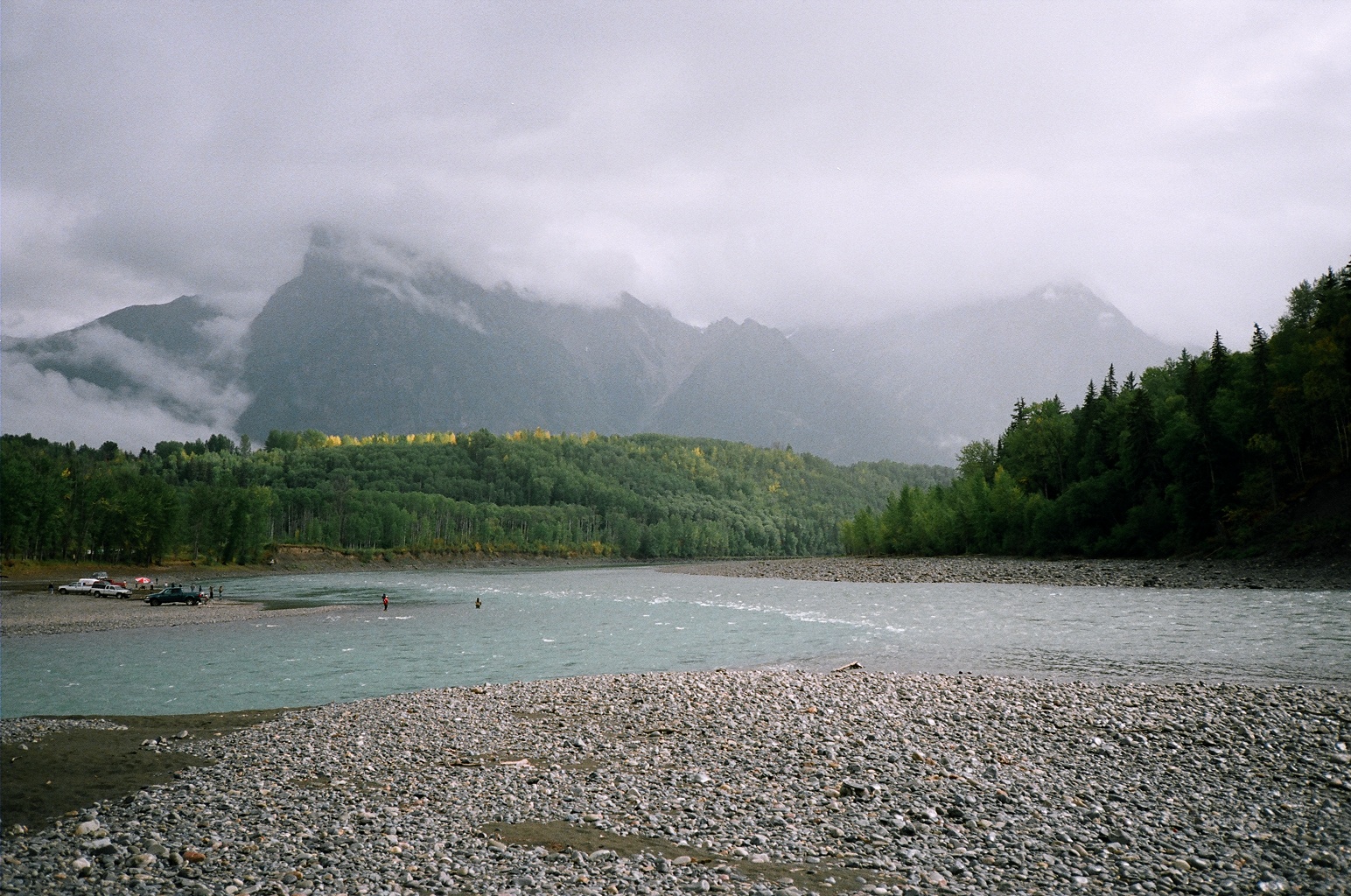
It’s all downhill from here (a favorite cliché in cycling). At least until I get back on land at Port Hardy. This segment starts at Smithers on the Bulkley River, which joins the Skeena River. Of course they both flow downhill. This is wild country, with lots of snow, a primal feel, and friendly people. The Skeena is a beautiful river, powered primarily by snowmelt.
The Skeena was navigated by canoe for centuries, then by mule train, and soon by steam boat. Many believed there was a fortune to be made in the area above Hazelton when plans for a railroad were announced. Hazelton was the staging area for the Omineca Gold Rush, and was widely advertised as the “Spokane of Canada”.
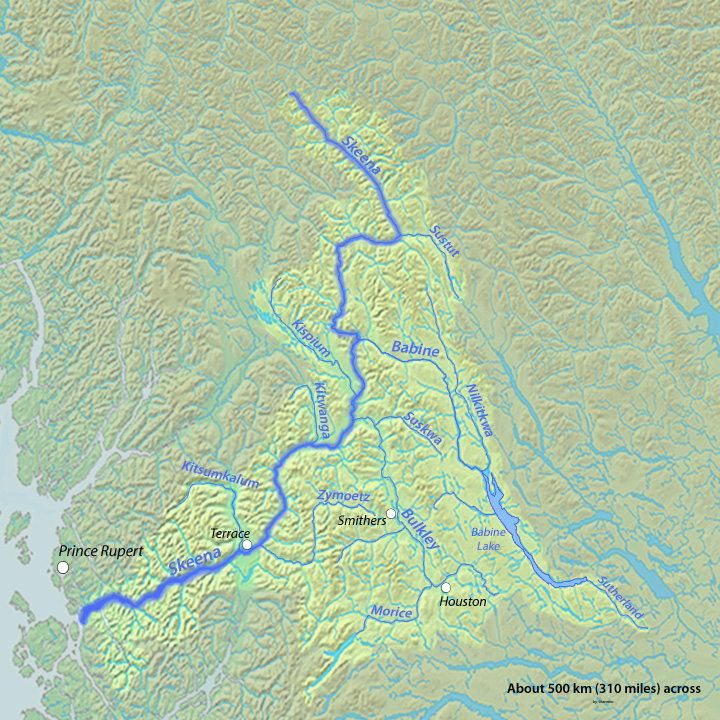 This segment of my route followed the Yellowhead Highway, which follows the Bulkley and Skeena rivers. My stops were Seeley Lake Provincial Park, near New Hazelton (at the confluence of the two rivers); Kleanza Creek Provincial Park, just before the bigger town of Terrace; and Park Avenue Campground, in Prince Rupert. To borrow a phrase from Duke Ellington, this ride was “beyond category.”
Hazelton and the Seeley Lake
I had an unusual experience on my way to Hazelton. After a few hours on the road, I felt so groggy that I feared I would fall asleep as I rode. I fought it off for a couple of miles, but decided I had better take a nap. I rolled my bike into the grassy ditch, propped my head on my sleeping bag, and went to sleep. I worried that some random Samaritan would interrupt my slumber, but I don’t think a soul stopped to investigate. I recovered after a half hour or so, and continued on my way.
I stopped in New Hazelton on the way to Kleanza Campground at Seeley Lake, which is near the Skeena River. The Hazelton region is located upstream from there at the confluence of the Bulkley and Skeena rivers. New Hazelton is the biggest town in that region, but is small by most measures. Still, it has all the services for day-to-day living, in particular a laundromat, which eventually becomes a necessity for a bicycle tourist.
The laundromat served as a social club as well as a laundry. An attendant and a few of her friends were drinking coffee when I arrived. I saw that they had a “washroom” there, and changed out of what I was wearing into street clothes. After loading the washing machine I sat down to talk with the coffee clutch. I told them about my nap attack on the road, and they had a good laugh.
They wanted to know where I was going, what I ate, if I have a tent, etc. There was an old fellow there washing clothes too. We talked about the bicycles he had when he was younger, and I asked him about the Cassiar Highway. I heard about the Cassiar when I talked with Thane a few days before, and had already put it on my bucket-list. One thing I remember is that it passes through a dry area that only gets about three inches of precipitation per year.
The attendant described another bicycle tourist who stopped at the laundromat a few years before. It might have been my HP friend Jake Layte. After I got my clothes washed and in the dryer, she offered to watch my bicycle while I shopped for groceries. Soon after that I was on my way to Seely Lake. It had been an efficient and enjoyable stop in New Hazelton.
Kleanza Creek Campground
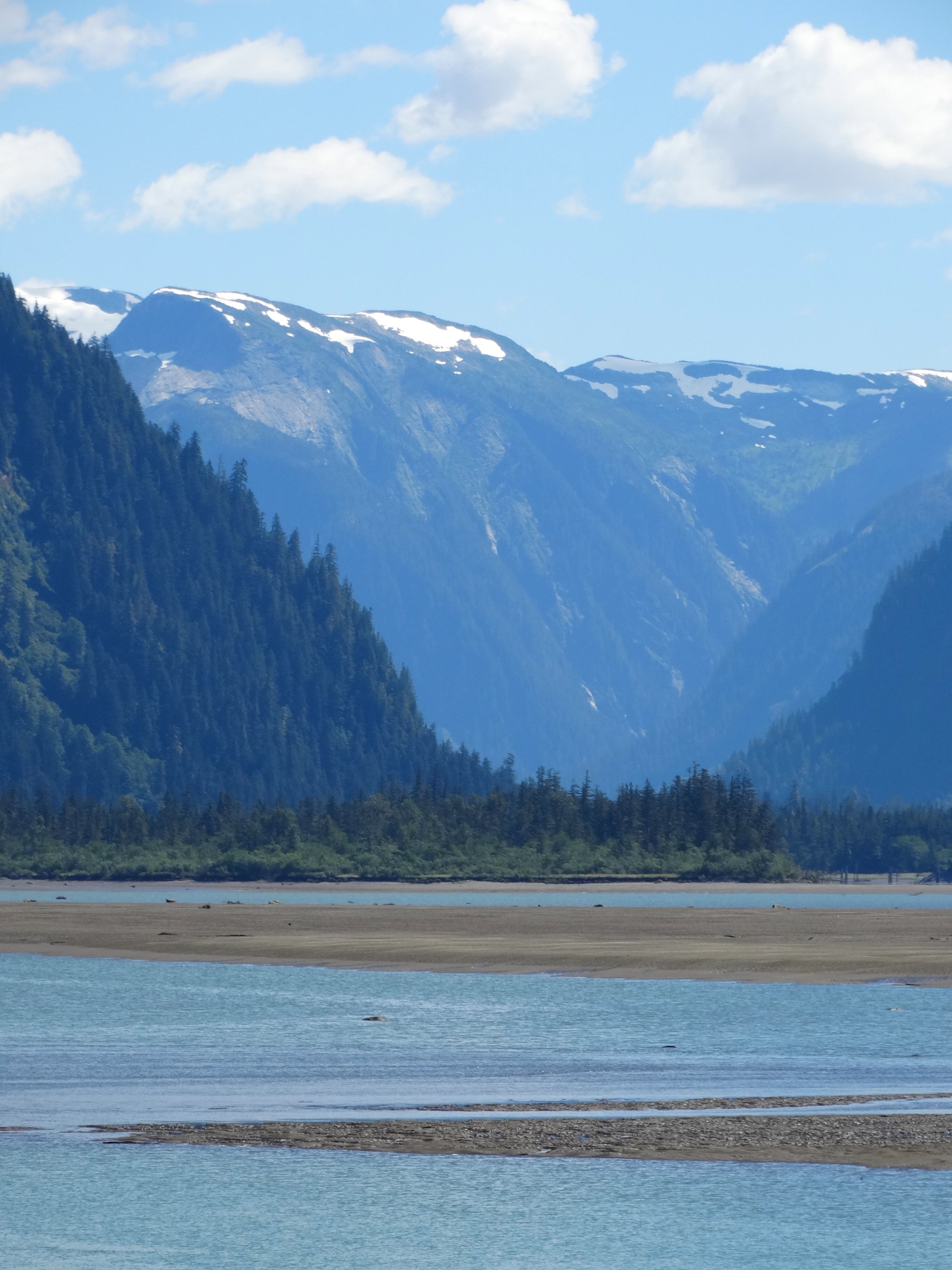 Yellowhead Highway runs alongside the Skeena River between rugged mountains on the way to Kleanza Creek. I was there in the spring when the snow was melting. The river was about as I expected — 100 yards wide, and flowing at 12 miles per hour, according to my speedometer. It appeared to be at least 20 feet deep. That’s a lot of water. Splendid.
When I talked with Thane outside Houston he recommended that I eat at “Mothers” restaurant in Kitwanga where Cassiar Highway joins the Yellowhead. I crossed over the river to the tiny town and ate breakfast there. The food was not equal to Thane’s rave report, but I had a long chat with the new owner. Then I visited a native-arts place at his recommendation. There was a large collection of totem poles alongside the road, and the art was interesting, but there was no room for any of it on my bicycle.
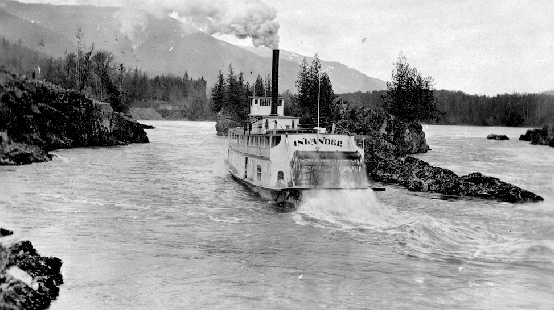
Then I was back on the road again, headed to Kleanza Creek Campground near Kitselas Canyon on the Skeena. It took a few years of trying and some wrecked boats before they were able to get sternwheelers past that point, and on to Hazelton.
A woman came over to talk with me while I was setting up camp at Kleanza. She and her husband had seen me on the road several times, and were impressed with how far I had gone. They had a camper, and obviously were enjoying a leisurely journey down the highway.
On to Prince Rupert
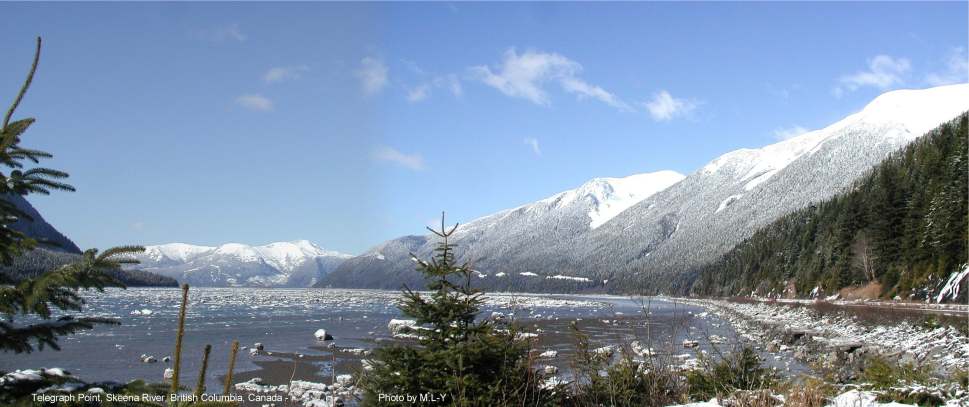 This was a 100 mile day. The Skeena becomes an estuary (salt water mixed with fresh water) about 25 miles from Prince Rupert. The vista widens and seems less foreboding than it is further upstream. The estuary is actually the channel that was formed during the ice age and is now drowned by the Pacific ocean.
In a couple of hours after reaching the estuary I was in Prince Rupert, which is actually an island reached by a short bridge. I was soon in the Park Avenue Campground, setting up my tent. You do not want to wait until later to to do that in this country (Prince Rupert is the city of rainbows). The grass is perpetually wet in the campground, and the ground slopes, but there were raised wooden platforms for tents. It was all good.
To be continued…

 Didit.Live
It’s as you describe it…wonderful scenery and wonderful people. In one of the many BC campgrounds we tented, I tried drying out my Solomon hiking boots by placing them near a fire ring, and the theory worked well. But there was a metal or hard plastic undersole in the boots, which were so badly warped by the heat I couldn’t wear them. The helpful gal who waited on me in a Smithers outdoors store had just the ticket…Solomon boots featuring waterproof Gore Tex, which I still wear today.
LikeLiked by 1 person