 Spar City is uniquely located a few miles into a National Forest. It had only been abandoned a short while when it was bought — lock, stock, and barrel — by a group of Kansas prohibitionists (primarily from Wichita). It was not yet a true a ghost town and soon became a summer retreat. The cabins at Spar City still functioned much as they did in the 1890s.
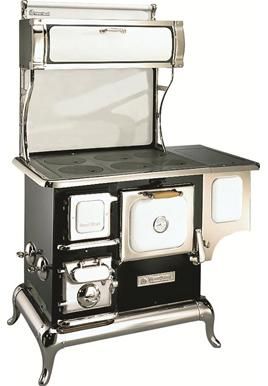
Our kitchen (attached to the main room) still operated as it once did. The essential element was a classic wood stove. The other main necessities were a sink, a cupboard, and a table and chairs.
 The sink had a hand pump to draw water from the creek. When the pump lost its prime, you poured a bucket of water from the creek in the top while pumping the handle to get it going. The creek also served as our refrigerator. It was just a box with holes in the side and a shelf inside. It was partially submerged in the flowing creek. I imagine that the temperature of the creek was about 45 degrees.
A rustic kitchen was not a challenge for Mom and Grandma Miller. It just took them back 30 years or so. The breakfast menu included bacon and eggs, homemade biscuits, oatmeal with half-and-half, and trout. Grandma Miller’s superb fried chicken was one thing on the menu for dinner. Surely there were other things, but I’m too much of an omnivore for them to have left an image. I’m sure there was no duck, though.
One adventure there could have ended badly. Paul and I were enlisted to help one of the owner’s fill potholes in the road. There was a bank on the road near the entrance to the town site that had a perfect mixture of crumbled rock for filling potholes. The fellow we were helping had a two wheel trailer, which we filled with that material, and made a fine job of fixing the worst potholes.
The main road forded Lime Creek at the entrance to the town. Paul and I were sitting in the middle of the trailer when we went through the ford. The little bump where the ford joined the road tossed the hitch pin out of the trailer tongue. There we were, floating along with the tongue a foot or so off the ground.
Somehow we were sitting at the balance point. We were sure the tongue was going to dig in. That would have thrown us out on the road. We couldn’t think fast enough to move toward the back of the trailer to keep the tongue up. We just rode along until the trailer slowed down and veered off the road. That was not an event we were likely to forget.
There was no store in Spar City anymore. There was no electricity, laundromat, telephone, or running water either. Not even WiFi. 😀 Creed was 14 miles away if you needed anything. It might sound primitive, but it was peaceful.
However, there was an ice house, a classic log structure lined with insulation. The ice blocks were cut from a beaver pond after it froze. They were stacked about five feet high with sawdust between each layer to keep them from freezing together. That gave me another insight about simple, practical pioneer technology.
Monsoonal moisture comes up through Arizona to southwest Colorado in the summer. There’s enough orographic cooling at the high altitudes around Spar City to create thunderstorms. The storms popped up about the same time on many afternoons. They didn’t last long, but the rain was a pleasant change.
I’ll wrap up these mountain memories with another fish tale. Paul, dad and I went part way up the mountain to check out some rumored fishing holes. We found them after crossing a couple of ridges. There were two or three very deep pools, about the size of a home swimming pool. All of them were teeming with nice size rainbow trout.
We tried dry flies, wet flies, and live grasshoppers on a hook. They were not even curious, let alone ready to strike our lures. We knew they were feeding by the way they were swimming and jumping. The pools were fed by Bird Creek. It only had little fish in it at that time of year, so we couldn’t fish there either.
We were hugely disappointed, so we decided to turn our quest into more of a hike. We went on down Bird Creek to where it joins Lime Creek and made our way back to the cabin.
On the way we found an old mine tunnel, half filled by a micro-glacier. There was a cold draft when we stood at the entrance. Most mines leak water (they’re much like a well), and we imagined that it froze in the tunnel during the winter. If you put your cabin near there you wouldn’t need an ice house.
Marcia and I took a side trip to Spar City around 1988. It was pretty much the way it was in the 1940s. Judging by Goggle Earth today, the cabins have been greatly enlarged, the beaver dams are gone, and the main road no longer fords the creek. Another tragedy of the commons.
Previous >

 Didit.Live