I had to backtrack to Merced Lake to connect with the trail over the ridge to Lafferty Creek. It was a stiff climb to Vogelsang (bird song) — an extensive designated campground. There was nobody here that early in the season, so I was camping by myself again.
The next morning was interesting. I came to a large creek right away. The trail crossed it in a big meadow. It was about three feet deep and ten feet wide there. The current was not strong, but the water was almost freezing.
I decided that was probably the best place to cross, though. The question was, how to manage it. I would have to wade, but I also had a big pack to get across. I took a chance and threw my sleeping bag across. It was in a bag, so I figured it wouldn’t get too wet before I could fish it out if it fell short.
The creek had a sandy bottom. I took off my boots, socks, and pants; picked up my pack and waded over barefoot. Sounds easy, but not in that icy water. That made crossing the creek had been a bit risky, but that’s the kind of thing you run into in the mountains. It’s called adventure.
I soon came to another big snowfield. I could tell it was ten feet deep or more. At first, I was apprehensive of sinking in over my head, but the snow was firmly packed. It was a delightfully easy stroll over to Lafferty Creek. Now it was all downhill to Tuolumne Meadows.
When I got to the little bit of “civilization” and campground at Tuolumne Meadows there was a surprise. A mob of campers was there. Most of them arrived in 4WD vehicles with big tires. No rookies there. They were fully equipped to challenge the “wilderness”. There’s a paved road to Tuolumne of course. But you never know what you’ll run into. 😉
It was all kind of depressing if not disgusting, so I was soon on my way to the Cathedral Lake region — another five miles or so from there. Cathedral Peak is a primary destination for hikers from Tuolumne Meadows, but I didn’t have time to make it there that day.
I also wanted to see Cathedral Lake the next day, but it was some distance off the trail and I didn’t have time to go there if I was going to make it to my next destination on schedule. Between the time it takes to decamp and set up camp again, there isn’t a lot of time to hike to interest spots during the day. Not if your goal is to cover some distance.
My daily routine started with getting my warmest clothes and my boots on. That’s easy in a roomy tube tent. (It gets harder in a tiny one-man tent, which I started using later.) Building a little fire comes next. I used a small wire grill spanning two rocks to cook on. (I switched to a tiny butane stove a few years later. I also switched from oatmeal for breakfast to food that doesn’t need to be cooked.)
After breakfast, it was time to pack up all my stuff. It takes some time to get it organized so that it will all go back in the pack. It’s important to put things like snacks and lunch in last. You can’t just dig around for things in a pack unless you don’t mind organizing things all over again.
Then it’s off down the trail. You need some idea of where you’re going to find water, and where the steep sections are. You hope the map didn’t lie. The high spots along the trail are changing scenery, wildlife, flowers, creeks to cross, snack time, and maybe a sweeping vista or two.
It’s always nice to arrive at your camp spot. Then it’s time to unpack your gear and pitch your tent. The next step is usually unpacking your sleeping bag and putting it in the tent to expand. Then you need to find a limb on a tree that is far enough off the ground to keep your food out of the reach of bears, but not so high that you can’t throw a rock over it. That’s the only way you’re going to get your hoisting line over it. That usually requires quite a few tries.
It’s great when you are close enough to a creek or lake to go catch some fish. There are usually some nice ones when you’re ten or more miles from any road. If you don’t catch some fish, it’s back to the dry salami. Yuk.
Eventually, I needed to find the right rocks for my hearth and some firewood. Then I’d build a small fire, and usually have a cup of tea before getting dinner organized. When you’re hiking solo, the trick is to eat out of the kettle and in courses. That way you have fewer things to clean up.
It starts to get cold in the mountains when the sun gets low in the west. You can put on more clothes and enjoy the evening for a while. But soon, you’d better haul your food up to the limb you picked out and get ready to turn in. It always feels nice to go to your tent and slide into your warm sleeping bag. These chores get more complicated if it is raining, though.
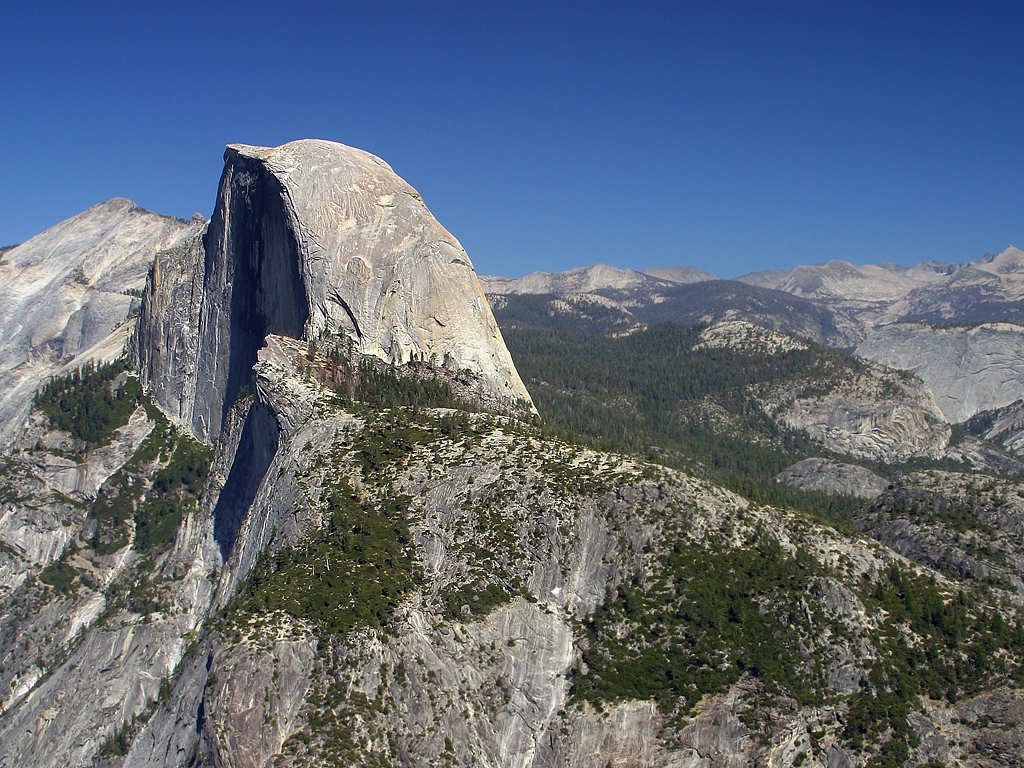
It was interesting to see Half Dome from the back side on this leg of my hike. That’s where (most) climbers go. There are cables to grip as you climb on the worst parts. I imagine too many people were hurt of killed before the cables went in. Domes like those in Yosemite are formed by layers peeling off giant blocks of granite. Granite exfoliates in layers when overlying rock erodes away and relieves the immense pressure it was under. Much like peeling layers from an onion.
Domes like those in Yosemite are formed by entire layers peeling off of giant blocks of granite. This gradually rounds them off. Granite exfoliates in layers when overlying rock erodes away and relieves the immense pressure it was under. Much like peeling the layers of an onion.
I camped twice between Tuolumne Meadows and Yosemite Valley. It’s all down hill and my pack was lighter because I had eaten most of the food. That made it easy to cover the distance. I could have taken it slower, but I had discovered that moving through the terrain is more fun than looking for other distractions. I was already planning my next hike as I drove home.

 Didit.Live
WordPress tells me my comment on your backpack #4 blog suffered an error. Just said nice hike and description preserved for posterity.
LikeLike