Aerobatics took me on a path similar to those I traversed in learning to fly, sailing, and skiing. I began to lose my keenness for boring holes in the sky as I reached a certain level of confidence. Yes, it was nice to do loops, rolls, and Cuban eights once in a while, but solo aerobatics eventually lost it’s compulsion.
Sailboat racing had once made sailing fun for me again. Sailplanes had added renewed fun to flying. Aerobatics had been a life-long dream for me, so I was not surprised to feel my interest wane as it became easier. I could have gone into competition aerobatics, where the challenge is limitless, but that would have been expensive in terms of time, travel and money.
Steve Wolf entered an aerobatics competition event once himself. Sport Aviation had an article about it. Aerobatic figures and routines are rigid for this kind of competition. On the other hand, air show routines rely more on originality and fluid transitions. So it was no surprise to learn that Steve’s figures were not quite precise enough. That kept him from winning first place. The writer’s closing comment was, “But, the man can fly.” Yes, like few others.
Anyway, my intuition was I’d soon tire of the sustained hard work required to be competitive in aerobatics. I like to do unscripted things, not set routines for judges. Luckily, serendipity had already entered the picture when I met Dave Cook and learned how to roll his yellow Citabria.
Dave invited me to fly up to his hanger at the Sandpoint, Idaho airport. I began going up there for brunch on weekends and soon met two other Citabria owners he knew. One day we all made a short hop from Sandpoint over to Ohlmstead Sky Ranch where I was attacked by dandelions (scroll half way down that post). Group activity centered on a mutual interest is my favorite kind of social event. This was a perfect example.
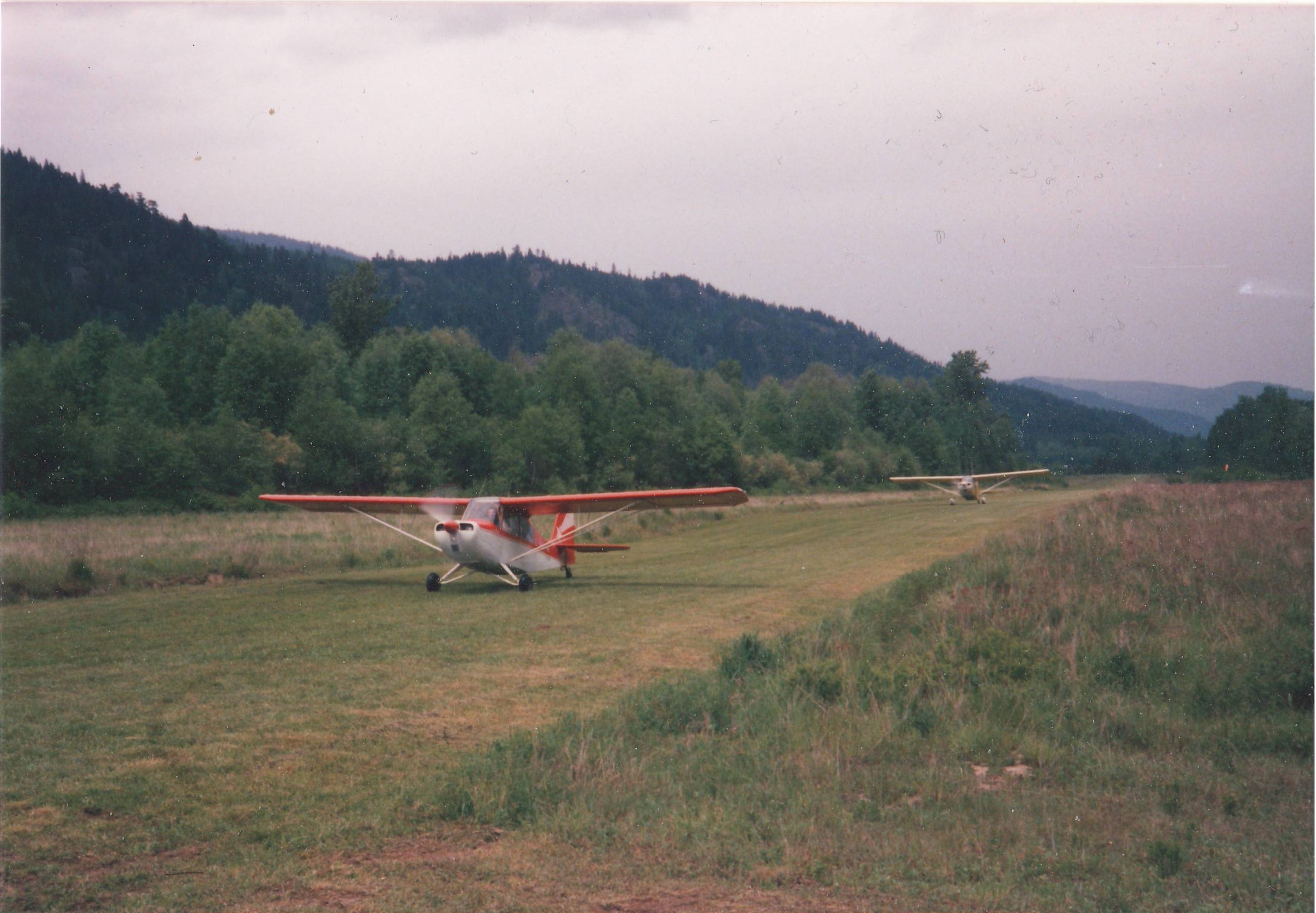
Dave had rented an “office” at the end of the row of hangers where he kept his Citabria at Sandpoint. The idea of forming an aerobatics team came up during one of our “hanger flying” sessions there. The Blue Angles and similar aerobatic teams base their routines on formation flying. It adds a challenging and impressive dimension to aerobatics. Why not do it with our mismatched red, yellow, blue and green Citabrias?
High-performance airplanes are better suited to formation aerobatics than Citabria’s. We knew flying the kind of synchronized maneuvers that you see professionals doing would be foolhardy in our Citabrias. We could start off by learning to fly in formation, though, and maybe take it from there. Dave was the only one of us who had done formation flying so he gave us some ground schooling, and off we went.
The basic principles of formation flying are simple to describe: The leader of the formation is the eyes and ears for the whole “flight” (a group of airplanes). The other pilots match the leader’s maneuvers by keeping their eyes on the plane they are shadowing. They strive to hold a precise position with respect to its closest wingtip. That requires matching his attitude and speed precisely. They strive to maintain position in three dimensions with an accuracy of a few feet, and bank angle within a degree or three. Matching the leader’s speed within a few hundredths of a knot per hour is the hardest part.
It involves a little practice to get to where you can do all those things well. We got together at Sandpoint on most weekends the first summer to practice formation flying. We also began to devise aerobatic figures that emerged from close formation to separated paths and then rejoined in formation. That’s how we planned to avoid the risk of flying in a tight formation during an aerobatic figure. Yet the complete figure would be more interesting than any figure flown by a single plane.
FCC regulations for radio operations created a little problem for us right at the start. Communication with traffic controllers, for example, control towers is clear cut. The regulations for plane-to-plane communication are ambiguous, though. We decided it was best to ignore the question and plead confusion if we were accosted. Radio silence was just not an option while learning formation operations. No problem though. Who was going to hear us on an unused channel anyway?
The first aerobatic figure we developed is a good example of the ones we used in our routine. In this one, we transitioned from close formation to flying in trail (all the planes in line) by executing sequenced “U” turns.
It worked like this: The one on the left initiates a U turn. One second later, the next plane to the right follows. The third plane waits one second after that, etc. Since we are flying at 100 knots, we ended up all in line, separated by about 340 feet (the distance between goal posts on a football field).
If there are three planes, the second one then executes a barrel roll while the third one executes a loop. The planes end up separated by about 1000 feet because a barrel roll takes more time than level flight and a loop takes more time than a roll. Now all three can safely execute loops or Cuban eights in unison. To rejoin the formation and begin the next figure they fly a reversed form of the U-turn maneuver. (Those U turn maneuvers are easier to fly than to think about.)
We eventually had three or four similar figures in our routine. Coupled with our formation flying and some individual figures we had a nice little air show. Then we put on a couple of private routines for friends and families. We continued to polish our routine for a couple of years but some team members began to miss sessions. I decided to drop out when that happened. It was obvious that our sporadic practice created a safety hazard.
Then we put on a couple of private routines for friends and families. We continued to polish our routine for a couple of years with an eye to public performance. But some team members began to miss sessions. I decided to drop out after that. It was obvious our sporadic practice created a safety hazard.
One of the last things that we did as a team was fly to a big airshow at Glacier Park National Airport near Kalispell, Montana. We flew in “loose formation” over there and back. When you arrive the team leader calls the tower to request landing clearance as a “flight of four.” Then we executed a snappy military-style roll out to position ourselves for closely sequenced landings.
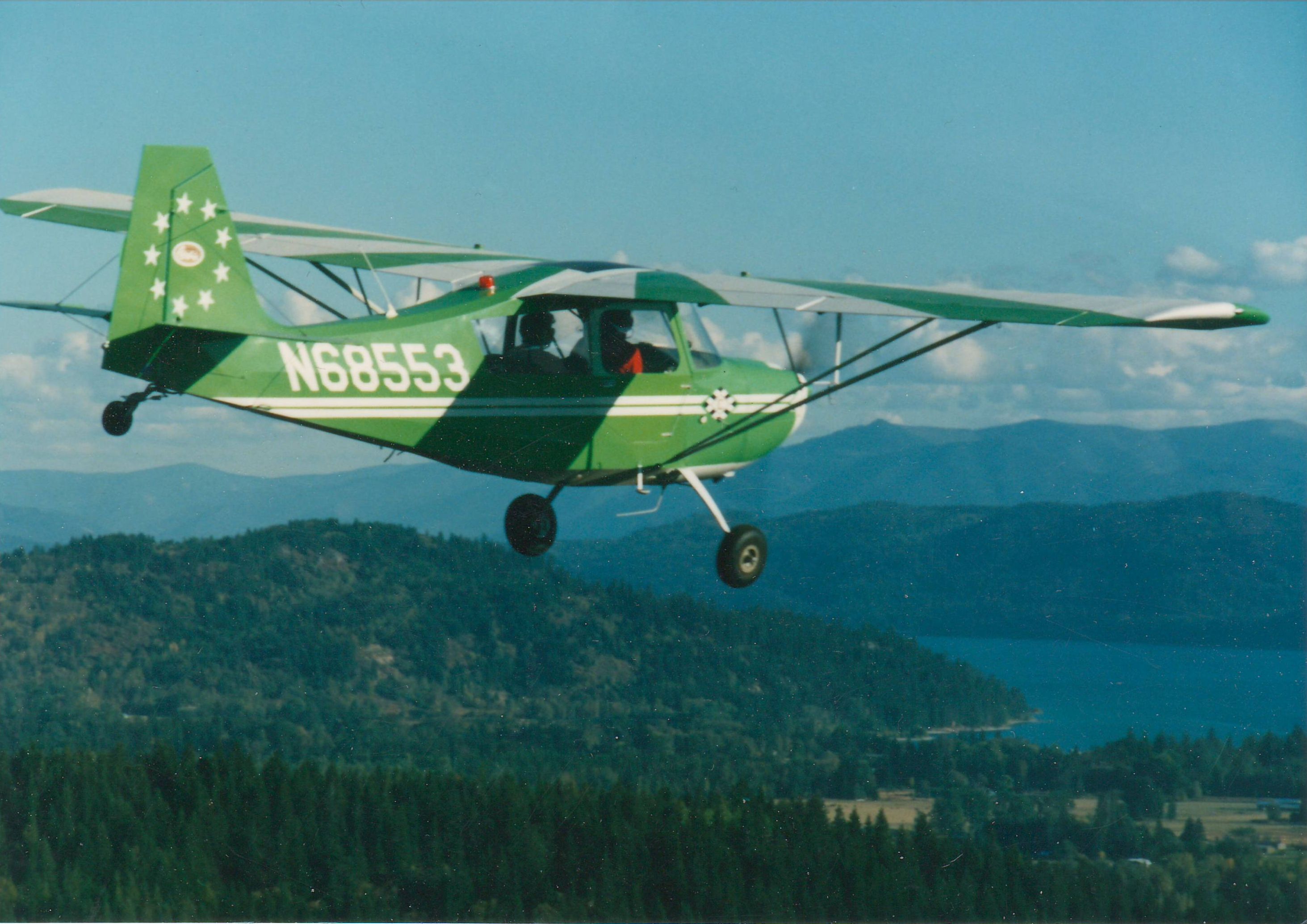
Marcia did quite well on the flight over but it was too hot when we got to Kalispell. She ended up dehydrated and we had no luck getting water for her. Eventually, we had to walk quite a ways to the terminal building, and that added to her distress. We needed to refuel when the show was over, but there was a big wait for the fuel truck. We hopped over to a little airport nearby and got our fuel. By then it was a little cooler, and we had a nice flight back over the mountains.

 Didit.Live
Love the photos! Mom was a good sport going up in that cute green flying machine!
LikeLike
Yes, she was a good passenger.
LikeLike
What an exhilarating way to spend a weekend. You and Marsha had far more than your share of fun!!!!
LikeLike