At some point in my cycling career, I discovered Spokane Bicycle Club. That was before the Internet amounted to much, so I might have seen it in the paper, or maybe someone told me about. (BTW, today I learned on the Internet that the club had been reincarnated just a short time before I discovered it. Serendipity?)
SBC fit my interests like a glove. It wasn’t a racing club, where I wouldn’t have been competitive. It wasn’t a picnic-basket sort of group either. It was a bunch of ordinary mortals — most of them over 40 — who enjoyed serious cycling.
Spokane is a great place to cycle year round. Oh, there’s a little snow at times, but you’d be surprised how well a mountain bike works in that stuff. I commuted eight miles to work on my bike year-round for six years without much trouble.
The roads are the best thing about Spokane cycling. Native Americans established routes to the nice places in Washington long before white men arrived. Naturally, they followed creeks and the contour of the land. Those are the easiest ways to get to where they were going.
Roads in the plains states follow the rigid grid imposed by the hasty government survey instigated under the abominable concept of manifest destiny. Don’t get me started… The survey didn’t reach Washington Territory though.
That’s why roads around Spokane follow natural routes. The interlopers just turned the trails into roads. They are much more pleasant to travel on than the grid in Flyover Territory. The result was that cycling routes in Washington are much like those in Europe (or Canada and Alaska).
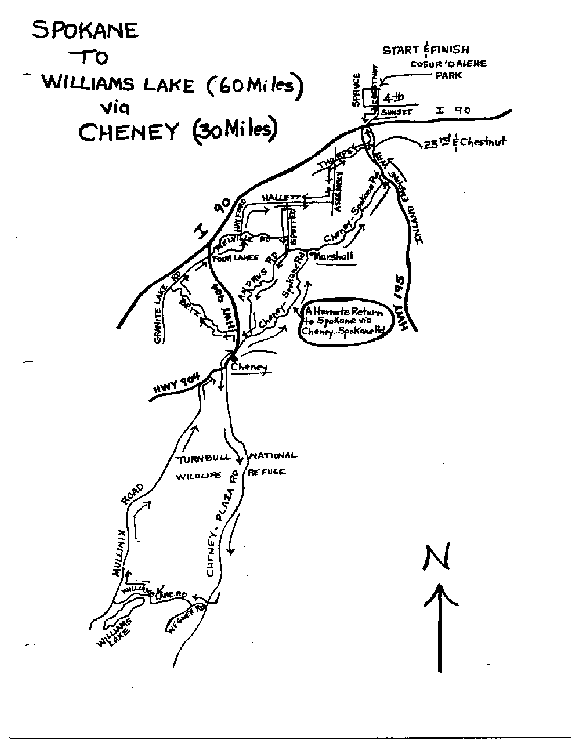
SBC offers a wide variety of rides. I started with some of their shorter ones, but soon gravitated to Saturday rides, which were more ambitious. The general scheme for a Saturday was to cycle out to a small town for breakfast, take a scenic route back, and cover 50 to 80 miles.
Sometimes we more or less paralleled the Centennial Trail from downtown Spokane over to Coeur d’Alene or beyond. (You’re supposed to get a permit for a group on the trail, so we only used bits of it as necessary). We often stopped in Post Falls along the way for breakfast at a place that served wonderful buckwheat pancakes.
The “Valley Chapel” ride was one of my favorites. It starts at the South Hill region of Spokane, drops down to Latah Creek, climbs back up to the town Rockford, and returns on the Palouse Highway. Latah Creek flows along in a mile-wide gully, essentially a canyon and the ride there is idyllically rustic. There is a two-mile climb up to Rockford, which most riders complain about. That was the best part of the ride for me. A short burst of effort and you were up out of the canyon and on your way downhill to Rockford.
I usually picked “Devils Gap” loop when it was my turn to plan a ride. For some reason, I was the only one who chose that route, but everyone was excited about it when I did. The ride starts downtown by the river, climbs the grade up past the Air Force base, and proceeds out on Highway 2 to Reardon for breakfast. Then it heads north toward Long Lake on the Spokane River and turns back toward Spokane at Devils Gap (two prominent bluffs). There are three miles of fantastic coasting down to the gap.
The road climbs back out of the Spokane River Valley after ten miles or so and then descends back to the Nine Mile Falls region below Spokane. Another thrilling descent. From there it follows/parallels the Centennial Trail to where we started.
Most of us went to Libby, Montana for the “Scenic Tour of the Kootenai River” a few times in the 1990s. STOKR is a “Century” (a 100-mile ride). It follows the river down past Kootenai Falls, ascends the valley of Yaak Creek, goes over a high mountain ridge and returns to Libby. There are about 50 miles of constant climb to the summit. Then there are five miles of the most exciting descent I’ve ever experienced.
The descent is paved, but it is steep, twisting, narrow and lumpy. There is no traffic so you can go as fast as you dare (35-40 mph) for about five miles. After that there are 20 more miles of downhill where you scarcely need to pedal to keep up 20 mph. It takes half a day to get to the top and an hour or so to get back.
SBC puts on the Autumn Century each year. The officers planned those events, and I was the treasurer for a few years. We knew there was a lot of broken glass on the route we preferred one year. I suggested we ride the route and sweep the glass off the shoulder. Off we went with our dust brooms the week before the scheduled ride. It was a splendid day and we had a great time. We touted the ride’s “hand-swept route” on our flyers.
It takes seven or eight hours for most riders to complete a century. There are three or four stops along the way where you can get food and water. On one century I “rode to the ride,” which added 20 miles at each end of the 100 miles. But I was already wondering how much further I could go by the time I got to Loon Lake. No doubt because I hadn’t been eating enough along the way. I had ridden 95 miles and it was another 45 miles back home.
I decided to rest a while at the food stop at Loon Lake and discovered they had a basket of boiled red potatoes. I ate a bunch of them sprinkled with salt and began to feel a lot better. So I headed for Spokane. I actually felt better and better as I went along. That starch fueled my effort evenly as I rode along. I had been thinking I’d be forced to stop at the official end of the ride and have Marcia come and get me. As it turned out I made it all the way home with no trouble.
By rough calculation, I rode over 20,000 miles with SBC in 10 years. It was simply grand out there on the road with my friends. It’s hard to relate exactly how it feels to know you’re all able to doing something hard and enjoying it. A few times I’d feel worn out at the 50- to 70-mile point in a ride, but knew there were only 20 miles or so to go. You can always do another 20 miles. 😉

 Didit.Live