More Spar City Memories

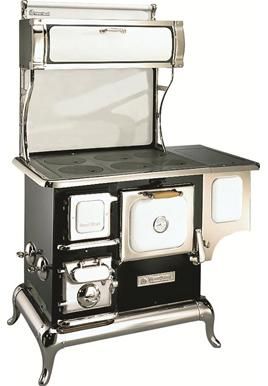
stoveSpar City is uniquely located a few miles into a National Forest. It had only been abandoned a short while when it was bought β€” lock, stock, and barrel β€” by a group of Kansas prohibitionists (primarily from Wichita). It was not yet a true a ghost town and soon became a summer retreat. The cabins at Spar City still functioned much as they did in the 1890s.

Our kitchen (attached to the main room) still operated as it once did. The essential element was a classic wood stove. The other main necessities were a sink, a cupboard, and a table and chairs.

pumpThe sink had a hand pump to draw water from the creek. When the pump lost its prime, you poured a bucket of water from the creek in the top while pumping the handle to get it going. The creek also served as our refrigerator. It was just a box with holes in the side and a shelf inside. It was partially submerged in the flowing creek. I imagine that the temperature of the creek was about 45 degrees.

A rustic kitchen was not a challenge for Mom and Grandma Miller. It just took them back 30 years or so. The breakfast menu included bacon and eggs, homemade biscuits, oatmeal with half-and-half, and trout. Grandma Miller’s superb fried chicken was one thing on the menu for dinner. Surely there were other things, but I’m too much of an omnivore for them to have left an image. I’m sure there was no duck, though.

One adventure there could have ended badly. Paul and I were enlisted to help one of the owner’s fill potholes in the road. There was a bank on the road near the entrance to the town site that had a perfect mixture of crumbled rock for filling potholes. The fellow we were helping had a two wheel trailer, which we filled with that material, and made a fine job of fixing the worst potholes.

The main road forded Lime Creek at the entrance to the town. Paul and I were sitting in the middle of the trailer when we went through the ford. The little bump where the ford joined the road tossed the hitch pin out of the trailer tongue. There we were, floating along with the tongue a foot or so off the ground.

Somehow we were sitting at the balance point. We were sure the tongue was going to dig in. That would have thrown us out on the road. We couldn’t think fast enough to move toward the back of the trailer to keep the tongue up. We just rode along until the trailer slowed down and veered off the road. That was not an event we were likely to forget.

There was no store in Spar City anymore. There was no electricity, laundromat, telephone, or running water either. Not even WiFi.Β  πŸ˜€ Creed was 14 miles away if you needed anything. It might sound primitive, but it was peaceful.

However, there was an ice house, a classic log structure lined with insulation. The ice blocks were cut from a beaver pond after it froze. They were stacked about five feet high with sawdust between each layer to keep them from freezing together. That gave me another insight about simple, practical pioneer technology.

Monsoonal moisture comes up through Arizona to southwest Colorado in the summer. There’s enough orographic cooling at the high altitudes around Spar City to create thunderstorms. The storms popped up about the same time on many afternoons. They didn’t last long, but the rain was a pleasant change.

I’ll wrap up these mountain memories with another fish tale. Paul, dad and I went part way up the mountain to check out some rumored fishing holes. We found them after crossing a couple of ridges. There were two or three very deep pools, about the size of a home swimming pool. All of them were teeming with nice size rainbow trout.

We tried dry flies, wet flies, and live grasshoppers on a hook. They were not even curious, let alone ready to strike our lures. We knew they were feeding by the way they were swimming and jumping. The pools were fed by Bird Creek. It only had little fish in it at that time of year, so we couldn’t fish there either.

We were hugely disappointed, so we decided to turn our quest into more of a hike. We went on down Bird Creek to where it joins Lime Creek and made our way back to the cabin.

On the way we found an old mine tunnel, half filled by a micro-glacier. There was a cold draft when we stood at the entrance. Most mines leak water (they’re much like a well), and we imagined that it froze in the tunnel during the winter. If you put your cabin near there you wouldn’t need an ice house.

Marcia and I took a side trip to Spar City around 1988. It was pretty much the way it was in the 1940s. Judging by Goggle Earth today, the cabins have beenΒ  greatly enlarged, the beaver dams are gone, and the main road no longer fords the creek. Another tragedy of the commons.

Previous >
Mountains and Creeks

Mountains and creeks are two of the words/things that I most resonate with. Trees are another. I’m sure that’s true for many other people as well. I suspect it’s innate. Think back 100,000 years ago. Mountains, creeks and trees were a matter of survival for people then. No doubt a lush savanna seemed equally important to them as well.

“The streams of the mountains please me more than the sea.” ~Guantanamera lyric, (maybe appropriated from Jack London, Mark Twain or John Muir?)

“Let children walk with Nature, let them see the beautiful blendings and communions of death and life, their joyous inseparable unity, as taught in woods and meadows, plains and mountains and streams of our blessed star, and they will learn that death is stingless indeed, and as beautiful as life.” ~John Muir

This post is a preface to the series I’ll write on backpacking. I’ll soon find out if I took our daughters and my notebooks to Arizona last season. I think I was counting on the spare time to write them up there. The series won’t be nearly as good without them, but I can get a start here, and look for them when I get there.

If special feelings for mountains and creeks is not nature (innate), it’s nurture. The first time I remember being in the mountains was at Spar City, Colorado. I was probably five years old. I’ve been captivated ever since.

spar-city
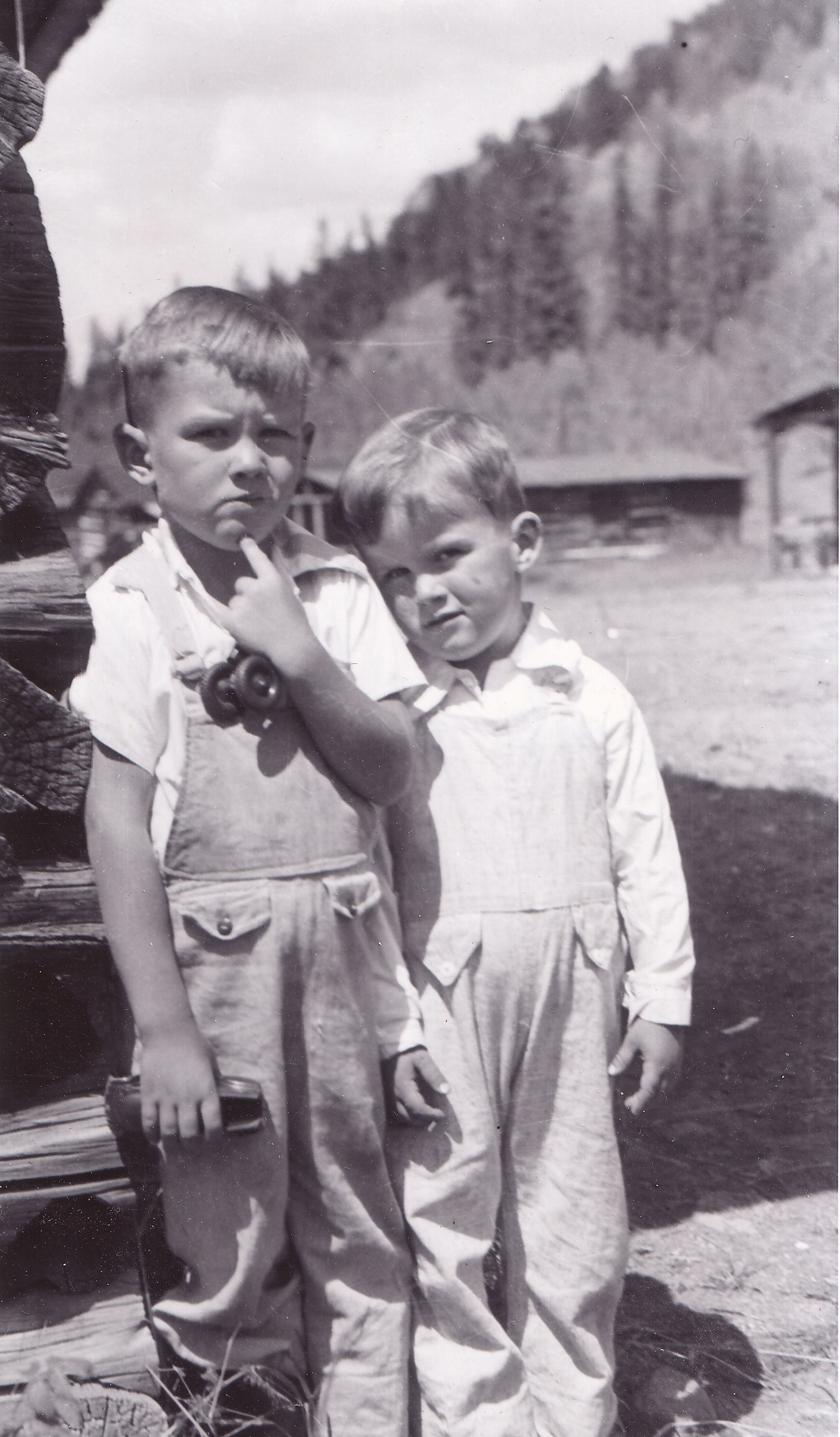
Paul and I by the corner of the cabin. Looks like I have a toy tractor and a truck.

I only have fragmented memories of that. A few stand out β€” my dad sawing an opening for a window in my grandparent’s log cabin, the Coleman lantern that hung from a beam for light at night, the wood cook stove and the smell of aspen burning in it β€” and a general feel for the landscape, the creek just behind the cabin, and the smell of pine trees.

Spar City was a small silver mining town. Thirty log cabins, the jail, aΒ saloon, and a “dance hall” was all that remained when we were there. Spar City was a satellite of Creed, Colorado, a famous mining town where people like Doc Holiday hung out, and where Bob Ford who shot Jesse James was shot. “Spar” is short for feldspar. Feldspar is a component of granite β€” a telltale mineral that indicates the possible presence of precious metals.

The next time we were in Spar City was after WW II. When we arrived, I remembered the smell of pine trees. And there was the perpetual creek behind the cabin. I saw that Lime Creek had a series of beaver dams that I didn’t remember from before. The cabin was very familiar too β€” one main room, about 16′ X 16′, and a kitchen attached to the back.

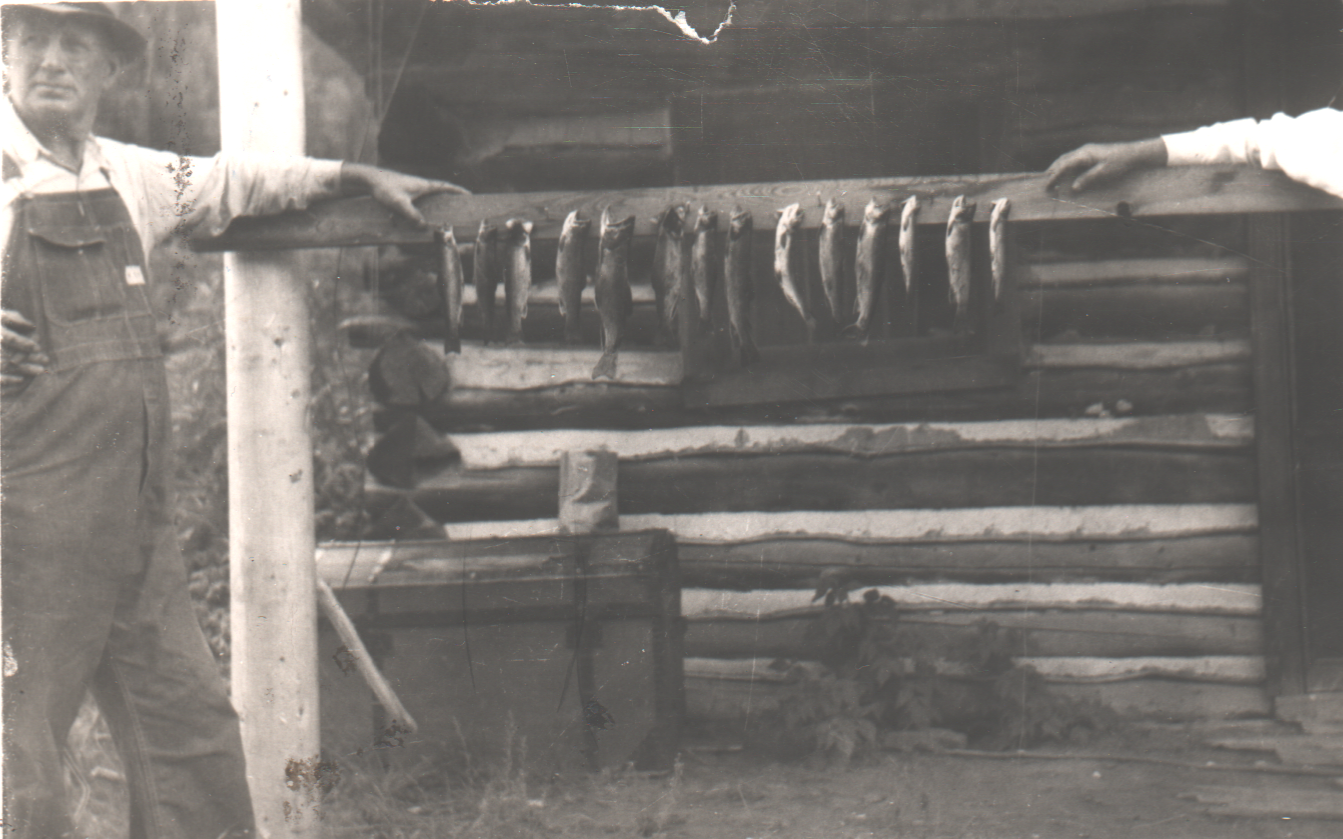
Grandpa Moe Miller (and I imagine the arm of my dad) holding a string of trout in front of the cabin.

Trout fishing was a top activity for us there. Red Mountain Creek was our favorite spot. It had a series of little rapids and pools, and was set in a nice little valley. We also fished the Rio Grande River, and one summer I caught a 14″ trout there. That was the camp record for the year.

Miners Creek tumbles down the face of a mountain near Creed. I kept suggesting that we try fishing there. But dad would say, “Ah, that’s too close to town. It’s all fished out.”

The last time we were in Creed, he agreed to give it a try though. It was three times as steep as Red Mountain Creek, and had a nice series of deep pools. There were plenty of nice trout there. We both caught our limit that day.

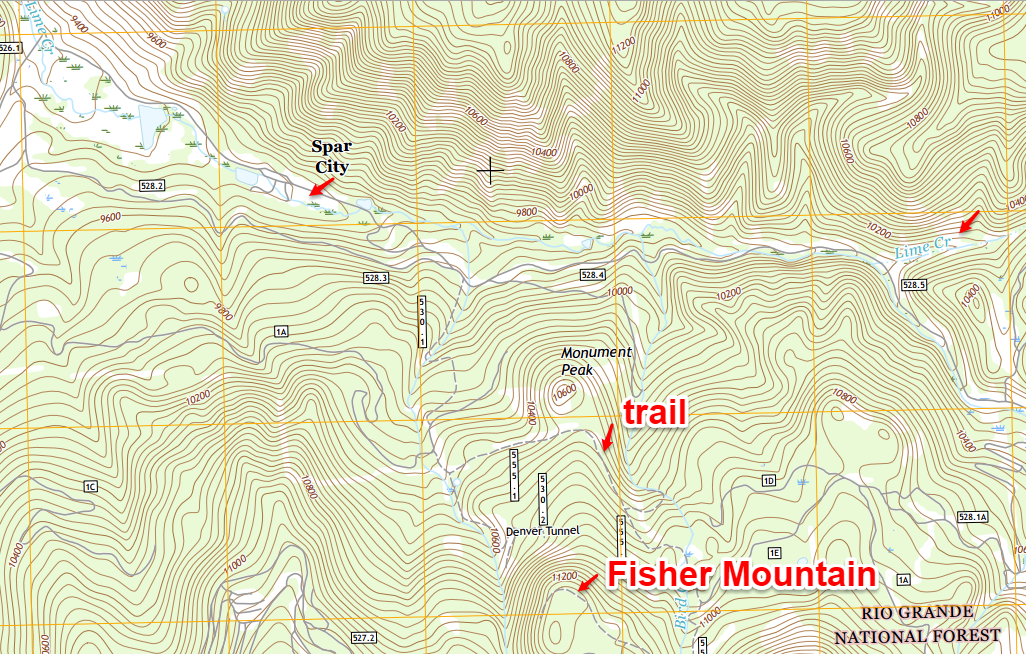
topoPaul and I discovered a topographical map of the area tacked to the wall of the old dance hall in Spar City. It inspired us to climb Fisher Mountain.

We invited Everett Horton β€” the camp caretaker’s son β€” to go with us, and set off with little more than a knife, and lunch in a paper grocery bag. We counted on little creeks for water.

We followed a trail for the first part, stopping to investigate Pete’s mine on the way. A sheep herder came by while we were there. We left the trail when we were close enough to see a route to the top of the mountain. It was easy at first, and then quite steep for 1,000 feet or so. After that it was just a stroll to the top.

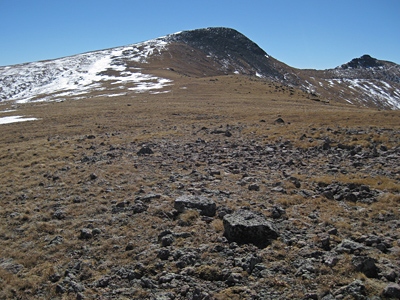
The broad summit of Fisher Mountain. It's easy going at this point.
The broad summit of Fisher Mountain. It’s easy going at this point.

Fisher Mountain is 12,855 feet high, about 3,000 feet higher than Spar City. There is a spectacular view from the top. You see mountains in all directions for 50 to 100 miles. After surveying the scene, we sat down and ate our lunch. A gust of wind (start of a thermal) picked up our empty paper bag. It slowly circled the peak three or four times, and then spiraled up out of sight.

There were many loose rooks lying around on the top, some the size of a volleyball. Naturally, we rolled one off the top to see what would happen. What a surprise. It rolled down of course, but quickly started bouncing off the side of the mountain. It was going at least 200 mph, with one bounce about a quarter of a mile in length. That was so much fun we had to roll a few more of them down, but then decided we’d better quit.

I was captivated by the mountains and all that adventure. Unfortunately, Grandpa Miller decided to sell the cabin after that, so I didn’t get back to the mountains until I was in California.

My first encounter with the mountains there was a trip to Yosemite. It was organized by Charlie Everhart (eventually my best man). Five of us Army buddies rented sleeping bags, and I drove Charlie’s car to Yosemite. What splendid country. Simply too much to take in on a short trip.

We were pretty naive. We decided to swim in the Merced River in the valley. I jumped in at a deep spot and it was so cold I couldn’t breathe. The current quickly swept me down to a bank where I was able to climb out. Then when it came time to camp we learned that we needed a reservation (even back then). No problem, we just drove down the road until we spotted a flat area, rolled out our sleeping bags, and spent the night.

The next day we hiked to the top of Vernal and Nevada falls. That night we returned to San Francisco via Fresno, which was one tenth the size it is now. I knew I’d be back to Yosemite again.

The Whistle

When I started this blog I mentioned that I might recount some pranks from time to time. For some reason, pranks are an integral part of college life. I’ll start with a simple but rewarding one.

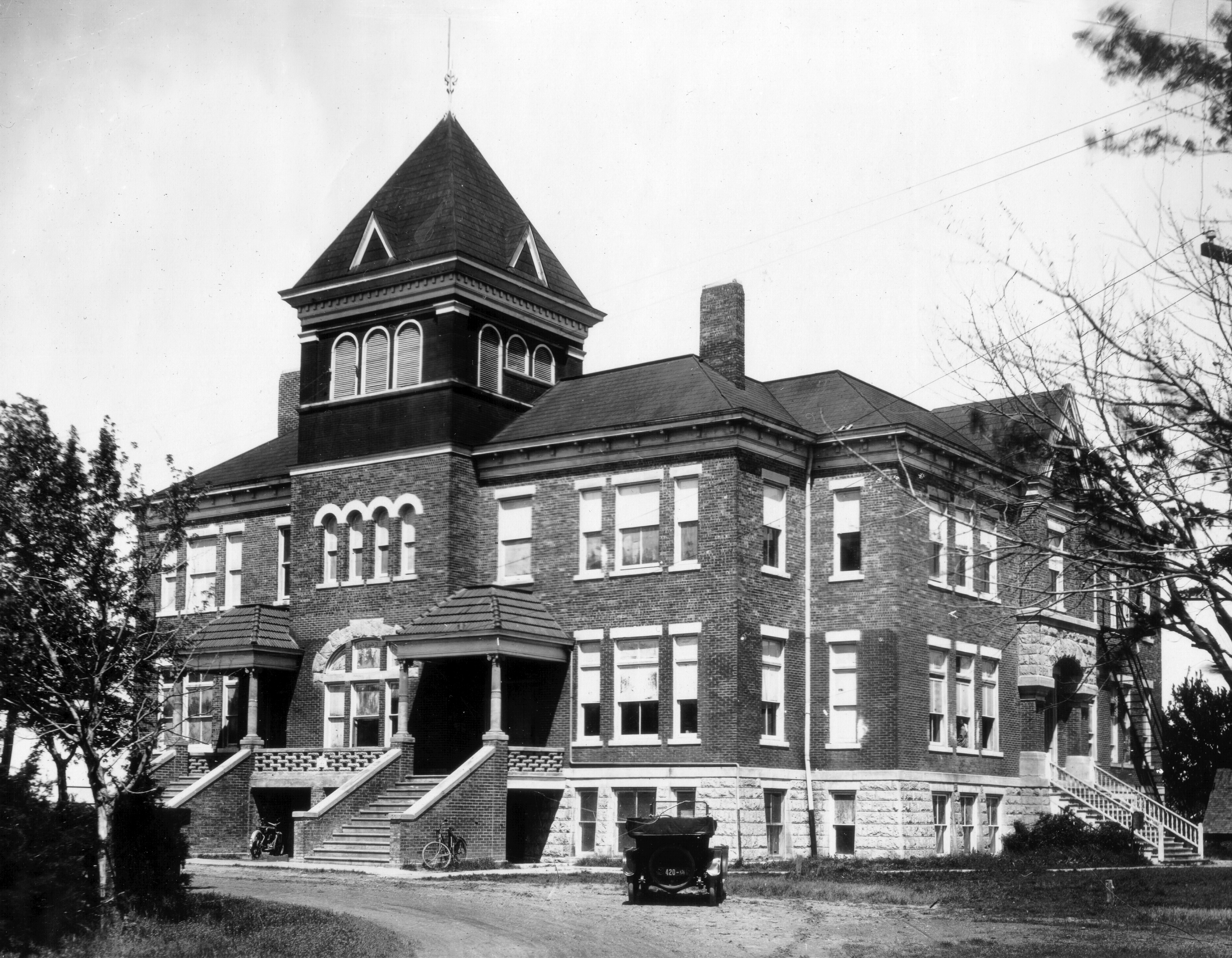
The whistle was located in the steeple-like structure of this legacy building.

The entire McPherson College campus was heated by a central steam plant β€” much like parts of Manhattan Island. It was natural to use a steam whistle to mark important times during the day, noon, for example. (The evening curfew was rumored to be more important in earlier times.)

The head maintenance man for the college naturally viewed the whistle as under his exclusive jurisdiction. And his personality made him the perfect victim.

Access to the whistle was simple. The building was never locked. All you needed to do was climb the last flight of stairs, and pull the whistle’s chain. So one night my buddy and I blew the whistle emphatically right at midnight. Then we flew down the stairs and out a little used door.

Nothing happened, so a few days later we blew the whistle again. This time the maintenance man came to investigate, but we were a little too quick for him.

We knew he was fiercely determined to catch the culprit(s) by now. We figured that he would be much quicker to respond if we blew it again, but we had a diabolical plan.

There was a large, empty packing crate sitting a few feet away from the whistle. Other than that, the room was bare. We decided that it would be the last place he would look for culprits. We carefully checked out the whole building, found that the coast was clear, blew the whistle and calmly walked into the packing crate through a loose side.

Sure enough he came flying up the stairs. He inspected the whistle, and opened aΒ  window to see if we were out on the main roof. We imagined that he scratched his head for a while, and then we heard him go back down the creaky stairs. After waiting an hour or so, we carefully exited the building. I’m sure we had more fun than the the maintenance man.

Radios β€” Dream Realized

Trigger alert: Some content may be hazardous to your mental health.

You may recall I wanted to get into Radar when the Army drafted me. It was the most advanced radio technology that I knew about. But the army sidetracked me with their kind offer to send me to school to learn to be redacted… πŸ˜€ That worked out fine for the short term. The best aspect of my assignment was living in an apartment with a view up on Twin Peaks in San Francisco. The rent was $128 a month, split three ways. We had an allowance to cover food and other expenses like that. (I imagine you’d pay at least $3,500 a month to live there now.)

We had a grand time in San Francisco. To start with, everyone in our special unit was a college graduate. Our work situation was unusual too. We worked 40 hours a week, and the rest of the time was our own. We were enlisted men, but we lived like officers (except on a fraction of the pay). Tough duty.

I was having such a good time that it never occurred to me to move my amateur radio equipment to San Francisco until Marcia and I were married. But I had already decided that I wanted to go back to school to learn electronic engineering.

I went over to UC at Berkley to see about taking the courses I needed to change my vocation from chemistry to electronics. They were amenable at first, but it turned into a Catch 22 situation when we got down to the courses I wanted to take.

I couldn’t take the graduate level courses I needed until I took the prerequisite courses. (I could have done fine without them, but that wasn’t the rules.) But I wouldn’t be able to take the required undergraduate courses because I already had an undergraduate degree.

I probably could have worked something out at KU, but I wasn’t sure, and Marcia and I didn’t want to leave San Francisco. So I decided to get the courses I needed for another major at Heald Engineering College. You may have heard of Heald College during recent kerfuffle about the ATT Tech & Corinthian for-profit schools.

Heald Engineering College, which no longer exists, had a remote connection to Heald (business) College in my day, but student loans had not yet been invented by the government. Anyway, it all worked out well for me, including the Master of Electrical Engineering degree I eventually earned at Stanford.

Marcia and I left San Francisco with our new daughter Nancy after I graduated from Heald Engineering College. We literally had one thin dime between us. We did have a place to stay while I looked for a job though, thanks to “Grandpa” Charlie Clark and “Grandma” Kay (Marcia’s sister Jane’s new in-laws). The economy was in a depression, but I soon landed a job at Hewlett-Packard. Not as an engineer, but as a technician.

I was soon working with microwave test equipment. Microwaves are just very short radio waves, and the instruments we produced were used by the military and AT&T (very, very remotely connected to ATT Tech) to develop and maintain β€” get this β€” Radar and microwave links (for long distance calls). This was before the solid-state era, and those vintage instruments relied on vacuum tubes instead of transistors.

Fortunately (for me), problems in producing that test equipment emerged. HP temporarily moved me to the R & D Lab, and I was able to solve those problems with simple, solid solutions. Soon they asked me if I wanted to be a product development engineer. Boy, did I.

The first development project I worked on was HP’s first all solid-state product. It measured the noise figure of Radar receivers. The team leader, Marco Negrette, had previously worked at AT&T. Transistors had been recently invented there. He had picked up the basic idea there of how to use them. We all learned more together, and soon I was well prepared to move on to newer projects, which would use transistors.

I had my own project team in a year or two. We were developing a higher frequency version of the Wave Analyzer that Barney Oliver had developed. This new one was basically an instrument-grade radio. I was in seventh heaven.

The best thing at HP was an open collaboration culture that Bill and Dave established. I even had occasional opportunities to work with Bill and Dave directly, along with Barney Oliver, a true genius, who was VP of Product Development.

Another couple of dozen engineers of similar caliber were there too. I learned more from them in a few years than most engineers learn in their whole career. (Years later I heard that some of the younger engineers viewed me as a legend too.)

My next project was an opportunity to develop an instrument that drew on virtually all my knowledge. For me, the best thing about it was that I had dreamed of building something like that in my Amateur Radio days. My project engineers were recent college graduates, so I was also their mentor.

The product we developed was the 8552/53 Spectrum Analyzer. That’s just the name for a wave analyzer that extends to microwave frequencies. In the legacy domain, radio waves extend to a few tens of megahertz. AM is 0.5 – 1.5 Mhz, FM is 100 Mhz, and TV is 200 – 400 Mhz. Microwaves fall in the 300 – 300,000 Mhz range. After that comes infra red, light waves and more.

What does it take to make a spectrum analyzer? That’s covered in a dozen or so math and engineering books, but here’s a practical list: A few precision oscillators, mixers and filters, half a dozen amplifiers, a logarithmic network, a precision power supply, a video amplifier, and a bunch of solid-state switches to control the whole thing.

Many of the elements of that spectrum analyzer came from ideas I picked up from engineers at HP. Perhaps my Amateur Radio experience was the most important factor in getting it done in record time.

I know I did a good job because HP produced that spectrum analyzer for 20 years. That is an unprecedented run in the world of electronics. These days they do the job with digital circuits. (Mine used analog and radio-frequency circuits).

That spectrum analyzer required a little over 100 transistors. The digital approach requires billions of transistors. I’d have had to start all over again to learn how to do it the digital way, but that was a long way off.