El Toro Class — Part One

An urge to build a boat of my own sprang from a picnic for McPherson College juniors. A classmate brought a small hydroplane that he had built. He let several of us take it out for a run. It only had a 10 horsepower motor, but it skimmed over the water at maybe 15 knots. I toyed with the idea of building one, but I had few funds and no motor.

I was in the Army soon after that, and then engineering school. A severe recession had set in by the time I graduated. I did find a job, but it barely paid our living expenses.

Boats probably never entered my mind in those busy, lean years. But like flying, it was another of the things I told Marcia I was going to do when I grew up.

An opportunity to show I had the skills to advance to better job came along a while later. It was a temporary project to solve some problems that HP had with their microwave products. By coincidence, I had been reading up on microwave engineering. Must have been serendipity.

I solved those problems, and soon was working full time in HP’s development lab. About twenty engineers there were in a sailing club, and that intrigued me. However, the boats they raced were expensive, ungainly, and easy to capsize. Somehow I knew better than to get sucked into that attraction.
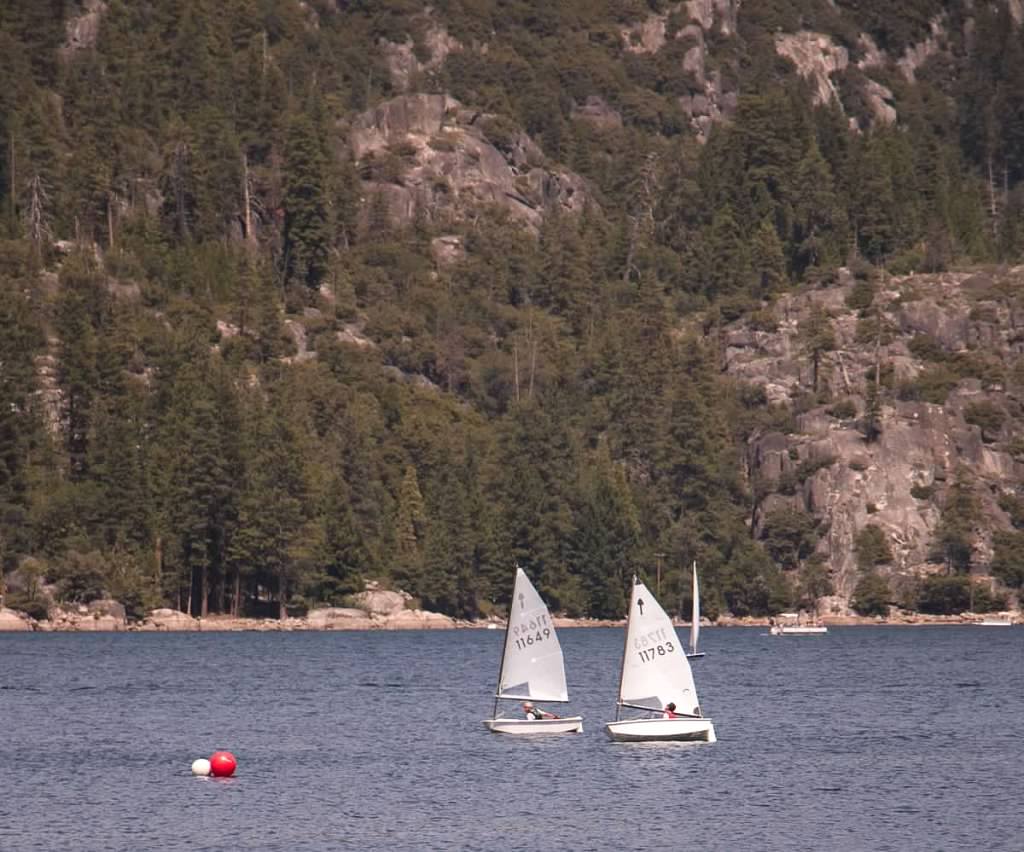
worlds2Several sailing club members grew tired of those clunker boats, and a year or so later decided to start a new sailing club. They chose the El Toro as the club boat. El Toros are a simple dinghy, and the El Toro racing class was the largest in the world. The club organizers knew that in racing, the size and speed of the boat are not where the fun comes from. Racing is where the fun is.

The organizers negotiated a group discount for new El Toros. If we could line up orders for a dozen, they would cost $450. We had more than a dozen takers, and soon I was a new El Toro owner. It was built of fiberglass instead of traditional wood. It was light enough to carry by yourself, and maintenance was zero. It also had air-tight flotation compartments. You could get back in and bail it out if you capsized.

Now all I needed to do was learn how to sail it. Dave Gildea, one of my friends, said he could teach me in an hour or so. The El Toro has only one sail. It’s easy to rig, and it’s easy to handle. Dave brought his boat to show me how to sail, and I followed along in mine. I was soon sailing on my own. Racing is another matter altogether, though.

Because of the tides, our races alternated between Steven’s Creek Reservoir and two spots along San Francisco Bay. We knew them as bullship races (get it?). I think my first race was at Steven’s Creek. I imagine that I finished close to last, even though I put in quite a bit of practice beforehand. In any case, I’m sure we went for pizza and beer, probably at Round Table.

Boat Building

As with most of my threads, this one on sailing will be roughly chronological. I think most young people are intrigued by boats. It’s only natural. They offer the challenge of a new and different domain. Of course I, being me, found them compelling.

I learned about boats when my dad built a rowboat. He got the blueprints (copies of drawings) for a rowboat from somewhere like Popular Mechanics. Before he started building it though, he designed and built a big table saw and a workbench for woodworking. Remember, we were emerging from The Great Depression. You didn’t spend cash for something you could make yourself.

The first step in building his boat was building a mould, which is an assembly jig that looks a bit like an upside down skeleton of the boat. Nice boats have compound curves, so you need something to form the hull around. Building the boat itself could now begin.

You need good material to make a good boat. Dad’s boat had a plywood hull, so he needed marine plywood. The transom, which was also going to support an outboard motor needed to be sturdy. He bought a one-piece slab of mahogany for the transom. It was about two feet wide, four feet long, and nearly two inches thick. He assembled the boat using an assortment of brass screws and special waterproof glue. It was a classic beauty, painted battleship gray.

The boat was all about fishing though. Sometimes we just rowed it a short distance offshore to get to where the fish were. We used his fishing buddy’s outboard motor if we wanted to go up and down a river, or to a good spot on a larger body of water. All this was fun, but it was not “messing around with boats.” That’s what I wanted to do.

At various times I considered building a canoe, a small hydroplane, and a sailboat. I didn’t have time (I had other interests to pursue), nor funds for those projects though. But I was primed for a little serendipity (next post).

Aerobatic Lesson Three

This will be my last post about aviation for a while. I want to shift to sailing. Think of sailing as two dimensional flying. We’ll get back to three dimensions after a while.

The owner of the “2-hole” (two-place) Pitts had not arrived when I got to Henley for my third aerobatics lesson. While Steve and I waited in the diner, I told him about an article in EAA Sport Aviation by Gene Beggs. Gene had devised, and extensively tested a simple method for recovering from spins.

Here’s the method: 1) Take your hands off the controls. 2) Stop the rotation (spinning) using the rudder only (push on the rudder pedal that is out the furthest if you don’t know which way the plane is spinning). 3) Recover smoothly from the ensuing dive.

Much simpler and more reliable than the conventional method.

Steve said, “Yes, let’s try that. I was down in Texas last week advising Gene about rebuilding Stearman wings, and he told me about his method.” Steve does get around in sport aviation circles.

When the S2-A Pitts owner arrived, he was flying a brand new S2-B. He told us he had sold the S2-A, but that it was in a hanger at Henley. The paperwork hadn’t gone through yet, so we could still fly it.

Steve and I went around the corner to the hanger and rolled the door open. There was no airplane in there. Did someone steal it? Back we went to the diner to report its absence. The owner figured the buyer took it for a spin, and offered to loan us his brand new, $90,000 S2-B for my session ($175,000 for one today). I think Steve was as excited as I was.

The S2-B has a six-cylinder engine, while the S2-A has only four. That’s 50% more power, with little increase in weight. We took off and circled around to go to our practice area. On the way Steve told me to do a loop so we could “see how this thing performs.”

I spotted another plane below us as we entered the downside of the loop. Someone had been following us, probably to see what we were going to do. I finished the loop and flew past the interloper at 185 knots (210 mph). We continued on our way, and never saw him again.

After practicing some maneuvers and trying Gene Beggs spin recoveries, Steve asked me what I wanted to do before we went back. I said I wanted to try an inverted spin. He asked me if I knew how to do that. I told him I thought so, rolled the Pitts inverted, pushed the nose up, waited for the airspeed to drop off, shoved the stick all the way forward, and kicked one rudder pedal.

The next thing I heard was, “Phil, hold it right there! Don’t move a muscle! When we get back down, we can tell everyone we survived an inverted flat spin in a Pitts Special!” At first I thought we were in trouble, but Steve told me to keep the stick forward, and watch. The Pitts continued to spin in an increasingly elliptical path. Then the flat spin converted to a conventional inverted spin. All that was left was to use Gene Beggs’ recovery method.

Steve got excited because there is a persistent myth that you can’t recover from an inverted flat spin in a Pitts. That’s what killed Wayne Norton. The difference was, we had a few thousand feet for recovery.

After landing we went back to the diner, and Steve regaled the audience with our tale of heroic survival. That ended the last lesson I had with Steve. I wasn’t polished, but I was confident I could now do aerobatics safely. I’ll take up the next phase of my flying adventures after some sailing stories.

Aerobatic Lesson Two

A week or two later I had another lesson with Steve lined up. I was eager to learn new things, and I knew it would be fun all over again. It turned out to be more fun than I anticipated.

When Steve showed up, he told me he had an ulterior motive. There was a radio-controlled model airplane contest at a nearby park that day. He had promised to fly a routine for them. Steve asked, “Would you mind if we do that first?”

Would I mind? I knew this would be a special treat. Steve flew most airshows “on the deck,” which means low-level aerobatics. We would be flying at 500 feet AGL, because he had not arranged an FAA waver for the performance. But it would still be exciting.

A good professional routine is a fluid sequence of aerobatic figures. There are few or no gaps in the action. Now I was getting a pilot’s-eye view of the routine I’d seen before from the ground. Most airshow routines take ten minutes or so. Steve narrated the routine as we went, which helped me keep track of what was happening.

Time seemed to fly by (no pun) and we were done. Then I flew the Pitts to our usual practice area. I flew the figures from the first lesson when we got there, and then we added spins (vertical) and snap rolls (horizontal spins).

Those last two figures were a bit disorienting. I was glad there was someone behind me in case I lost the bubble. That didn’t happen, but I would have been too tense to enjoy those figures without Steve behind me.  [Aerobatic Figures: https://www.iac.org/legacy/aerobatic-figures]

A video of Steve giving “Gail” a demonstration ride. Gives you a feel for aerobatic figures viewed from the cockpit, and what it’s like to fly with Steve. [YouTube: https://www.youtube.com/watch?v=aT6bioMTN5s

After we landed we went to the diner to have lunch, and do some hanger flying. Steve told me about his trip to teach precision aerobatics for the pilots in the Royal Jordanian Air force.

Some time before 1975 Steve and Dave Rahm joined up as an aerobatics team. I think Steve was as impressed with Dave as I was with Steve. The King of Jordan had seen Dave fly, and invited him to come to Jordan to fly there. Later on, the King asked Dave and Steve to come teach aerobatics for his air force pilots.

They crated up twelve new Pitts Specials, and put them on a ship bound for Jordan. After the planes arrived, they reassembled them and began instructing. Near the end of the training, one of the pilots wanted to see what low-level aerobatics looked like from the cockpit.

Everything was going well until they started a Cuban 8. On the way down in the first loop, the elevator would not travel far enough for them to finish it before they hit the runway. Using his usual quick thinking, Steve rolled the Pitts inverted and “pushed” instead of “pulled” it around the loop. Later they found that a screw had jammed in the elevator horn (where the control cables attach).

Steve knew where the screw came from. Before the flight they dropped a screw in the cockpit while replacing a fairing (aerodynamic trim piece). They had searched and searched but could not find it. The screw worked its way through the tail cone to the elevator horn during the flight, and got stuck in some soft paint there. Murphy’s law at work.

The King had arranged an airshow for the next day. Dave Rahm was flying some of his more extreme aerobatics when he crashed and burned. Steve said he didn’t know why, but Dave had done the one thing he had warned Steve never to do in a Pitts. I don’t know what that was, but it must have been a figure that needed a bit more kenetic enerty or altitude than he had. Murphy’s law again. [Article: Spokane Daily Chronicle]