Henley Aerodrome — Taildraggers

Taildraggers separate the men from the boys. Most airplanes handle more or less the same in the air, taildraggers included. And these days most of them have tricycle landing gear (nose wheel and two main wheels). That’s for a reason. Tricycle gear makes it much easier to handle airplanes on the ground. Taildraggers have a tail wheel instead of a nose wheel though. They fly better, but you can lose control of them on the ground.

The center of gravity (center of mass) for tricycle-gear airplanes is in front of the main gear. If the airplane begins to turn on the ground, a restoring force develops, which tends to straighten out the airplane.

The center of gravity for a taildragger is behind the main gear (it would flop on its nose otherwise). That location of the center of gravity makes it directionally unstable though. Taildraggers do not have a restoring force on the ground. It is a diversionary force instead.

When a taildragger begins an autonomus turn on the ground, the pilot must counter it immediately. Otherwise, the turning force will quickly become too strong for the pilot to correct. The plane will execute a vicious spiral, called a ground loop.

Handling a taildragger on the ground is similar to the challenge of controlling an automobile if you back it up at 15 miles per hour or more. You must have a feel for it, or things will quickly turn out badly. It’s part of “flying by the seat of your pants.”
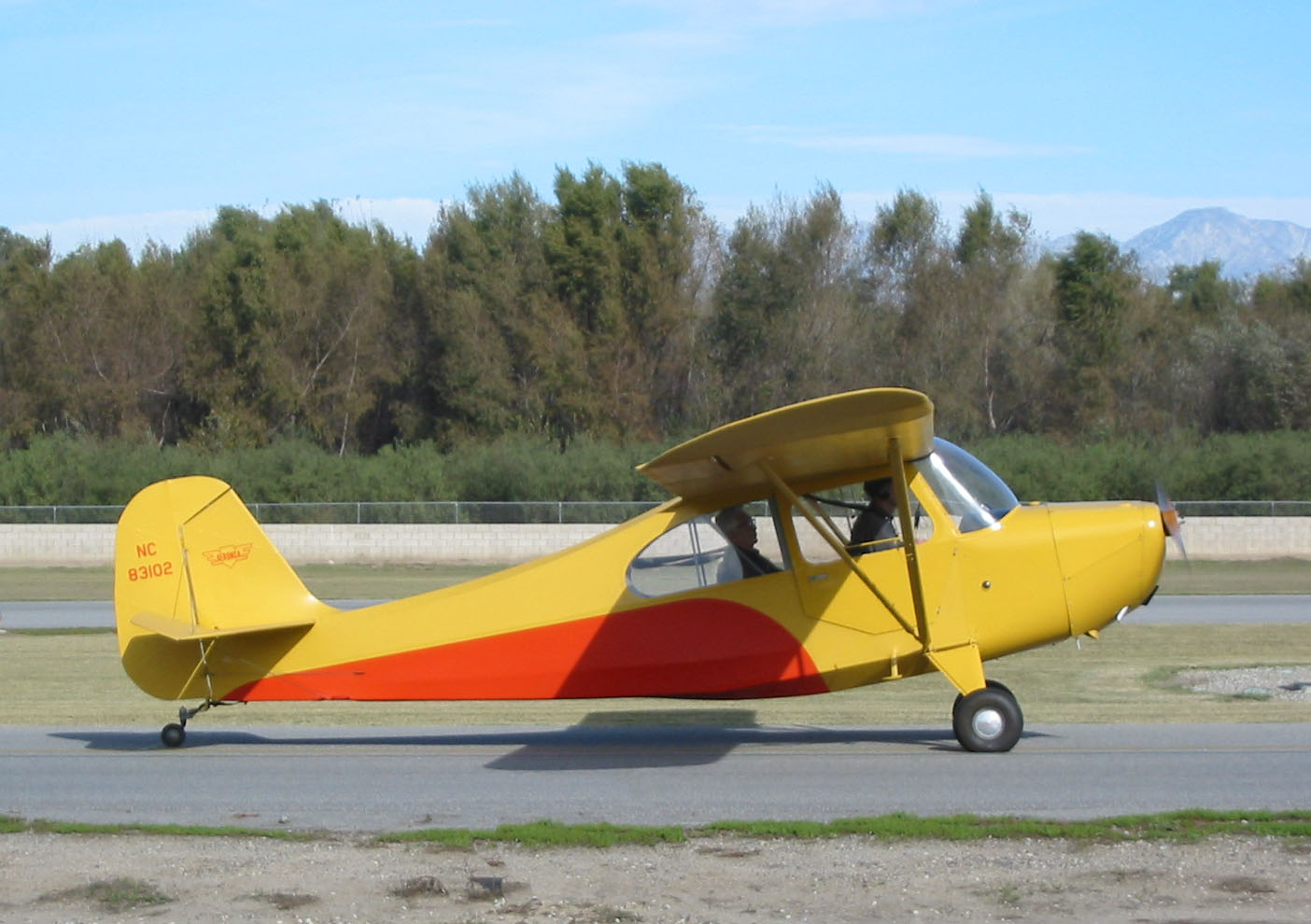
An Aeronca Champ: a classic, but still one of the sweetest airplanes to fly.airplane
Aeronca Champ: a classic taildragger. Still one of the sweetest airplanes to fly. Ever.

Gladys Buroker [video profile], a legendary flight instructor, lived in a house beside the Henley runway. She gave flight lessons in the Aeronca Champ that was available at Henley. I had begun to think about aerobatic flying, and almost all aerobatic airplanes are taildraggers. It wasn’t long before I decided to add taildraggers to my pilot ratings.

As I recall, I only needed three of four flight lessons before Gladys signed me off (a logbook endorsement) as qualified for taildraggers. Gliders only have one main gear wheel, so they are taildraggers too. Between gliders and the Champ, I acquired a seat-of-the-pants feel for ground handling fairly rapidly.

Old pilots say, “It’s not a question of if. It’s a question of when you will experience a ground loop.” A ground loop can result in dragging a wingtip on the ground. Stearman biplanes are noted for ground loops. The advice to military cadets was to always check the bottom side of the wingtips before you got in a Stearman. “You don’t want to land nicely, only to be held responsible for some other poor devil’s previous indiscretion.”

I have to admit, I’ve experienced two ground loops. The first was caused by turning off the runway too quickly. An unstoppable ground loop emerged. No problem, just a screeching of tires. My other ground loop was one of those events called “gaining experience.” In this case, I was landing in a very strong crosswind at Felts Field.

I handled the crosswind landing expertly and was rolling out nicely. I was going fairly slow when all of a sudden my airplane entered a rapid ground loop. Around I went,  ending up headed directly for a blue runway marker light. I had regained some control and managed to just miss it with the propeller. Then I had to turn the other way to avoid hitting the light with the belly of my airplane.

I just sat there in the grass after I got my airplane stopped. The controller in the tower didn’t say a word. I regained a little composure, and radioed, “Permission to taxi to parking, N68553,” (my tail number). The reply from the tower was business like and crisp, “553, taxi to parking.” I had narrowly missed becoming a member of the “Blue-light Club” (hitting a taxiway light).

II sat there in the grass I figured out what had happened. I had fallen into a trap. The crosswind was largely blocked by hangers down at ground lever. It wasn’t bad landing at all. But there was a gap between those hangers. The crosswind was even stronger at each gap that it was aloft. I now know how I would have handled it if I had known, but that’s called gaining “flying experience”.

Radios — Part Five

A chance meeting with the radio maintenance man at McPherson Power and Light lead to a new dimension in amateur radio for me. I don’t remember how the visit came about, but while I was there I learned that he was a radio amateur. I had never met one before or even thought about how to find one. I didn’t know what I was missing.

My new friend's ham rig look somewhat like this one.
My new friend’s ham rig look somewhat like this one.

He-whose-name-I-can’t-remember invited me to come over to his house to see his rig, and talk about radio. He had a nice station — upscale receiver, high-power transmitter, good auxiliary equipment — much like the one in the picture. He also had a mobile amateur rig in his car. I spent many evenings there, messing about with ham radio. He also took me over to meet another ham who had an even more powerful transmitter down in his basement “ham shack” (man cave).

I told my new friend about losing the radio repair job, and he told me about a possible opportunity at the Crabb Brothers store. They sold farm equipment but had set up a TV sales department. They hired Carl Holloway to do their service. Carl had just returned from TV service school and was relying on my friend to help him get started.

My friend had several TVs to work on with Carl so we went over that night. My friend had set one aside because he had been unable to find the problem. While he and Carl worked on the other TVs, I tackled that peculiar one.

It didn’t take me long to figure out the general nature of the problem, but it wasn’t obvious where it was located. I asked Carl if he had a vacuum-tube (highly sensitive) voltmeter. He had one. He built it during his TV school work (it was very nice too). Carl had it in its case under the workbench. I couldn’t believe he wasn’t using it, but it was just what I needed to pin down the problem.

After I fixed that TV and a couple others my friend told Carl he should hire me. Carl had been the friendly butcher at the Safeway store. Now he was trying to enter the emerging TV business. But he sorely lacked practical experience. Carl agreed to give me a try.

Carl and I made a great team. I came in afternoons, and Carl went out installing TV antennas. That work was bringing in more money for him than TV repairs did. He also fixed TVs in the mornings but left the puzzling ones for me.

When Carl came back from installing antennas I explained the TV problems and how I fixed them. I understood TVs because my previous radio experience helped me fully absorb the self-taught TV course that Leon Matson had loaned me. I was surprised myself by how well prepared I was.

The repair shop was tucked into a former display window at the Crabb Brothers store. We were certainly on display, but we had our own door. Customers always asked for Carl when they came in. They knew and liked him from his Safeway days. I don’t know where they thought he was hiding.

One day a woman came in and demanded to see Carl. She wanted to get the dial on her table-top radio fixed (we fixed those too). She reluctantly left it with me since Carl wasn’t there. When I went to fix it I could not see any way the dial string could have ever been routed in the first place. I bent some metal out of the way and installed a new one doing it my way. It worked just fine.

The woman came in the next day and picked it up. I charged her $3 and put the jury-rigged fix out of my mind. A couple of days later she came back, mad as a stepped-on rattlesnake. She told me I hadn’t fixed it at all, and demanded to know what I was going to do about it. I told her I was sorry for her grief (not in those words) and promised I’d talk it over with Carl. When he got back I explained the customer’s complaint and told him I couldn’t see any way the replacement string could have broken.

Carl looked at it for a while and then asked if I had ever seen a string break in three pieces. I realized the impossibility of that and told him no. After pondering some more he said, “I know what happened. She has a screen porch full of birds. There is birdseed scattered all over the place. So she has mice too. One of them must have wanted some string for a nest.”

I replaced the dial string again, and he took the radio to her house (no charge). He also explained that she needed to do something about her mice. We never saw her again.


SONY DSC
Flyback sweep circuit. Notice the high voltage arc.


The flyback sweep circuit is perhaps the quirkiest part of those old picture tube TVs. The parts in them were highly stressed and often failed. You need to understand magnetic fields, high voltages (15,000 volts), a novel voltage boost circuit, etc., to sort out the problems they had.

I understood those flyback sweep circuits because Leon’s course described them clearly. And I had the right background to absorb how they worked. The flyback sweep circuit was invented by the very same Barny Oliver that I mentioned in a later post.

That was my senior year. I was far enough ahead on credits that I only needed to take 12 instead of the usual 15 – 16-hour course load. That gave me plenty of time to enjoy myself even though I had that half-time job. I was still active in amateur radio too. I even had some time for social life. I was going into the Army after graduation, so I also joined the National Guard to get a leg up on military service. That particular gambit paid off nicely in the long run.

I wanted to get into Radar school after basic training. Radar was one of the pinnacles of electronics technology in those days. It was mega-radio. I didn’t make it though. The Army made me an offer I couldn’t refuse. I could tell you what I did do in the Army, but then I’d have to kill you. 😉 I can tell you that Army service interrupted my electronics quest. I’ll be back later with more electronics stories.

Radios — Part Four

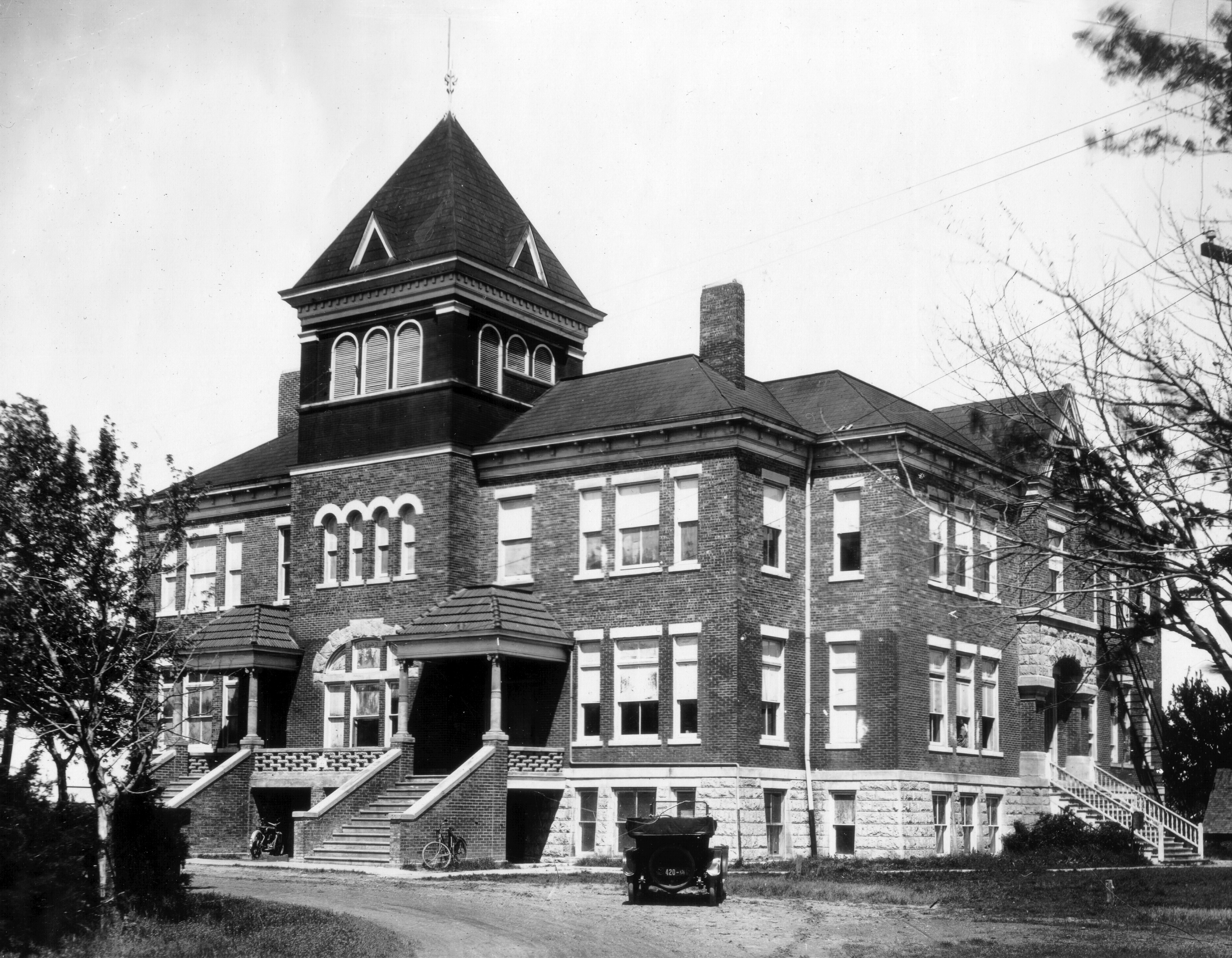
One of the original buildings at McPherson College. It's possible that's my dad's car.
One of the original buildings at McPherson College. It was still there when I attended. It’s possible that’s my dad’s car when he attended.

Now that I had my license, I could “go on the air.” I was living in the dorm when I received my license. I had a nice antenna at home on the farm, but now I needed to put one up on campus. FCC regulations require you to get  permission to install and operate your transmitter from the property owner. I reviewed the benefits for society from Amateur Radio, screwed up my courage, and asked to see the President of the college. Somehow I mustered the right protocol and tone, presented my case, and got permission to install an antenna and operate my amateur station.

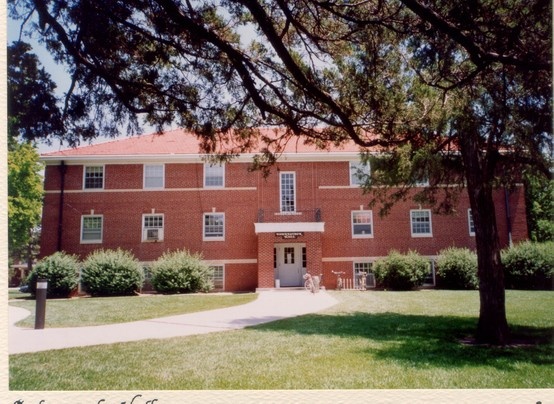
The men's dorm: Our room was the second on to the left of entrance on the top floor.
The men’s dorm: Our room was the first to the left of the entrance, on the top floor.

Dorm rooms aren’t large, and my roommate already had a complete photography darkroom in our room. We converted the beds to bunk beds, which made room for my radio gear. I had been listening to hams (amateurs) making contact and conversing, so I knew what I should do when I “got on the air” the first time. I don’t remember anything about my first contact, but if I had my old log book I could tell you. I spent quite a bit of time at first seeing how many contacts I could make, and trying to add some long-distance contacts.

Operating my station was a nice diversion, but I was more interested in improving my equipment than making contacts. I needed some test and measurement gear to make progress, so I started building it. I had already built a voltmeter because you can’t do much radio work without one. I needed a way to measure and adjust the efficiency of my antenna, and a way to measure frequency accurately. I also wanted an oscilloscope, so that I could “see” waveforms at various points in my “rig” (amateur station). I built the first items on the list in a few months, but I had to scrounge parts for a year or so before I could build the oscilloscope.

Keep in mind that I was taking a full course load at the same time. Everybody needs some diversion though. My all consuming interest in radio gave me the energy I needed to indulge my hobby and do course work too. The Korean War was on during this time. In order to avoid the draft, you had to make good grades in school. I managed to get excellent grades, with a couple of exceptions, and made it all the way to graduation (cum laude) three years later.

My General Class license only permitted CW (continuous wave) operation. CW is another term for Morse Code communication. You had to have a year of experience before you could get an Amateur Extra Class license, which allowed voice communication. I started to design and build the required “audio modulator” while I waited for the year to pass.

I chose “plate modulation” mode to add voice capability. A plate modulator is a high power audio amplifier that is connected in series with your DC power supply. That was another fun project. It involved big audio transformers, high power tubes, and three stages of audio amplification. I found the parts at bargain prices. It worked as expected the first time I turned it on.

One of my friends had a part time job at Matson Radio, a local repair shop. He was graduating, so I approached Leon, the owner, about picking up the job the next year. He said we could give it a try, so I started the next fall. I could tell Leon was dubious about my value to the business, but serendipity stepped in again.

Leon had an old pickup for the business, but it had a broken starter. I offered to take a look at it, and deduced that it had a broken “Bendix Drive” ($2 coupling spring). I told him if he picked up a new one at the Ford garage I could install it using my tools. It was fixed that afternoon. I don’t know what being a good mechanic had to do with radios, but he kept me on for the rest of the year.

In nosing around the shop, I discovered Leon had a complete course on TV repair. It was in a big binder about 4″ thick. He wasn’t using it, so I asked to borrow it over the summer. I enjoyed working my way through the course that summer. When I came back in the fall, Leon had gone out of business and was working for someone else. There went my income for amateur radio projects. It wasn’t long before another opportunity opened up though. I’ll get to that in the next post, which will wrap up my career stories until after I’ve told some war stories.

Radios — Part Three

Rhetorically speaking, “Where is this “Radio” thread going?” My earlier experiences with radios gave me the background and confidence I needed to take on more ambitious challenges. Amateur Radio was the next and most import phase of following this passion.

I’m planning two or three more posts about these radio experiences. They will take us up to the point where the US Army entered the picture. I’ll pick it up later with stories about how the boyhood dream that stemmed from my interest in radio came true. And now, back to our regular programming.

***************************************************

My passion resembled this:

“There is nothing — absolutely nothing — half so much worth doing as simply messing about in boats.” —From The Wind in the Willows, by Kenneth Grahame

Amateur Radio

Amateur Radio gave me a solid grasp of the practical aspects of electromagnetics and electronics. I gained insight from it that helped me penetrate the complex, abstract nature of electronic systems. Amateur Radio gave me a big advantage when it came to engineering studies, practical knowledge, and problem-solving. Problem-solving was particularly important, as I’ll relate in future posts.

Having my own copy of 1947 ARRL Radio Amateur’s Handbook opened up a new world of simply messing about with radios. My limited budget was fortuitous, but I didn’t look at it that way at the time. I would need to build, not buy all the gear that I needed. I learned a great deal more by building my equipment than I would have if I had bought it.

My regenerative receiver was good enough for two-way communication. I needed a transmitter though. And I needed to learn Morse code to qualify for an Amateur Radio Operator’s license. I also wanted to get an electric soldering iron. Heating a 4-pound plumber’s soldering iron on the kitchen stove worked well enough for the limited amount of soldering I had done up to then. It would not do for what I was planning to build next.

I found a place to rent a code machine that I could learn Morse code with. It cost something like $3, plus $1 per month after the first month. I was telling dad about my plans, and he said if I learned Morse code, he would buy me an electric soldering iron. I took me two or three months to get good enough with Morse code that I could return the machine. After that, I used my little receiver to listen to code practice from W1AW, the ARRL station.

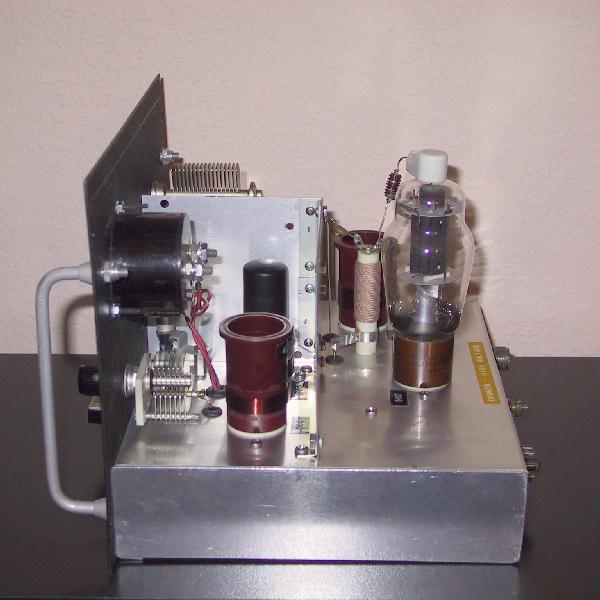
My transmitter looked somewhat like this one I found on the internet.

Meanwhile, I poured over the handbook, learning about what was important and deciding which design to select for my transmitter. I didn’t have my license yet, but that didn’t mean I couldn’t begin building my transmitter. I would test it by connecting it to a light bulb to absorb the output power. After I got my license, I could connect it to my antenna.

I selected a 25-watt design that used a classic Type 807 tetrode. The maximum allowed for Amateurs is 1,000 watts, but 25 watts is plenty for contacts anywhere around the world. The transmitter required a 300 volt DC power supply. That voltage puts you in danger of electrocution, so safety precautions are essential.

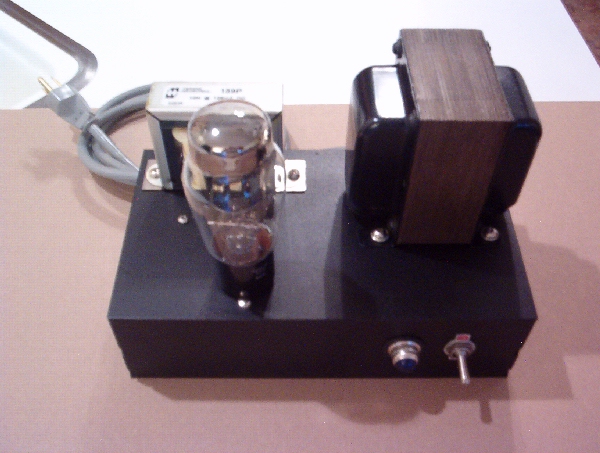
My power supply probably had two rectifier tubes.

I needed parts for the power supply and the transmitter before beginning my project. Since it was shortly after World War II, many parts that would have been beyond my budget — 807s, large capacitors, power transformers — were available as war surplus at a fraction of the cost. Some of the other parts I made myself. I had a little income from odd jobs, etc. so I acquired the parts over a few months. It took a year or so for me to complete the build phase.

Now I needed my license. There was a written test, and a Morse code test. I had a good handle on the technical questions, and I had studied the regulations, which are extensive and detailed. I was getting good enough (fast enough) with Morse code that I thought I could pass that test.

It’s not like a driver’s license though. The tests are only given periodically and in just a few locations. By this time I was a sophomore at McPherson College. I drove down to Wichita, Kansas for the test. I aced the written test, but I thought I had failed the Morse code test for one error too-many. To my surprise, I passed the code test too. Maybe the examiner cut me a little slack because I did so well on the written. At any rate, I now had my “General Class” license.

Related links