Balsa Wood Aeronauts

Airplanes are a prime example of things that intrigue me.  I wanted to experience flying, understand how airplanes work, and learn to fly them as long as I can remember. Model airplanes were much more accessible for a farm boy than the real thing though. This story relates the first phase of my interest in airplanes. I had no idea at the time, but Kansas was the light plane capitol of the world then.

***************************************************
hnas
Biplanes at Hutchinson Naval Airbase

I had virtually no contact with real airplanes until World War II began, other than what I heard in radio programs and read in magazines. After the war started airplanes were always in the news, and in the skies over our farm. The Navy had a primary training base 20 miles south of us. The Army Air Corps had a bomber training base 50 miles NE of us. Serendipity.
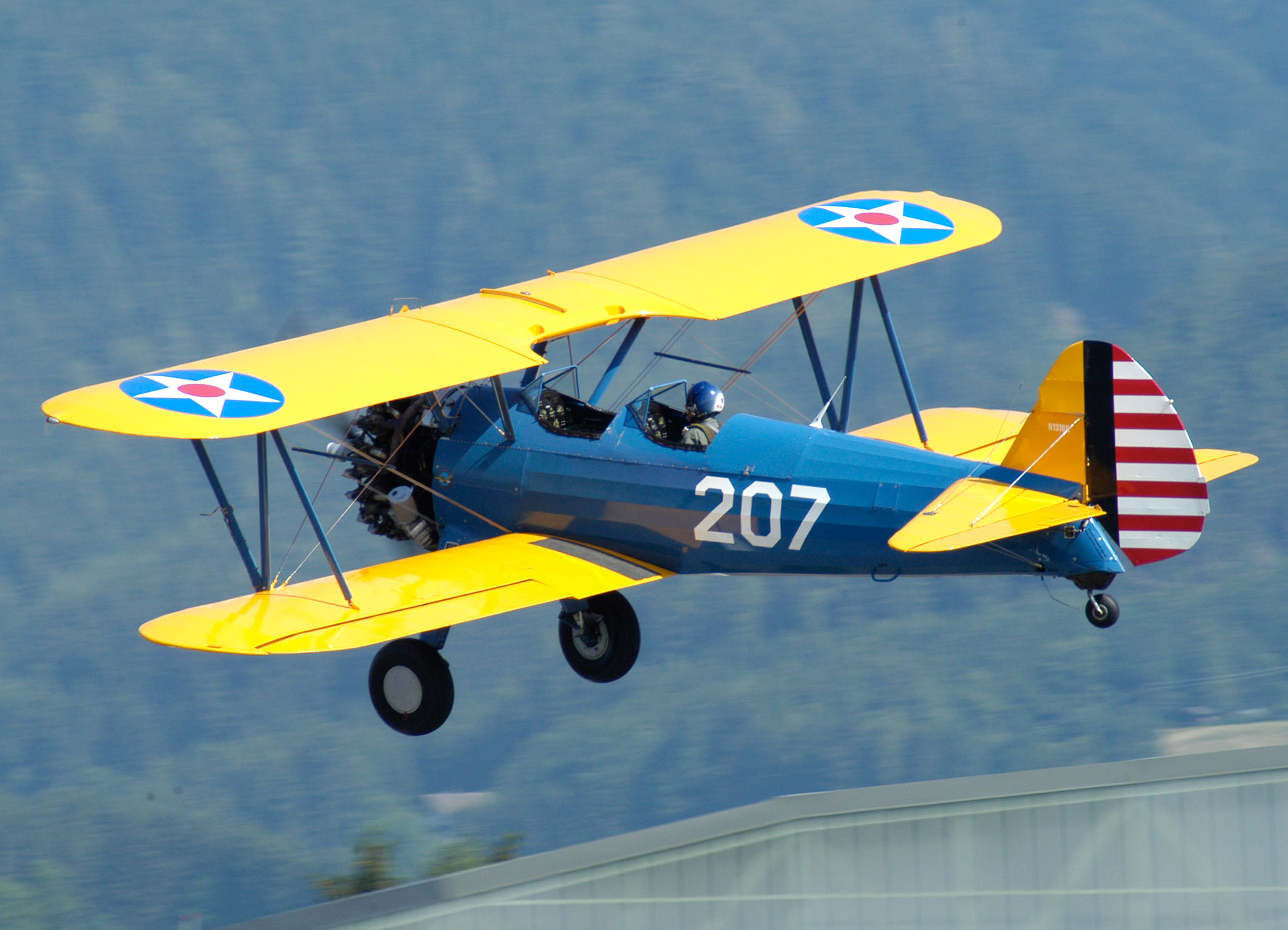
We saw Naval cadets flying their Stearman biplanes over our farm many times. Sometimes a formation of B-17 or B-29 bombers flew over. One day scores of formations were in the sky. One after another flew by for two or three hours.

I was totally intrigued by all those planes. One time a Navy cadet flew low over our place. We ran out of the house and waved wildly. He kept coming back to fly over us, and we kept waving.

The next thing was a complete surprise. He flew across the wheat stubble field on the other side of the road at about 50 feet. We ran over there of course.  He flew over the field a few more times. We thought he might land, and he did. Then he taxied right up to where we were.

The Stearman became my permanent favorite airplane right then. I never forgot how splendid that big yellow biplane looked. The pilot got out of the cockpit, stood on the lower wing walkway, and adjusted the straps on his parachute harness. Then he came over to talk to us. He said he was getting a cramp in his leg, but admitted that was a ruse in case they asked why he landed out there. After a few minutes, he took off, flew back over us waving his wings, and left. After the war, you could buy a Stearman for $500. You’d pay $250,000 for a nice one today.
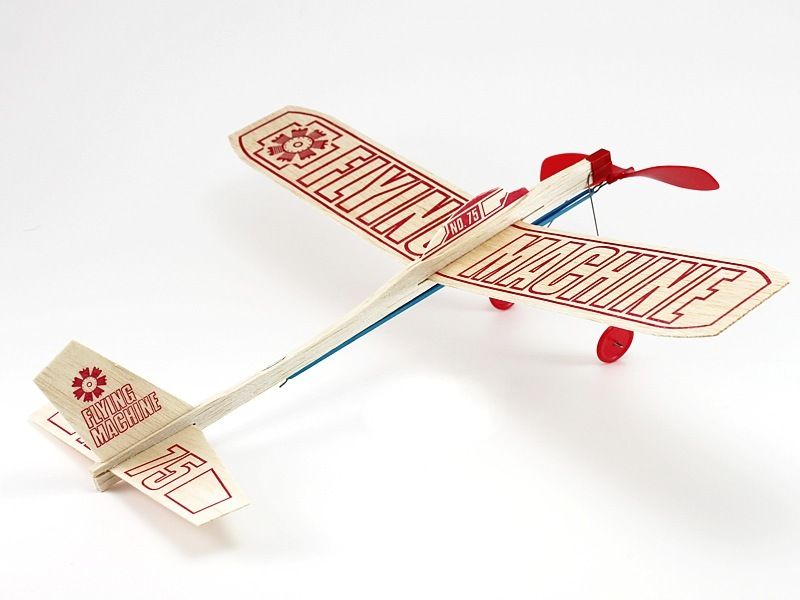
rubber-bandMy brother Paul and I built non-flying models of various military aircraft soon after the war started. Then, much like the Wrights, we began to build gliders that did fly. Just a slab of balsa wood for the fuselage, and another tapered piece for wings. Later on, we added rubber bands for power. I hand carved the propellers out of white pine.
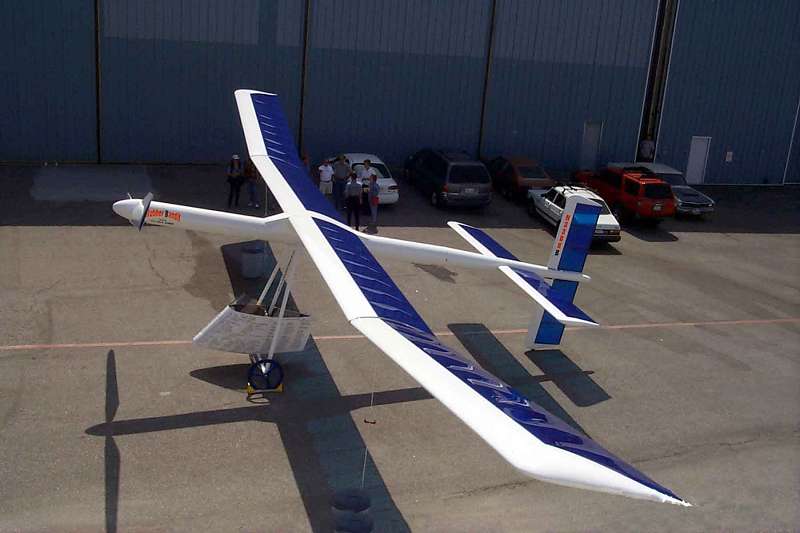
rubber-bandit

The “Rubber Bandit” is an interesting throwback. It was a full-size airplane powered by rubber bands. I’m sure it could have flown, but the builder ran into personal difficulties that interfered his preparations to fly it.

The next step for us was more realistic models, built up much like real airplanes were. We assembled small pieces of balsa using “model airplane glue” to make the wings and fuselages. We covered the airframes with a tough material called “silk span”. The last step was “doping” the model (using a sort of lacquer) to tighten the silkspan by shrinking it. It came in colors so we devised our own color themes. Rubber bands still provided the power.
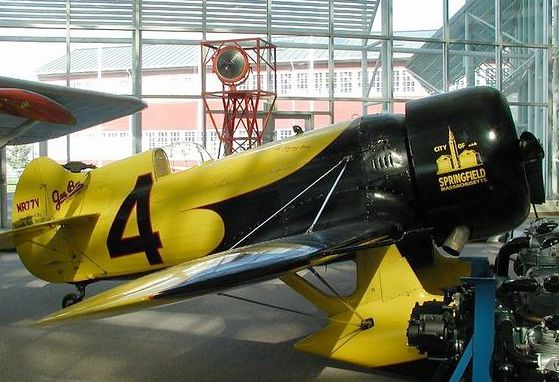
ImageThen an amazing thing happened. Our teacher bought a model airplane kit for the school, complete with a real engine. It was a model of the GeeBee Z.
The engine ran on a mixture of gas and oil. It had a miniature ignition system — spark plug, breaker points, capacitor, and battery. [Update: video]

Mr. Van Dyke commissioned me to build and fly it. That was the biggest model airplane project that I had undertaken by far. I was able to fly it, but I also crashed it several times. That’s a picture of the real airplane that our model was based on.

Fifty years later I found out why it was so hard to fly that model. It was a scale model of a GeeBee air racer. Real GeeBees are just as tricky to fly as our model was. The last GeeBee was the Model R2. A famous aviator, Jimmy Doolittle, won two air races in the R1 sister ship. [story and picturesThere’s more about GeeBee racers and the R2, but I’m saving that for another story.

We went on to build more sensible model airplanes with lighter and more powerful engines. They were easier to fly than that first one. We built one for free-flight too. It was small, light and had a tiny engine. The idea was to trim the airplane to fly in circles and launch it. You hoped it would wander into a thermal (rising column of air) before the engine ran out of gas. We had some success, and then one day a thermal lifted it about 1,500 feet. It drifted with the wind to the other side of the river about a mile from our place. We went over to find it the next day and found a mouse had chewed up the sponge rubber wheels.

The last model I built was an inch per foot scale replica of “Lil’ Stinker.” I built it from scratch when I was in college. The color pattern was red with white stripes, and it had a checkerboard pattern on the bottom. Curtis Pitts designed and built the original Lil’ Stinker for himself. [story and pictures]

There were no other airplanes like Lil’ Stinker at that time. He sold it to Betty Skelton and continued to design and build improved versions. I never dreamed I’d fly real Pitts Specials one day myself.  [story and pictures] There’s more to come on Curtis Pitts and his airplanes.
The Great Pheasant Hunt

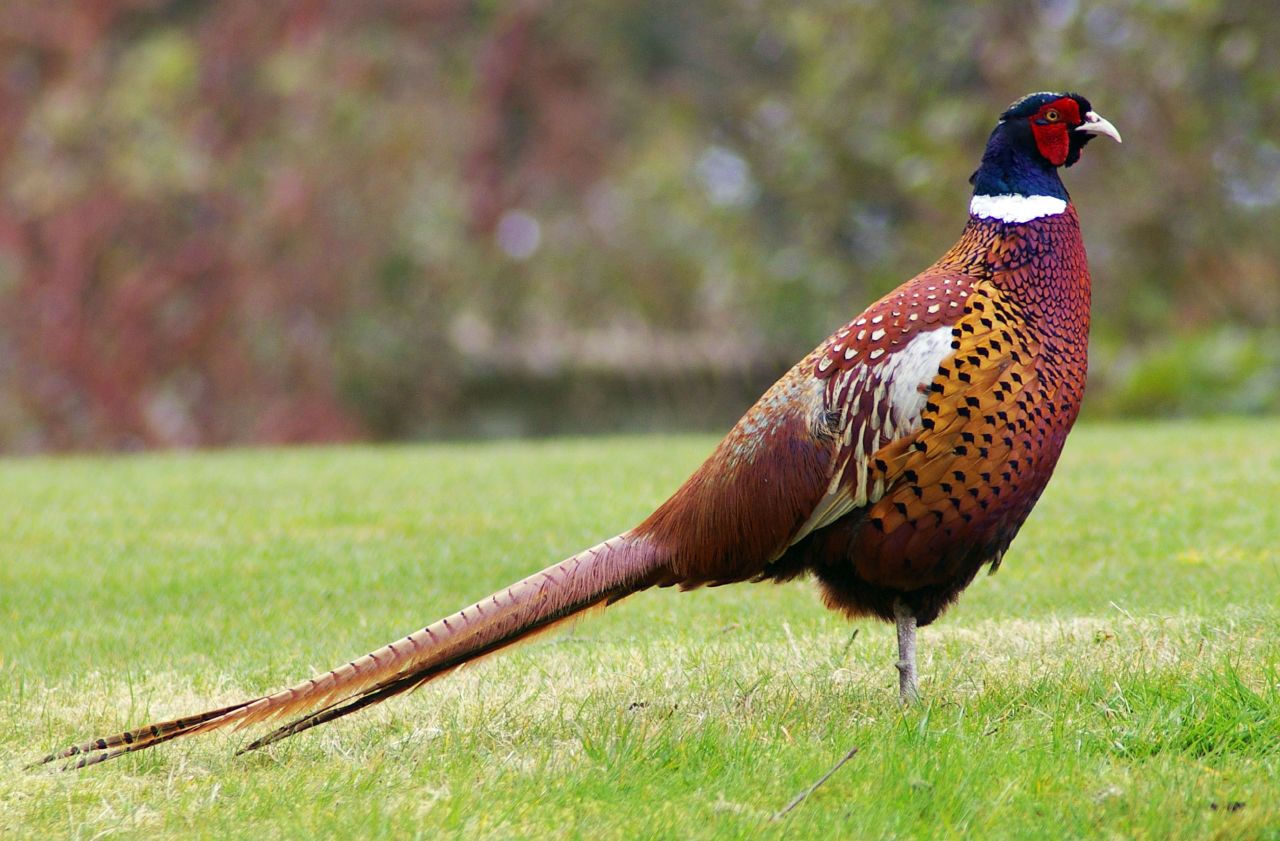
There were few deer, wild turkeys or pheasants in Kansas a century ago.  Chinese pheasants are [Duh!] not native, and were not introduced in Kansas until 1906. The populations of all three have now expanded. There were enough pheasants by the middle of the 20th Century to allow open season in many Kansas counties.

PheasantIn 1948 Grandpa Miller, my dad and I went to North Western Kansas on an opening-day pheasant expedition. We paid to stay at a ranch house out there, and to hunt the ranch the next day. Everything looked fine when we got there. There was lots of cover for pheasants, and it looked like easy hiking. We spent the evening with the rancher and his wife and then turned in.

We were eager to go in the morning, but we heard the wind blowing hard. When we looked outside it was snowing. Sideways! Not quite a blizzard, but the prospects did not look good for hunting. We ate breakfast, bundled up and went out anyway. After an hour or so it was obvious the pheasants were going to stay hunkered down no matter how close we might step. We did not have a hunting dog, and even if we had, the scent would have blown away anyway.

We gave up and went back to the ranch house. Then my dad had an idea. He knew a college friend who lived about 100 miles south of where we were. He hadn’t seen his friend for several years, but dad was sure he’d let us hunt at his place. He hoped the weather would be better in that direction.

We found his friend’s place around noon. The weather was nice. His friend told us there was going to be a big pheasant hunt on his farm, and we were welcome to join in. Then he gave us a tour of their prairie home. Instead of a basement, the house itself was almost buried. The roof, chimney, and some small windows were all that was above ground. They built it that way to avoid the wind, heat, and blizzards that are common in Western Kansas.

Most farms in Western Kansas are huge. We were going to hunt half a section of farmland. We were going to hunt by forming a line of hunters and walking through a field. It took a while to get the line organized. I’m guessing that we were about 40 feet apart, so our one-mile line would have contained about 130 hunters. That’s a lot of shotguns.

We all started off together, and nothing happened for a while. The pheasants had wheat stubble for cover, and they run fast. They just scooted away from us. After a quarter mile or so they were either getting tired or more nervous, and they began to fly at random. That’s when the shooting started.

I don’t remember how many pheasants we shot, but I do remember a couple of them vividly. One pheasant jumped up right in front of me and I shot it. It came down and I was sure we’d find it when we walked up to where it landed. I was surprised when a pheasant jumped up when we got there. I didn’t think he would be able to fly. The pheasant flew right over me, and behind us.

I was sure it was the rooster I shot and expected to find dead. I whirled around, took aim and pulled the trigger just as everyone else called “hen.” (You’re only allowed to shoot roosters, not hens.) The hen came down, and then the other hunters pointed out the game warden driving along the road at the edge of the field. Oh, oh. My bad. There was a boy walking with us, and I told him to go pick up the hen and take it home. I figured the game warden wouldn’t be checking boys for pheasants.

A few minutes later another hen jumped up. Instead of flying away from us, it flew out toward the road, right down the line of hunters. Everyone called “hen” as she flew past them. The game warden shot her when she crossed the road. We could not believe our eyes. And I stopped worrying about the hen I shot by mistake. I imagine she tasted better than the roosters we took home.

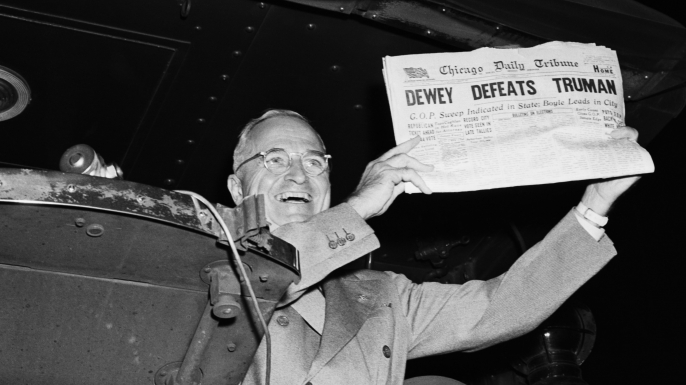
Truman with the Chicago Daily Times

We started our expedition on Election Day, 1948. We did not have a radio in the car, and I guess nobody turned one on that evening in the ranch house. Or maybe they didn’t have one. There was no electricity there.

Like most others at the time, we thought Dewey would win the election by a big margin. That’s what some newspapers assumed, infamously including The Chicago Daily Times. They reported Dewey had won and went to bed. There was a lot of amusement the next morning when it turned out that Truman won. We were as surprised as anybody when we finally learned the outcome.

Duck Hunting

More than half the US population lived on farms when I was growing up. Less than 2% live there now. Farming itself was an outdoors life, but it subsumed the native way of living. A few special places out there on the prairie still offered a remnant of the hunting and fishing riches of the prairie when my dad was growing up. He knew where most of the nearby ones were.

There is an element of diversion in hunting and fishing, but that isn’t why my dad had a lasting interest in the world outdoors. Hunting and fishing held a more primal motivation for him. It was a way to experience self-reliance, not just a field-and-stream “sport”.

The_Greeting

There are many stories about dad’s years on the prairie. I’ll relate a few aspects below. I picked up his outlook to some degree and dabbled in outdoor pursuits myself. But as a boy, I was more intrigued by the mountain men that I read about. I didn’t know then about David Thompson, perhaps the greatest mountain man of them all.

The nearby Sand Hills had several nice ponds that the wind formed centuries ago. The Arkansas river carried fine sand from the mountains of Colorado to central Kansas. Perennial Kansas winds blew this sand north and formed sand dunes, which are now covered with grass and brush. The blowing sand also scoured out depressions in the original clay soil. Clay is impervious to water, so ponds formed among the sand dunes.

Those ponds were part of a flyway that ducks followed to migrate to Mexico from Canada in the fall of the year. Grandpa Spohn — who died years before I was born — gave my dad a single shot 12-gauge shotgun for duck hunting when he was about 14 years old. If you’re only going to get one shot at a duck, you don’t want to miss. He also reloaded his shells to keep expense down. Two good motivations for learning to be a good shot.

He did not go to high school, so he was free to go duck hunting almost any day in the fall when he was young. He became a crack shot. He started hunting ducks again when we moved back to the farm.  When I was about 12 years old he began to take me hunting on weekends. I didn’t have a shotgun then. I carried our 22 caliber rifle. Some ducks that you shoot can no longer fly, but they can still paddle. My job was to shoot the cripples in the head so that we could retrieve them.

Grandpa Miller gave me one of his shotguns when I was about 16. But I never became a good shot with it. I was going to high school, so I didn’t have much time for hunting.  I never got good at hitting ducks. Dad was a dead shot. Sometimes he would see two ducks converging, and wait just a second before shooting. He’d often get two ducks with one shot that way.

Model 12My shotgun: Model 12 Winchester. Designed in 1912, manufactured until 1967. My dad started using it when he was 70. His double-barreled “goose gun” was too heavy for him by then.

Dad’s hunting rules: 1.) Never let the muzzle your gun wander so that it points at someone. 2.) If you fall down, hang on to your gun and keep it under control. 3.) Find all the ducks you shoot. 4.) Pluck and dress the ducks as soon as you get home. 5.) Eat all the ducks you shoot. We used the feathers to stuff pillows. Waste not, want not.

The reason for Rule 2 is simple. It’s not unusual for somebody, often the one who falls, to get shot if he lets go of his gun. You want to keep control of where it’s pointed, even at the expense of injury.

One year there were plenty of ducks flying south, and the daily limit was 15. We had been eating duck two or three times a week for several weeks. One day mom said, “Paul, Marilyn and I not going to eat any more duck this year. If you and Phil Jr. (that’s what she called me) want to eat duck I’ll fix it for you, but we are going to eat something else.” Lucky for them that we weren’t eating duck to survive.

Years later I came home on leave from the Army, but not in duck hunting season. One day my dad said, “Let’s go to town.” “OK, why not?” I said. Off we went, and we were soon in the Sand Hills. Then he said, “Let’s go left here.” “OK, why not?” I said again. I knew he didn’t want to chat about it. He liked for things to be surprising.

We went a mile and came to an open area with a bunch of parked pickups. I could see that some of the men had shotguns. Dad told me it was a “turkey shoot.” After we pulled in and stopped, one of the men came over. I’d never seen him before. He said, in a half-displeased way, “Why did you have to show up? We were going to have some fun here today.”

I didn’t know quite what the guy meant, and I didn’t know what a turkey shoot was either. There were no turkeys in Kansas then. A turkey shoot is a shooting contest, and if you want to shoot you have to put money in the pot. All I knew was that dad was good at trap shooting. He used to shoot with my Uncle Cecil and others, and almost never missed his clay pidgeons.

The same was true that day. He won the first rounds handily, advanced to the final, and won the pot. Then I understood what the guy who greeted us was saying. I also realized this wasn’t dad’s first turkey shoot. While Paul and I were off at school, he had time to hone his skills.

Addendum: This may have been part of Dad’s secret (from The New Yorker).

“There was a guy who was a great wingshot on a quail hunt in Georgia. He killed everything he saw, he dropped ’em all morning. One of the other guys said, ‘You’re the best wingshot I’ve ever seen.’ At lunch the guy asked him, ‘Do you shoot with one eye open or both?’ He paused and thought about it. Finally, he said, ‘I don’t know.’ ”

Down on the Farm — Part Two

I ended Part One of this series with our arrival back in Kansas for the last time. Here’s what I surmise about the situation there at the time. My dad had just bought the farm his mother owned and lived on. She wanted the money to move to a smaller house in Hutchinson. Dad and his brother Charlie had been farming wheat on her farm for almost 20 years. Each of the three of them probably got a one-third share of the grain each year.

Dad’s sister Lula and her family had also been living on the farm in a second house. They had been forced to leave their farm in the Dust Bowl a few years earlier. They were also using the barn, hog house, and chicken house.

That second house was a flimsy mobile thing painted dull green as I remember it. Aunt Lula and her husband Sy (Sylvester no doubt) had a little income from milk cows, hogs, and chickens. The Great Depression still held sway so it wouldn’t have been much. From what I’ve been told, Sy wasn’t too practical. They were eking out a living. (A few years later they were doing well running their own frozen food service.)

We were told to never go near that other house. I’m not sure why, and I was never inside it. It didn’t remain there long, maybe a year. My sister Marilyn recently told me that dad was anxious to get that second house off the property. He was concerned that one or the other of his sisters would plead hard times and beg to move in.

Aunt Lula moved to an old house on a farm in the Sand Hills a few miles west. They continued to earn income from their animals. She also opened a country store that provided a little more income. That farm was across the road from the Welsh ranch, where 40 years earlier Grandma Miller had gone as a cook.

Leona (grandma) was 14 years old then. She was one of 20 siblings, if you can believe it. A few years later she married William Moses (Moe) Miller. They settled a mile further west on another scrubby farm they bought. More about that later.

Dad bought a 1938 Minneapolis Moline tractor soon after we moved to our farm. I wouldn’t have known how to express it at the time, but the way those M&M’s design fit their purpose was exceptional. It even had rubber tires. That tractor never faltered in 40 years of use.

Dad hated the old tractor with lugged steel wheels that he owned before. He liked the M&M so much that he bought and overhauled a used one several years later. By that time, around 1950, Paul and I were old enough to work all day in the fields. We drove those two tractors during the day. Dad rigged lights on one of them and drove it all night in plowing season.

holt

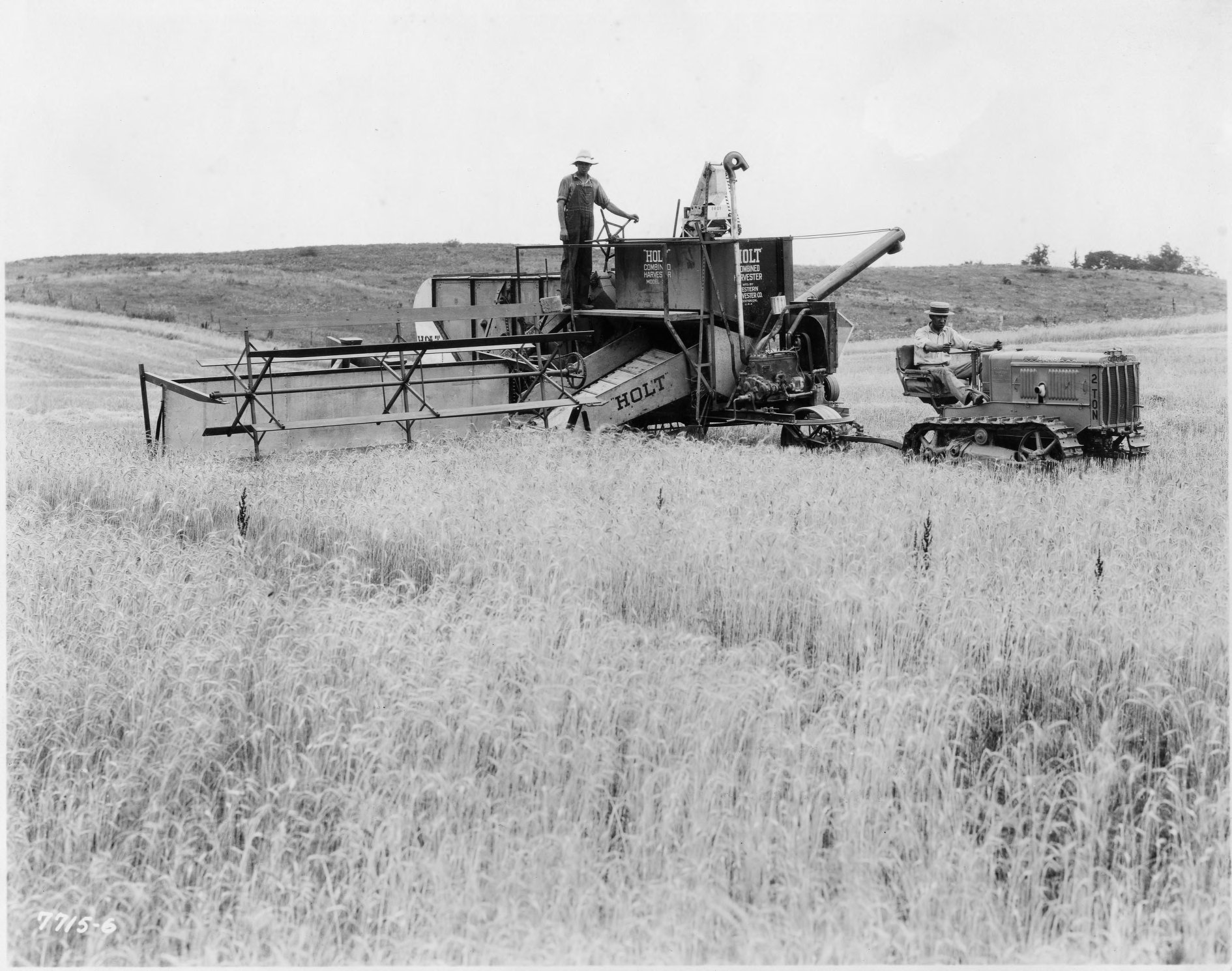
Dad had his 1928 Holt combine at the “home place” before we moved in. He might have even bought it new. The stock market crashed in 1929, and it took a couple of years for the Great Depression to get really bad so he would have had money to buy it in that time frame. We had a rubber-tired tractor to pull the combine. Picture me up there on the platform managing the operation of the combine.

Benjamin Holt designed the Caterpillar tractor, and also the Holt combine. It was the Cadillac of combines. They would work just as well today as any modern combine. It had 105 fittings to grease, and I could do that in less than five minutes.

As you see in the picture, combines are mobile threshing machines with a “header” attached to one side. The header cuts off the heads of grain and feeds them into the throat of the thresher. The thresher knocks the grains loose from the wheat heads. The separator section behind the thresher separates (Duh!) the straw and husks from the grain. A fan spreads the straw out behind the separator, and the grain is routed to a bin.

I wrote earlier about threshing crews of a dozen or more men. Combines made a huge difference in labor. Combine harvesting required one man on the tractor, one on the combine, and two men to transfer the grain to the granary. That’s four men. Less than one-fourth as many as a threshing machine crew.

Combines also eliminated the shocking step that preceded the threshing step by a week or more. Shocking itself takes longer than combine harvesting, and of course, there is still threshing time added to that. It was a huge step forward in the mechanization of wheat farming.

There is little need to trade labor with your neighbors for combine harvesting. But you still need some help. So where do you get hired hands for a combine harvesting crew? Dad took on three McPherson College students as “hired hands”. My mother also had a “hired girl” (my cousin Glenna) to help with cooking and laundry for those hired hands. I long wondered, but never asked why those men would be willing to work for only a couple of weeks.

Update: I’ve surmised that like contract harvesters today,  they started working in Texas, Oklahoma or Southern Kansas, and then moved north with the harvest to North Dakota. The further north you go, the later wheat ripens — about two weeks per state. So that would be 8 to 10 weeks of good-paying work if you went all the way to North Dakota.

Then came World War II. The draft boards took college students right along with other young men. They even drafted our Uncle “Doc,” who was 45 — not to be a doctor, but to be an officer in a training camp. Somebody eventually came to their senses and realized people in Lyons needed him more than the Army needed him in Montana. He ended up an officer’s sword to show off though.

Our Uncle Rowland was in medical school at the time the war started. The draft board allowed him to finish because the army needed doctors overseas. That left him free to help with wheat harvest for a couple of years. He used our car on Sundays to go see his friends a few times while he was at the farm. When he got back he always reset the rearview mirror exactly to where my mother had it before. She appreciated that.

I was 12 years old in 1944. That was halfway through the war. I was “drafted” that summer to run the combine. My dad told me it was a good thing I lived on the farm. Otherwise, he’d have to pay me $12 a day ($300 a day for a combine man today). Dad drove the tractor, which required more strength. I had no trouble handling the combine. But who would transfer the wheat to the granary? Shoveling wheat into the bin was strenuous and took a long time. That’s where more mechanization came in.

Dad knew of a “grain blower” that he could borrow. A grain blower works like a big vacuum cleaner. It blows grain into the granary instead of dust into a little bag. He powered the blower with a Model T engine that he borrowed from his brother Charlie. All we had to do now was shove the wheat out of the truck into the hopper on the blower. Even a 12-year old (me) could drive the truck to the granary, blow the wheat into a bin, and go back to load some more.

The blower worked so well that dad built his own that winter to replace the one he borrowed. He fabricated the blower from metal objects in the junk pile. He had some blower pipe made in town to direct the flow of grain. Then he cut off the passenger body of a Model A Ford, mounted the blower in its place, and coupled it to the engine. Worked like a charm. He also bought an old dump truck bed and mounted it on our Model A Ford truck. Now we didn’t even have to push the grain out of the truck. All we had to do was dump it in the grain blower hopper (which he had also designed and built).

There’s some irony in there: The Holt combine had a screw auger to empty its grain bin into the truck. Many combines did it that way. But nobody ever thought of using an auger to empty trucks. (In 1945 someone in Toronto designed a portable auger for just that purpose. Virtually every grain farmer had at least one portable auger by 1955.)

The new augers were simple and light enough to move around by hand. The one we bought had a 5 horsepower Briggs & Stratton engine for power. Everybody moves grain that way now. The original idea to use a blower was overkill, but it was the catalyst for an elegant solution. Only one big step remained at that point to finish mechanizing wheat farming. That was the self-propelled combine.

The original combine harvesters had their own engine to power the threshing and separating sections. There was no way to run a belt from your tractor to power the combine as you did with a threshing machine. The tractor was not stationary, it was pulling the combine. It took two men to run the separate units used for combine harvesting. Why not combine the harvester further with the tractor? That idea became self-propelled combines. Now you’ve reduced the complexity. One man and one engine now do the complete harvesting process.

We just had to have one of those new-fangled combines. Dad found a year-old one for $3,000. (A new one today costs more than $300,000.) You can see why I said earlier that farming has become capital-intensive, not labor-intensive. Both Paul and I went off to the Army and other pursuits at that point. Dad ended up doing all the wheat farming by himself. He continued until he wore out at 84 years old.

***************************************************

I found some nice videos about old-time farming —  combines in particular —  on YouTube. [Palouse, Washington in the mid-1940s – YouTube | To Till a Field: Man and Machine in the Palouse – YouTube]