I’m writing this Down on the Farm series to paint a backdrop for this blog. These posts will cover the final years of the transition from the late Iron Age to mechanized farming. By 1950 farming had changed from labor to capital intensive. My dad lived through a longer part of that transition than I did, of course. I learned about blacksmithing, horses, engine repair, tractors, grain augers, self- propelled combines, and other practical things by watching and working with him. Some of it was hard work, but it was interesting, and I was proud to be doing it. It played a big part in my becoming who I am. I hope a few stories about those times will give you some sense what I experienced down on the farm.
***************************************************
Nancy, Cathy and Barb will recall the big red barn on the “home place”. There were 6 horse stalls in that barn, and two horses to a stall made 12. By the time my dad was 14 he was doing much of the plowing and planting with those horses.
I often heard dad say, “We kept 12 horses in that barn. In the morning I hitched six of them up [to some farm implement] and went out in the field to work. At noon I brought them back in and had dinner (lunch is still called dinner in Kansas). After dinner, I hitched up six more and went back out in the field to work until supper.” Somehow he didn’t think it was fair that the horses worked half a day and he had to work all day.
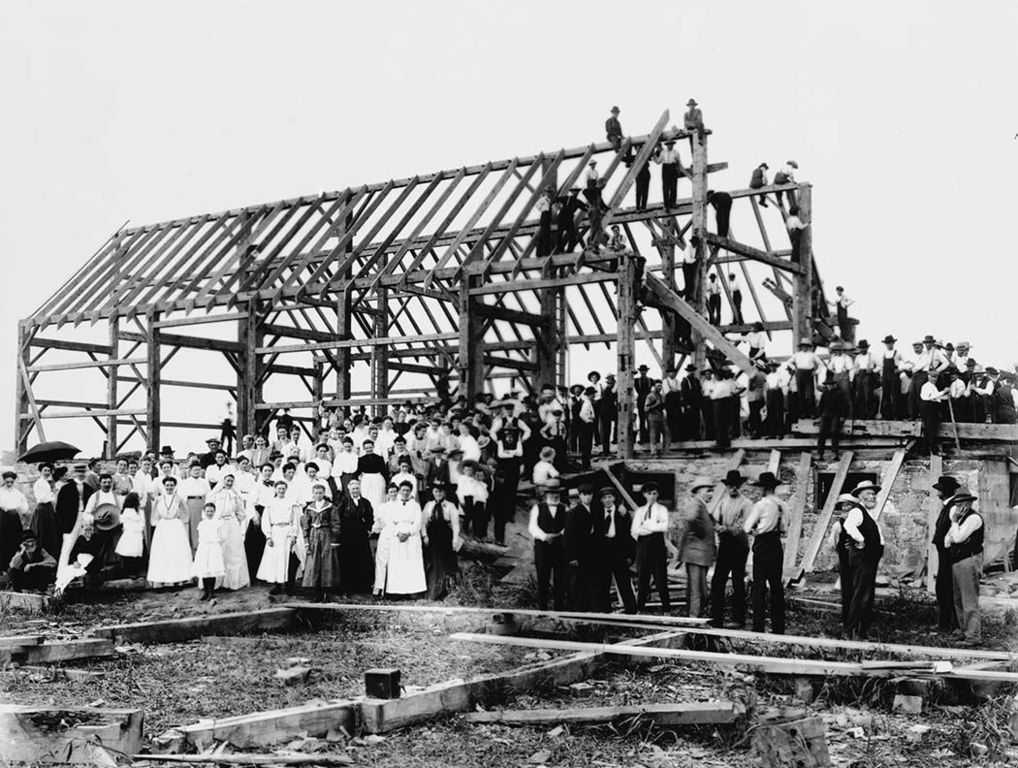
Most Midwestern farms had a big red barn in 1900. They were for horses and milk cows. There was hay in the loft and oats in a bin to feed them. There was a “stock tank” outside for them to drink from (and for boys to swim in). Building a barn was a big undertaking. The community held a barn raising when it was time to build one of those barns.
By 1920, tractors had replaced horses on over half of those farms. Barns fell into disuse. Their color changed from barn red to weathered gray over the years. Lack of maintenance doomed the roofs. The wood inside warped and rotted when rain began to penetrate the barn. By 2000, all but a few barns were torn down or had collapsed in on themselves. Sad.
My Grandpa Spohn followed German tradition. When Uncle Ralph, the eldest son, got married he helped finance a farm for him. That was the German way. Uncle Charlie, the middle son, got no help with a farm, but he was free to leave home when he got married. As the youngest son, my dad was expected to stay home and help on the farm. No getting married, no high school, no leaving. That was the German way. He did buy my dad a nice 12-gage, double-barreled shotgun though.
My grandpa’s family made drain tile in Kokomo County, Indiana. Farmers used it to drain their fields. Grandpa left Indiana for Kansas City, Missouri late in the 19th Century. He worked in a roundhouse there repairing locomotives. After three years, they sent him down the track as a railroad engineer (train driver would make better sense). He had to leave that job for health reasons (malaria) after a few years though, but that’s where he got the know how to run a steam tractor. Then he ran a country store for a while and ended up buying the farm I grew up on.
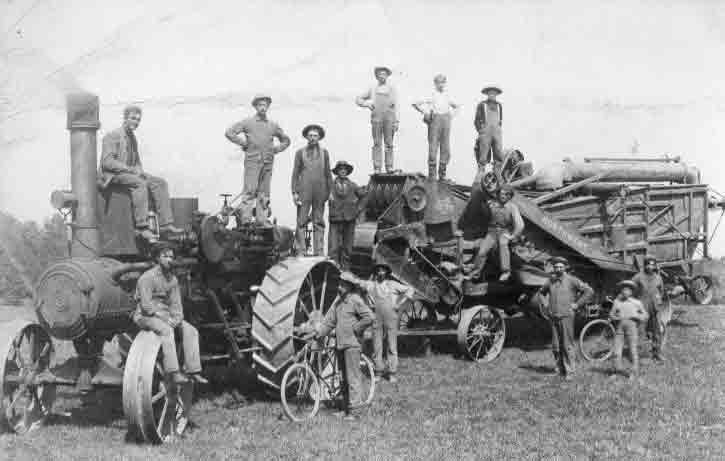
Grandpa bought a steam tractor and a threshing machine when my dad was about 17 years old. He didn’t buy the steam tractor for himself. Grandpa saw himself more as the “farm manager.” It was my dad’s job to make a profit with the tractor and threshing machine. Their business was threshing wheat and oats in return for a “custom threshing” fee.
The tractor pulled the threshing machine from farm to farm, and it powered the threshing machine. A great long belt ran between a big pulley on the tractor and a smaller one on the threshing machine. The cylinder (the part that knocks the kernels out of the head) needed to run twice as fast as the steam engine. The belt was mounted with a half twist. That trick kept the belt centered on the pulleys. Otherwise, it was sure to “walk” to the side of the pulleys and fall off.
It took a crew of a dozen or more men and boys to thresh wheat or oats. Most of them were usually the farmer’s neighbors. They all came to your place to help thrash your crop, and you went to each of theirs in return. The wheat had already been cut and bound into sheaves. The crew brought the sheaves in on wagons, pitched them in the thresher’s maw, hauled the grain away, kept coal and water in the steam tractor, etc. My dad was the (young) man in charge. He used to say, “I’ve done every job on a threshing crew except cook and wash dishes.” (Women and girls were working in the farmhouse to keep the men fed and watered.)
I don’t know how long my dad ran that thrashing rig. Grandpa Spohn died when my dad was about 20 years old. My dad and Uncle Charlie continued to run the farm for his mother Frankie. It’s likely they were still using that thrashing machine at the home place. I know they stopped using it when they each got combines. 😉
After his father died, his mother let him attend McPherson Academy (high school). He lived in the dorm there. He went on to McPherson College as well. You could harvest wheat, plow the ground, and replant the wheat in the summer months in those days. He was free during the rest of the year to go to school. All that’s another story.
That’s the background for my dad’s practical education. Dad was a natural born engineer. He knew how things worked, and understood the principles behind the skills he developed. Dad could handle anything from blacksmithing to fine woodworking, and from horses to internal combustion engines. He did most of it with hand tools.
His skills were apparent when a piece of equipment broke down. Dad would analyze what went wrong and say, “Some dumb engineer thought….” Then he’d improvise a way to make it work again. One year his friend and neighbor came over with a new hay baler to bale our alfalfa hay. It worked great all morning, but in the afternoon it began to stop at random with a loud bang. Dad looked the baler over and saw that a pawl was dragging against the cover of the timing mechanism. That caused it to trip, which put the timing out of step. We stuck a stick of wood under the edge of the cover so the pawl wouldn’t drag, and got back to bailing.
The equipment dealer got a factory representative to come see the problem. After looking at dad’s solution, he said they would redesign the cover. Meanwhile, the stick of wood remained in place. A couple of years later our neighbor had worn that baler out and replaced it with a new one. He came over to our place to try out the new one. We saw they made more room the pawl. It looked good to go.
So we started baling hay. Bang! The timing mechanism went out of whack right away. The factory built in more clearance for the pawl, but they hadn’t gone far enough. Like the carpenter who said, “I’ve sawed it off three times already, and it’s still too short.”
My dad predictably remarked, “Some dumb engineer didn’t plan on any variation in manufacturing.” In went a stick of wood to prop up the cover, and we got back to baling hay.


 Didit.Live