It just occurred to me that Steve Wolf might have been willing to go up with me to try aerobatics in my “Big-bad-Green” (paint color) Citabria the first time. But it didn’t. I took my plane out of the hanger, fueled it up, put my parachute on, and went off “into the wild blue yonder.”
You are required to wear a parachute for aerobatic flying. If you need to use the parachute, you need to get out of the plane quickly too. The Citabria’s door is designed to drop away with the pull of a lever. All that’s comforting, but I was a bit nervous about trying aerobatics without an instructor backing me up.
I knew that with enough altitude there was no attitude that you couldn’t recover from, but that did not completely assure me. Oh well, there’s still the parachute.
I tried some stalls and spins first. They may sound hazardous, but they are easy to recover from. A spin is the only adverse thing that a stall can induce. And remember, Steve and I had tried some recoveries from upright and inverted spins using the Gene Beggs method of spin recovery. Dead simple from a stall induced spin.
The spins went well, so I decided to try a roll. That’s the least disorienting aerobatic maneuver, so I pushed the stick to the left and the roll began. When the wings were vertical (90 degrees to the horizon), I sensed that the roll rate had slowed to the point where the 270 degrees left to go were in doubt.
“Do not do anything for which the outcome is in doubt,” is a cardinal rule of flying. So I leveled the wings and thought about what happened. In theory, nothing could go wrong, but the fear of becoming disoriented was a little too strong for me to continue.
It wouldn’t hurt to try again, though, but be more observant of how things went. I tried two or three rolls and decided it was something I’d put aside for the time being. I knew aerobatics in a Citabria are quite a bit harder than the video-game ease of a Pitts Special. But I knew I was missing something.
Flying a (nice) loop is more challenging than a roll, but I decided it would be OK to try one. The physics of a loop are simpler in a way than those of a roll. I didn’t care how pretty the loop would be, I just wanted to get the feel for a loop in a Citabria. Needless to say, it was successful or I wouldn’t be writing this.
I decided to return to Henley after a few more loops and a spin or two. I don’t mind admitting that my stress level was quite elevated. The landing was easy for me because a Citabria is just a beefier version of an Aeronca Champ. I had landed one of those dozens of times. Nobody asked me what I’d been up to when I was back on the ground. 😉
I now realize that I didn’t rehearse getting out of the Citabria quickly and using my parachute before I went up. I might have had more confidence if I had done that — or not.
Every writer has blindspots. It’s so easy not to realize that readers have little or no knowledge of things you reference, or don’t think to mention. Here is a modest start to remedy that.
Timelines
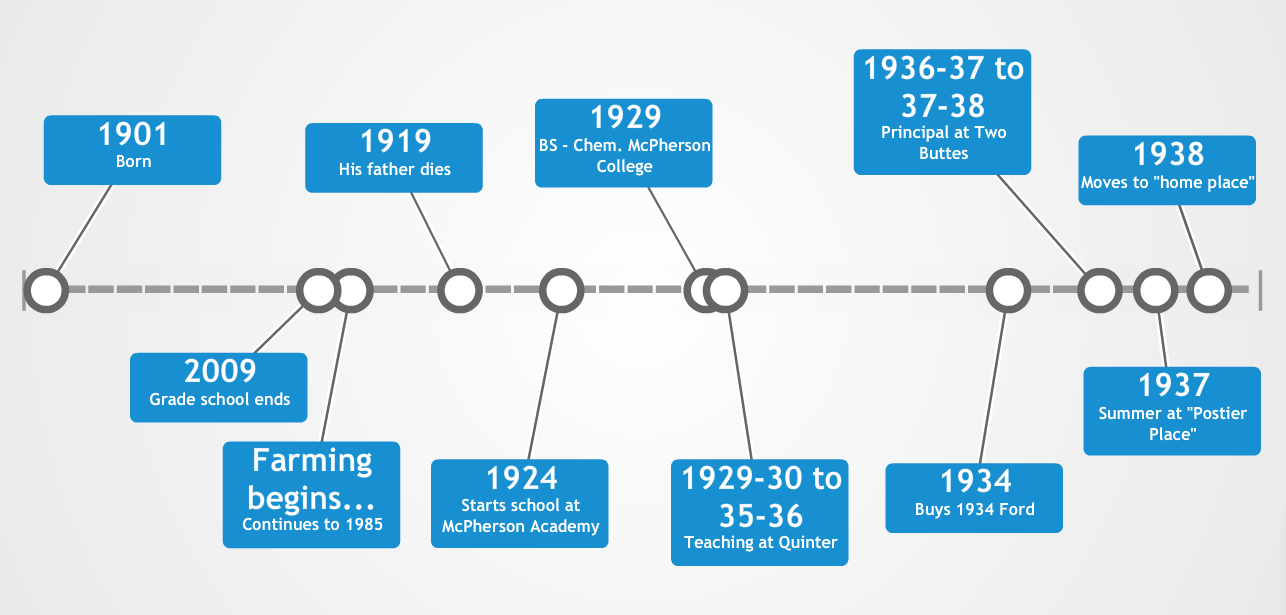
The first two that come to mind as relevant cover the early years for my mom and dad. Partly that’s because we moved around a bit during those years. They also provide perspective on some of the stories I’ve told and probably others that I will tell.
Philip Dallas Spohn
This timeline covers the time up until our permanent move to the “Home Place.” That’s where we siblings grew up, but how we got there is interesting too: Remember to click images to see them larger.
We always knew how old Dad was — just subtract “1” from the current year and that was it. As the youngest son of a German family, he became a “full-time farm hand” right out of grade school — the same Alpha we attended — at 14-years old. It wasn’t long until he was running a steam-powered threshing machine during harvest season.
His father died in 1919. From that time on, Dad managing the farm on his own (I sure his brother Charlie helped some). He farmed until the fall of 1985. Most of the farming from 1924 until 1938 was done in the summer time. Not the best farming practice, but I’ll tell that story later.
In 1924 his mother allowed him to start school at McPherson Academy, where he took courses for students who hadn’t gone to high school. No doubt he did some commuting back to the farm because he was the first student to have a car — naturally, a Model T — at McPherson.
He went on to McPherson College and graduated in 1929. Mom and Dad were married that summer. They evidently lived with his mother while working her farm. In the fall he started teaching “out in Western Kansas” — as they would have said — at Quinter. Remember — it had only been 60 years or so since most of Kansas had been settled, and anything beyond where you were was still “out West.”
Shortly after school started in 1929, the stock market crashed — big time. That didn’t have a lot of effect on the economy right then, but by 1932, when I was born, it had collapsed. I’m definitely an iconic “depression baby.” Dad still had a good salary as a school teacher, though, even though farming didn’t pay much at all.
In a few years, things got much worse, and politics reared its ugly head. (I’m sure you’re familiar with how that works about now.) The cronies of a young school teacher’s uncle got himself elected to the Quinter school board. The board discontinued the courses that Dad taught and fired him (laid-off in today’s parlance). Then they hired the nephew to teach some new cockamamie courses.
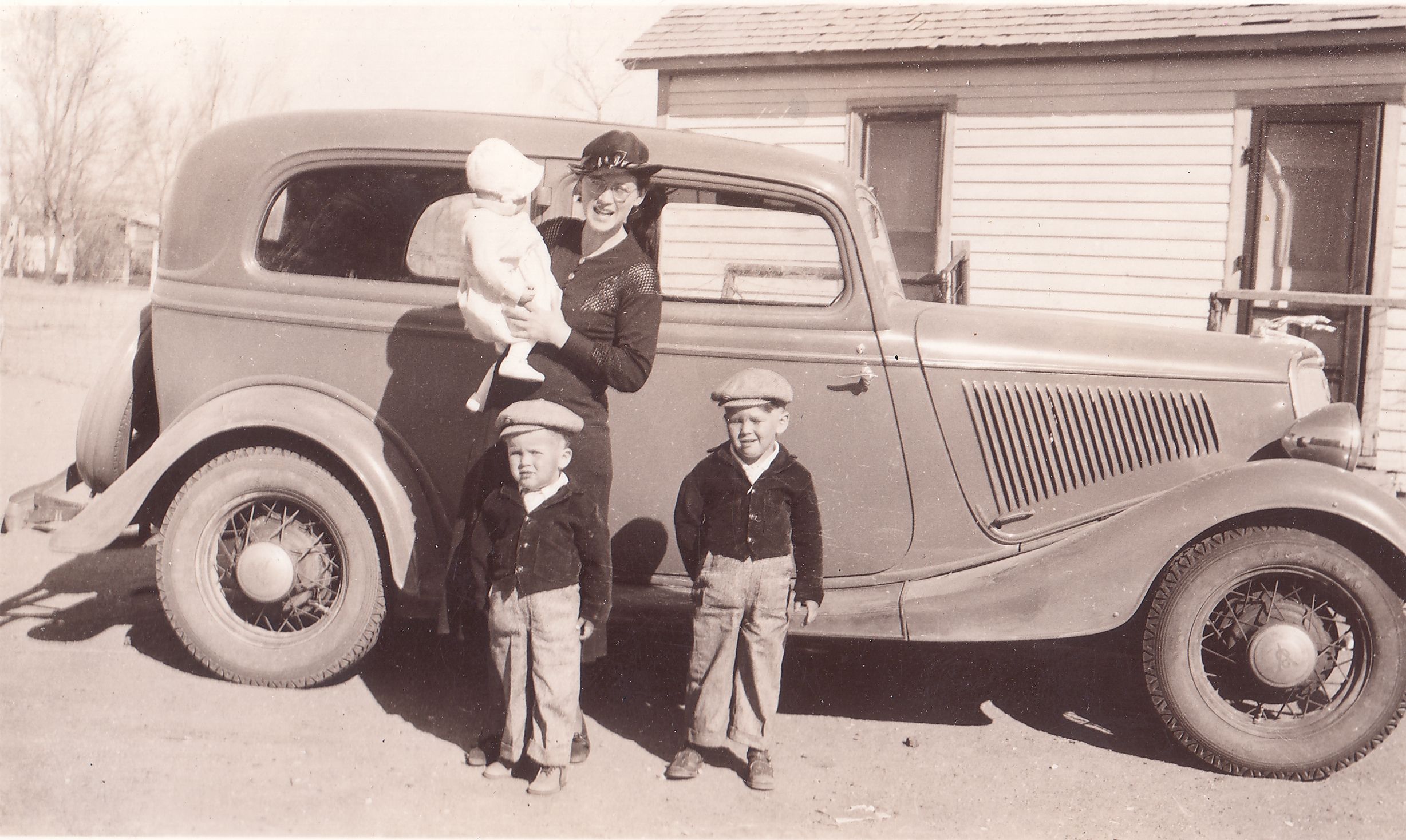
That’s how we wound up in 1936 in the depths of the Great Depression and the center of the Dust Bowl. I’m pretty sure it was 1936 going by this picture. It’s in the fall (no leaves on the trees), and Marilyn looks to be about a year old. That would make me a little over 4 years old, which is consistent with 1936.
Two years later, I was a little over 6 years old and going to Alpha Grade School. Of course, that meant we had moved to the “home place” permanently. The country was clawing its way out of the depression, Dad had a new tractor, and I had learned to read.
During the summer of 1937, we lived in the little shack on the Postier Place that I wrote about previously. That must have been quite a challenge. But Mom and Dad were still in their thirties.
Doris Daisy Spohn
The corresponding timeline for Mom. Marilyn, Paul, and I were born about 18 months apart. Mom had to drop out of College to teach grade school at Springfield, Kansas so she could finish College. She also helped her parents pay the mortgage on the hard-scrabble farm they had. Good thing — they would have lost the farm, but instead, they struck oil in about 1928.
Related Timelines
Leona Mae Griffitts: Born 1885 > Cooking at Welsh Ranch 1899 > Married 2002 (@17?) > Doris Daisy Miller born 2005
William Moses (WM/Moe) Miller: Born 1881 > Canada 1898 > Cripple Creek 1899 > Kansas 1901 > Married 2002 > Doris Daisy Miller born 2005
More to come…
I’ll add genealogy links after I do more research online.
Serendipity strikes again: YouTube knows all about you, so I shouldn’t have been surprised when they recommended a video about the GeeBee replica that Steve Wolf and Delmar Benjamin built. Oh, happy day.
Steve moved to Oregon before he and Delmar started building the GeeBee replica. Delmar had been part of an air-show team before that, flying home-built Pitts Specials with Steve Soper. The team came to an end after Steve had a serious crash. (Steve Wolf and the other Steve had been an air-show team before that).
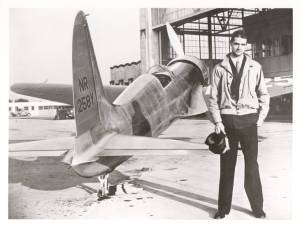
Steve had a big, new hanger/workshop in Oregon with some key fabrication tools. One of his first projects in Oregon was building wings for a Hughes H-1 Racer replica (the original H-1 was raced by Howard Hughes).
The idea to build a replica of the GeeBee R2 came out of Steve and Delmar’s hanger-flying sessions there. Steve had the shop and know how. Delmar had the commitment and money.
GeeBee R2s (and R1s) were dangerous machines. Steve and Delmar felt using a variable-pitch propeller, not available in the early 1930s, would add the edge they needed to make it a less foolhardy project. Variable speed propellers work well at both low (landing and takeoff) and high speeds.
With that, they proceeded to spend full-time for months drawing up plans, making parts and assembling the airplane. You might think Delmar would have kept in practice flying in the meantime, but he chose to mentally rehearse the first GeeBee flight during the time to construct it, instead. The maiden flight is shown in the Video below.
Below is a video of a complete airshow routine. I’ve seen a few like this at Felts Field in Spokane (where I kept my own plane). Delmar flew the GeeBee on the air-show circuit for several years and then sold it to a flight museum.
More videos for the one or three of you who are interested.
Steve is still designing and building improved versions of his proprietary biplanes. He is married to a flight instructor, and they both give aerobatic instruction. “The man can fly,” was an observation about Steve in an old article about aerobatics in Sport Aviation. Not bad for a boy who was once an “airport rat”.
One last note: Our class built a flying model of an earlier GeeBee design when I was in the 8th grade at Alpha school. Our teacher bought a kit and put me in charge. No one had ever flown a model, so I designated myself chief pilot. That model had a laminar-flow wing, which made it tricky to fly. After a few crashes and rebuilds, I regressed to less challenging model planes.
I had to backtrack to Merced Lake to connect with the trail over the ridge to Lafferty Creek. It was a stiff climb to Vogelsang (bird song) — an extensive designated campground. There was nobody here that early in the season, so I was camping by myself again.
The next morning was interesting. I came to a large creek right away. The trail crossed it in a big meadow. It was about three feet deep and ten feet wide there. The current was not strong, but the water was almost freezing.
I decided that was probably the best place to cross, though. The question was, how to manage it. I would have to wade, but I also had a big pack to get across. I took a chance and threw my sleeping bag across. It was in a bag, so I figured it wouldn’t get too wet before I could fish it out if it fell short.
The creek had a sandy bottom. I took off my boots, socks, and pants; picked up my pack and waded over barefoot. Sounds easy, but not in that icy water. That made crossing the creek had been a bit risky, but that’s the kind of thing you run into in the mountains. It’s called adventure.
I soon came to another big snowfield. I could tell it was ten feet deep or more. At first, I was apprehensive of sinking in over my head, but the snow was firmly packed. It was a delightfully easy stroll over to Lafferty Creek. Now it was all downhill to Tuolumne Meadows.
When I got to the little bit of “civilization” and campground at Tuolumne Meadows there was a surprise. A mob of campers was there. Most of them arrived in 4WD vehicles with big tires. No rookies there. They were fully equipped to challenge the “wilderness”. There’s a paved road to Tuolumne of course. But you never know what you’ll run into. 😉
It was all kind of depressing if not disgusting, so I was soon on my way to the Cathedral Lake region — another five miles or so from there. Cathedral Peak is a primary destination for hikers from Tuolumne Meadows, but I didn’t have time to make it there that day.
I also wanted to see Cathedral Lake the next day, but it was some distance off the trail and I didn’t have time to go there if I was going to make it to my next destination on schedule. Between the time it takes to decamp and set up camp again, there isn’t a lot of time to hike to interest spots during the day. Not if your goal is to cover some distance.
My daily routine started with getting my warmest clothes and my boots on. That’s easy in a roomy tube tent. (It gets harder in a tiny one-man tent, which I started using later.) Building a little fire comes next. I used a small wire grill spanning two rocks to cook on. (I switched to a tiny butane stove a few years later. I also switched from oatmeal for breakfast to food that doesn’t need to be cooked.)
After breakfast, it was time to pack up all my stuff. It takes some time to get it organized so that it will all go back in the pack. It’s important to put things like snacks and lunch in last. You can’t just dig around for things in a pack unless you don’t mind organizing things all over again.
Then it’s off down the trail. You need some idea of where you’re going to find water, and where the steep sections are. You hope the map didn’t lie. The high spots along the trail are changing scenery, wildlife, flowers, creeks to cross, snack time, and maybe a sweeping vista or two.
It’s always nice to arrive at your camp spot. Then it’s time to unpack your gear and pitch your tent. The next step is usually unpacking your sleeping bag and putting it in the tent to expand. Then you need to find a limb on a tree that is far enough off the ground to keep your food out of the reach of bears, but not so high that you can’t throw a rock over it. That’s the only way you’re going to get your hoisting line over it. That usually requires quite a few tries.
It’s great when you are close enough to a creek or lake to go catch some fish. There are usually some nice ones when you’re ten or more miles from any road. If you don’t catch some fish, it’s back to the dry salami. Yuk.
Eventually, I needed to find the right rocks for my hearth and some firewood. Then I’d build a small fire, and usually have a cup of tea before getting dinner organized. When you’re hiking solo, the trick is to eat out of the kettle and in courses. That way you have fewer things to clean up.
It starts to get cold in the mountains when the sun gets low in the west. You can put on more clothes and enjoy the evening for a while. But soon, you’d better haul your food up to the limb you picked out and get ready to turn in. It always feels nice to go to your tent and slide into your warm sleeping bag. These chores get more complicated if it is raining, though.
This is the front side of Half Dome (the most iconic rock in the world). You can see the valley behind it (green trees) where I hiked from Tuolumne Meadows to Nevada Falls
It was interesting to see Half Dome from the back side on this leg of my hike. That’s where (most) climbers go. There are cables to grip as you climb on the worst parts. I imagine too many people were hurt of killed before the cables went in. Domes like those in Yosemite are formed by layers peeling off giant blocks of granite. Granite exfoliates in layers when overlying rock erodes away and relieves the immense pressure it was under. Much like peeling layers from an onion.
Domes like those in Yosemite are formed by entire layers peeling off of giant blocks of granite. This gradually rounds them off. Granite exfoliates in layers when overlying rock erodes away and relieves the immense pressure it was under. Much like peeling the layers of an onion.
I camped twice between Tuolumne Meadows and Yosemite Valley. It’s all down hill and my pack was lighter because I had eaten most of the food. That made it easy to cover the distance. I could have taken it slower, but I had discovered that moving through the terrain is more fun than looking for other distractions. I was already planning my next hike as I drove home.

 Steve had a big, new hanger/workshop in Oregon with some key fabrication tools. One of his first projects in Oregon was building wings for a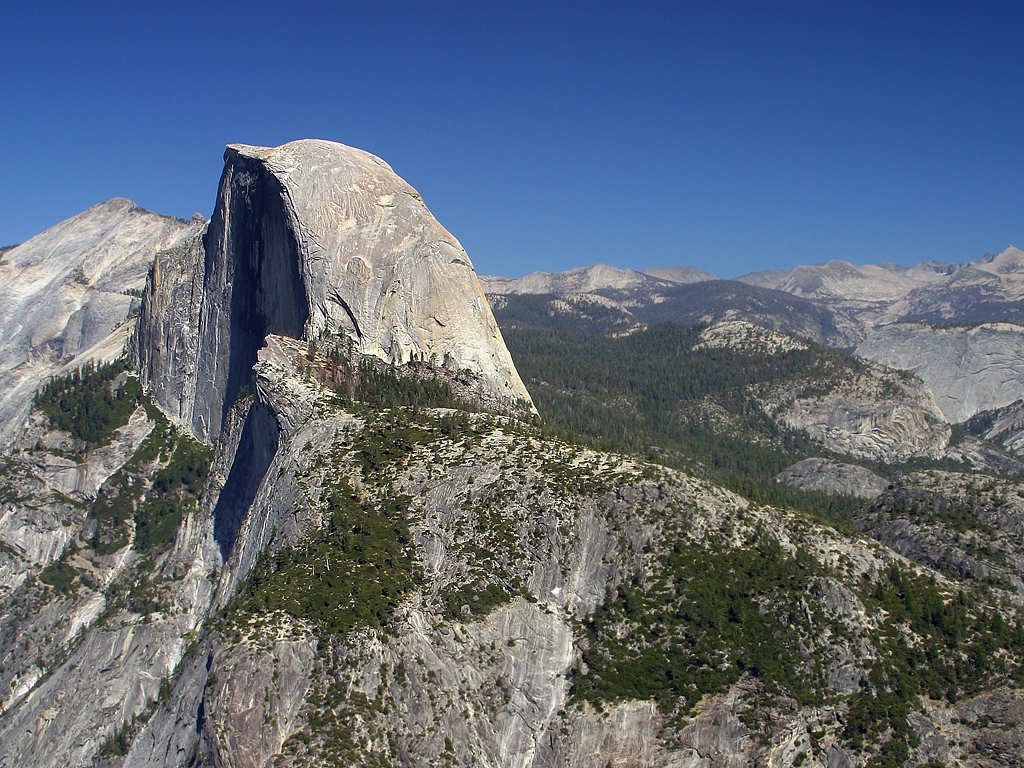
 Didit.Live