Maps are part of these bicycle tour posts. If you don’t see them, I suggest you try a different browser or computing device.
I started planning this tour while riding my Tour of The Rockies the year before. I wanted it to be a self-supported tour in preparation for a more ambitious “retirement tour.” I also wanted to see more of British Columbia, which is a vast open place with lots of mountains, rivers and trees. I also knew the small towns I would go through would be *real* towns like we had in the US fifty years ago.
I was confident that I could handle a solo bicycle tour. Seventy miles a day average on a fully-loaded bicycle – food, water, kitchen, clothes and shelter – was feasible for me. My Tour of The Rockies gave me a good idea of what I would run into. I knew how to maintain and repair bicycles. And life on the road wouldn’t be much different from the solo backpacking trips I’d taken. What could go wrong?
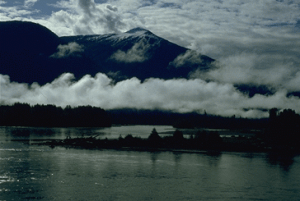
Naturally, I used the Internet to help me plan the tour. I wanted it to be challenging, but not epic. Bob Broughton’s British Columbia/Alaska Cycle Touring website was just right for expanding my concept of the tour. His dark, mysterious picture of the Skeena River led me to settle on Prince Rupert as the destination. A little more research, and I had my route set. I would ride from Spokane to Prince Rupert, and then back via Vancouver Island.
Jake Layte, an engineer I knew at Hewlett-Packard, was an inveterate bicycle tourist. He was originally from Europe. He often returned there for extended tours, and had also toured in Canada. When I told him where I was going, he had some good advice. One thing he told me was, “Bring a spare rear axle.” (He had broken a couple himself while touring.) You’d never think of that, but things happen. Most likely hundreds of miles from a replacement. Jake also told Bob… (forgot his last name), another cyclist at HP, about my tour. Bob wanted to come along, and while I was reluctant, I said OK. More about that later.
This tour started from our front deck. I met Bob down at the Centennial Trail, and we rode to the Trent Ave. bridge. Jake was there to see us off. He wished us luck, gave us both a Powerbar, and off we went. We soon left the trail and took the toughest climb of the tour up to the cliff where Arbor Crest Winery is. From there we took backroads – Spokane Bicycle Club routes – to Loon Lake, just beyond Clayton.
I planned to stop at Colville, which was about 80 miles from home. We could camp in the park there. When we got there Bob wondered why were stopping. He thought we should go on to Kettle Falls, another 22 miles away. Well, it was downhill all the way, so I agreed. There was a nice park there too, so all in all we had an excellent day.
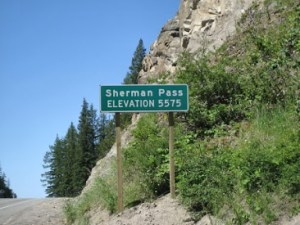 The next day we faced a 4,000 foot climb up from the Columbia River, and over the highest mountain pass in Washington. It had started to drizzle the night before, and by the time we got going it was raining.
That climb was a harrowing experience. There wasn’t much of a shoulder on the road, it was raining, and it was cold. Took us about five hours.
After that it was downhill to Republic,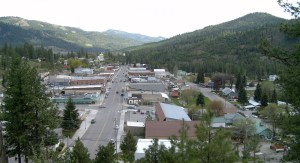 which is a nice little town because it is so isolated. We spent some time there and then rode on a few more miles where we found a forest road, and camped off in the trees.
In the morning we set off from the woods, headed to the border. As it turned out we made it all the way there. It was further than I wanted to go, but Bob wanted to go as far as we could.
We were camped on the Okanagan River in Oroville, four miles from the Canadian border, with Osoyoos, BC on the other side. It was raining lightly, so we went across the highway and had a Big Mac instead of cooking. The Okanagan Valley is a banana belt that extends up into BC. There are many orchards and vineyards there.
To be continued…


A Big Mac?!
LikeLike
Why would someone who turned their parents on to 15¢ McDonald hamburgers (with fresh fries) be surprised?
LikeLike